Saturday, December 31, 2005

Highlights of 2005

1. Sideways - great movie about drinking fine wines and women.

2. Gilad Atzmon concert at the Green Room - fantastic sax player, who did a wonderful piss-take of the execrable Kenny G - great album too: Muzik.

3. Sarah Broom's book about contemporary poetry in Britain and Ireland is one of the few that actually straddles the mainstream/avant-garde/performance poles successfully.

4. A weekend of avant-garde poetry in Cambridge.

5. A trip to South Africa to meet lots of poets and a visit to Soweto to meet a jazz-loving taxi-driver, playing Hugh Masekela in his car.

6. Geraldine Monk's Escafeld Hangings.

7. Chris MacCabe's The Hutton Inquiry.

8. Ashbery's latest book - and, from the end of last year, his Selected Prose.

More later...

Friday, December 16, 2005

The Ideology of No Ideology

Here's a claim that I read on the back of Miracle & Clockwork. "Other Poetry has sought to present excellent poetry in an attractive form without regard to ideology or fashion." I wouldn't want to quarrel with the "excellant": there's some good stuff in the anthology; I want to argue about that last phrase: "without regard to ideology or fashion." This makes such massive assumptions that it has to be questioned.

It seems to me that there are two kinds of poet: "just poets" and "label poets." You can, for instance, be a really good poet, like say John Siddique or EA Markham, a truly inventive poet like Edwin Kamau Brathwaite; and when people come to critique your work, you suddenly acquire a label: "Black poet." All poets of the female gender are automatically "women poets", whether, like Elizabeth Bishop, they protest against the label or no. You can choose to be an "avant garde" poet, I suppose; but then quite often it's not so much a choice as a question of chance. Most avant garde poets, like most other poets, fall into their categories because of factors such as who they meet, where they study, what really turns them on; not because of some self-conscious desire to be different.

But the "just poets": the "I'm just a poet" brigade. Well, they tend to be white, middle-class and mainstream. There is nothing wrong with that; but it's every bit as much of an ideological position as would being a gay avant garde post-modernist poet of colour (such as Timothy Liu, to take an American example...) It's just that it pretends not to be. The "mainstream" is the normative position. The word "poet" without a label is usually assumed to be white, male, Anglo-Saxon, middle-class, who writes poetry that is relatively closed, relatively comprehensible and doesn't do anything silly like "open-form." It can be a bit surrealist, but not so it frightens the horses. It can rhyme, but shouldn't use archaic poeticisms. It tends to be fond of the lyric eye, doesn't go in for fractured narratives, cut-ups, oulipean games playing, visual effects etc...

Anything that doesn't fit this mould is an "adjective poem." It's a "black poem" because it's about the legacy of slavery and it's written by a black man. It's a gay poem because it's about being picked up in a bar in San Francisco and the author is gay. It's "avant garde" because the editor can't understand it. Anything that is not mainstream is assumed to come with a label, anything which is mainstream is assumed to not need one.

The very notion of excellance assumes that the person making the claim to only like "excellant poetry" knows how to pick out the excellant poetry from the bad poetry. An "excellant poem" is one that confirms the idea of excellance that is in the editor's head. What is excellant to the editor of Other Poetry might well be dull, pedestrian stuff to the editor of Parataxis magazine. Yes, Miracle & Clockwork contains some excellant mainstream poetry (I don't include my own poem here, as I'd love to have had the opportunity to edit it) but to claim to not have a position, to be free of ideology, is nonsense. It's like saying "I'm not interested in politics," then always voting for the party that's in power.

Thursday, December 15, 2005

Miracle & Clockwork

I've just had a poem published in a new anthology. It's in the magazine Other Poetry's Miracle & Clockwork anthology, and I've put in the link to the magazine's webpage above though it doesn't yet show that it's now out. It's being launched in Newcastle on the 16 December. I won't be there (too far to go.) I find it slightly odd revisting that particular poem, especially as it's probably the unedited version from the one that's in Calling Myself on the Phone (I only received it this morning; I haven't had a chance to check it.) But I'm in good company: Anne Stevenson, Sean O'Brien, WN Herbert, Jon Silkin, Geoffery Holloway and a host of others.

It wasn't entirely a surprise, but only because I had read my name on their website when doing an ego-google on my own name. They didn't let me know by mail, though they probably didn't have my e-mail.

Anyway, it's a nice Christmas present.

Wednesday, December 14, 2005

Stuff

I must try updating this place more often. I've come to the end of term, but I still seem to have lots of work to do, and the possibility of more work to investigate (it never gets any easier; but anyone out there needs a poet/workshop leader for their writing group/course, send me a message.)

I did another workshop with the drugs/alcohol rehabilitation unit recently, something I can't help but enjoy enourmously. There's something about working with people who have no personal interest in the literary world, especially the poetry wars, that is remarkably refreshing. They always come up with something remarkable, not for its literary sophistication, but for its openness and honesty. Is it good literature? Who cares?

It does me good to remember where it all comes from: not from some desire to be famous, to be published by the "right" publisher, but to seek some kind of truth about your life. In today's post-modernist world, that word truth is a problem; but I'm not refering to some big grand narrative truth about God or Fate or capitalist hegemony, but the little truths about who we are when we strip away the labels ("mainstream", "school of quietude", "traditional", "modernist", "avant garde", "post-avant," all that stuff.) It's about being human - not with a big "H" but a little "h" - that's why I like working with these men and women who are trying to better themselves, to get back to families and to do their best for their children.

Last Trof Open mike of the year last night too; where I met a guy called Dave from South Africa, who plays a funky kind of guitar and writes poetry. John Calvert and his Yamaha was in good form too. I like that place too, though the DJ played too much prog for my liking. On Thursday, I hope to go to "how many days before Christmas" at the Horse and Hounds on Shude Hill.

Monday, December 05, 2005

I've been pretty busy of lot, and not had that much to say. I don't think I have much going on in my head beyond the usual stuff about identity, anyway. I've been reading a few interesting people - a new Salt collection from Chris McCabe called The Hutton Inquiry, which has some interesting takes on the contemporary scene, for instance. Then there's Geraldine Monk's latest from West House, The Escafeld Hangings. She just gets better and better.

I've also been reading a lot online of Landis Everson, a poet publishing his first book in his early 80's. He'd given up writing for forty-odd years when he lost contact with the poetic community that nurtured him (basically, the Jack Spicer group round Berkley and San Francisco), but then he was contacted by someone who remembered his name and started writing again. The new poems are open, generous, meditative reflections on the past, on friendships and on the quotidian details of his life. A little Frank O'Hara, perhaps, and charming.

But it's interesting, what would I have been like without the poetic friendships and encounters I've had over the years? I came to Manchester in 1980 from a small town in North-East Lancashire called Accrington. I was under the influence of Ted Hughes at the time, and the local library supplied me with a few interesting books, mainly Movement-y poets like Larkin and Elizabeth Jennings. I'd got every book of Sylvia Plath's, and Lowell's poems were in there too.

Then I came to Manchester, discovered O'Hara, Ashbery and co, started going to writing groups (I'd gone to one in Blackburn though) and Manchester Poets group, and here I am years later, this strange half-Modernist creature you see before you. C'est la vie! Had I stayed at the accountants in Accrington, I might have had more money, but would I have given up poetry? What's the point of writing if you don't have an audience? Anyone out there still listening?

Wednesday, November 23, 2005

I Dares Ya

There was an interesting comment on the Ron Silliman blog to the effect that poetry should be "daring." I find this odd. I mean, yes, poets should be challenging themselves I guess; but what does it mean to be "daring?" Mandelstam's Stalin Ode was pretty daring - it got him killed, but short of declaiming poetry whilst walking across the Niagara Falls on a high wire, in what way is poetry daring? It's certainly not life-threatening to write Language poetry, for instance, though Harold Bloom and Helen Vendler (not to mention our own Sean O'Brien) might come round and bop you on the nose.

But there is a certain amount of "dare" involved in doing things different from the way you did them before, or the way anyone else has done things before. Putting a canvas on the floor and dripping paint over its surface takes a certain trust in the process; you could make an absolute mess of things and end up with something that looks like an explosion in a paint factory. Instead of which, you end up with great art. So I find, when I think about this, that once again I contradict myself.

And poets can sometimes get themselves into ruts: this works well, I'll keep doing it till it starts becoming pure rote. Then you get to the stage where you even bore yourself; but everything's done well and nothing is "bad." It might even be admired.

"Daring" can itself turn a revolt into a style though. If you're so determined to be "different", you can often end up sounding just like everybody else, like rock stars so eager to be "real" they turn out to be clones of each other. Being true to whatever you you're playing with at the time is much better than trying to find some mythical authentic self among the rock-star postures. For all I'm not a real fan, Robbie Williams is still better than Coldplay because at least he doesn't take himself too seriously.

I was at an open mike event yesterday, and they played lots of Motown records: the Temptations, Marvin Gaye, Smokey Robinson. Pure commercial gold, not in the least experimental or daring it might seem. Certainly not prog rock, which proclaimed itself as so very advanced and meaningful but which now seems as stodgy as wet bread. But you could dance to them, they had killer bass-lines and were as sexy as Brifgette Bardot. And, along the way, quite a lot more adventurous and daring than some of that self-consiously experimental muso-music beloved of middle-class prog-fans.

So daring is not about choosing the most extreme technique; it's stretching yourself, trusting the process, seeing what you can do, in poetry as in all the other arts. And if you've never written a sonnet, then dare yourself to try.

Friday, November 18, 2005

Embracing all forms?

Irish Poets said:

By embracing all form the poet cannot fail, as s/he will not be restricted and
can engage with all the schools and groupings.


But I wonder if that's possible. I have to say that everyone has their biases and I'm not alone in this. I don't think I'm going to go back to writing regular iambic pentameter any time soon. I like sonnets, but my sonnets owe as much to Ted Berrigan as to Shakepeare, and they certainly don't "scan." Yet I do have that skill, because I taught it to myself early on. You choose the techniques you use to suit the kind of person/poet you are, and because of what the writers you admire have chosen.

But do young poets writing now need it? Irish Poets again:

the crop of young and thrusting urban poets scrambling about the world today,
are all concerned with making a name for themselves, but very few of them have
metrical ability.


I'm in a dilemma. Does a video artist, or installation artist, need to know how to draw? Apart, that is, from the ability to storyboard the video, or come up with a reasonable sketch of what they want the installation to look like? So if a poet uses, say, a lipogrammatic technique, rather than rhyme, does that person need to know how to rhyme?

But then writing poetry is different from visual art...

well, yes, unless you're talking visual/concrete poetry. It's also different from music, unless you're talking sound poetry a la Bob Cobbing. Rhyme and metre are part of the poet's toolbox, available for use should you feel inclined; what if you don't feel inclined? Picasso could draw by the age of fifteen, but gave up on the ability to draw what he saw in front of him and became a Cubist. Can Damien Hirst draw? Is Tracy Emin deliberately a bad drawer, or just a bad drawer, and does it matter?

Yet it matters that we have the skill to rhyme and do meter, even though we never use it. Hmmm... I'm still in a dilemma. Maybe a basic skill is required, like even punk bands have to learn a couple of chords to play even a note. To play the freest of jazz, though, you have to know your instrument inside out, and you have to know music probably better than your average orchestal player, because you have to keep the sound together even while you're tearing it apart.

In the end, the more knowledge of technique, the better. Three chords always gives you more options than two. But technique doesn't make you great. There has to be passion - but therein lie a whole host of questions - what is passion? for starters.

Someone else can answer that one for today.

Monday, November 14, 2005

I sort of half-watched the second Lord of the Rings film on television yesterday. I read that book years ago, about three times, which is a lot less than some do. I can't say I'd read it again, though the big Battle of Helm's Deep was pretty good and I liked their portrayal of Golum/Smeagol. The ents though did look vaguely ridiculous. It's all good spectacle and straightforward storytelling; but nowhere near a great film. I know that there are fanatics who can't get enough of things like that; but however much I used to like fantasy, now I just find its addiction to straight story-telling boring. And all those elves...

Ah well, back to poetry. I've been thinking again about the much-vaunted category of the "authentic" and what it means. Is there such a thing, really, especially in this day and age when everybody from poets to pop-stars are putting on masks? I watched the BBC's programme about sex and rock-and-roll, and it was interesting to see the way in which male pop-stars either rooted around in the fancy-dress box (Bowie) or went all macho-authentic (Led Zeppellin.) Of the two, I've always prefered the former; I actually find it more true to (my) life than the thrusting cock-rock of blokes in jeans with guitars.

I caught a newspaper headline that said that men always wanted to be cavemen even if they pretended to be "new sensitive men". Well, that's not true of me. I don't even like jeans. I don't like the idea that I'm supposed to go to the pub, like football, get drunk and read the Sun if I read anything at all. I am (stand up and say it!) a sissy, and I'm proud of that fact. I read books, I read poetry on buses, I write poetry and go to jazz concerts and art galleries, prefer romantic comedies to action films and postmodernism to straight narrative. I drink wine not beer. I'd rather engage in a nice intellectual conversation than watch reality TV or Pop Bile. And I like intelligent women. No really, I do. Even if you're more inteligent than me.

And I like leather jackets. Hey, I contradict myself, so I contradict myself. I contain multitudes.

Monday, November 07, 2005

The Prize, John Siddique

(Rialto, £7.95) http://www.therialto.co.uk/

First, the one objection. The print is too small and difficult to read as it's not the clearest print.

Maybe that means he can cram more poems in. Which would be great because on the whole this is a very readable and very thought-provoking collection. There is a quiet force to these poems that is rare to find in much English poetry. "Quiet" is not always a complimentary adjective in the poetry world: there are a lot of poems that are as undemonstrative as a dull day in Blackburn; but these poems are often full of feeling, emotions lying not very far from the surface, as here:

Cherry Tree

We are carving wood together,
I turn the head and Chris shapes with each beat.

The room is filled with cherry scent & schoolboys.
Every moment is its own. There is no talking,
no cause of pain.

I can smell the patcouli oil she wears.
We operate as one. I wonder do the schoolboys
notice our oneness. They are quiet too
shaping the pieces, rasping and smoothing,
carving shape. Constantly running their hands
over the limbs forming from each stroke and beat.


There's a sensuousness, even a gorgeousness about his language that drags you into the poems in this book, and a sense of enquiry that I find compelling. Even in the poems that deal with his own life as an Asian/European man living in England, I never see any striving to "put the message across" in a forced or artificial way. There is anger here; but there is also love.

He is, in fact, a very good love poet. I particularly liked his Ninety Day Theory, which manages to be both erotic and caring, and to reveal a truth about relationships that in the end you know aren't going to go anywhere. His poem about his father's smallpox (Variola) and the three sisters that died again manages to be both revealing and moving. It's a difficult task to be both, I feel; so many poems either pluck at the heartstrings or give us some information or play games with language that may be interesting but ultimately don't move us. There are poems here that are very direct, and others such as Horsebones which are more mysterious, like fragments from stories overheard but not completely; but always, there's an emotional charge, and an exploration of feelings that is very rare in a male poet.

John Siddique is published by a small but enterprising press from Norwich. All power to their arm if they continue to produce work like this.

Tuesday, November 01, 2005

Stop Making Sense

One of the things that I like about the poets from the New American Poets camp is that there is an attitude that anything goes, and that you don't have to be sensible all the time. You are allowed to be silly, or to do things that are not logical but which lead to insight; you can be surreal without being pompous, and you can stop making sense.

There is, of course, a tradition of "nonsense verse" a la Lear but that's not what I mean; that's still too tied to a basically logical way of reading the universe. For me, though, what I find in poets like Kenneth Koch or Ron Padgett is the idea that anything can become poetry if you let it. So I recently had a bad cold, and wrote a poem about it. Which was fine; but it still made way too much sense, so I turned it upside down to see what would happen. Poets like Rupert Loydell are using cut-up techniques - again to re-introduce an element of surprise into their poems.

It's that surprise, those unexpected shifts and turns in a poem that make you want to read past the first line. So here's my new poem:

A BAD COLD


The next stop is Bessie’s o’ th’ Barn
or a sneeze dismantling the universe.
Is that a break in the clouds
next Friday? Nostalgia sets in at 50.
I feel every week of my age,
some sweet green tea and a tissue.

I need an injection of sun.
Because I’m a man it’s my job
I’m taking this illness too far.
What’s that mobbing the lampposts?

The sky’s an ache overhead. Pigeons.
Metaphysical with snot,
I sit by the window at the front:
my head needs truth, and Nurofen.
It's a kind of unrhymed sonnet turned upside down. There's also the sheer childish pleasure of getting the word "snot" into a poem. It made perfect sense the other way around, and if you feel like reconstructing it from the bottom up, feel free. But here you get some unexpected connections, I hope; something that opens up the poem: plus a last line straight out of Alvaro de Campos (Fernando Pessoa.)

Monday, October 24, 2005

Open Letter to Sean O'Brien (and others)

I read your article on Rilke in the latest Poetry Review, and very excellant it was too. I'll spend some time next week re-familiarising myself with the Picador translation of Stephen Mitchell's. Thanks for that. I liked your poem too.

But you just couldn't resist a quick jibe at the avant garde could you? "These problems are mirrored among the avant garde, where the pleasure principle is tirelessly punished." What does that mean exactly, that all avant garde poets are basically puritanical over-serious disdainers of the pleasures of language and they all look down their noses at people who still find pleasure in rhyme and metre? Or what? Don't the avant garde believe in giving their readers pleasure, only in making their readers' heads hurt?

It was certainly a comment that had little or nothing to do with Rilke. It was tossed off casually, rather as one might say in the middle of a conversation about the driving skills of Ayrton Senna, "of course, women can't drive to save their lives."

There are no doubt huge arguments to be had over whether the range of avant garde techniques and schools that are currently around have anything to offer the world of poetry. But I for one have recently experiencecd great pleasure in reading the poetries of Geraldine Monk, Alan Halsey, Robert Sheppard, Rupert Loydell, Elaine Randal, I've just discovered Chris MacCabe, then there's John James and Lee Harwood, and the inimitable Tom Raworth. Quite a range of poetries there, and I've just confined myself to British names. I saw a terrific set of readings by people like Micheal Haslam & Vahni Capildeo that was most pleasurable. Difficulty has its own pleasure.

There's plenty of mainstream poetry I like; I'm the ultimate fence-sitter. Mathew Sweeney, for instance, John Hartley Williams. Jean Sprackland for another.

Vague remarks about the avant garde this, or the avant garde that, are not criticism. I'm not even sure these days what exactly constitutes an avant garde: how can poets who've been around for forty years still be considered avant garde (Harwood, Raworth - and Prynne, of course?) It's about time we got some proper criticism in this country, that wasn't about making snide remarks in otherwise useful essays. That's just petty; and is unworthy of the art.

There is a debate to be had about the various poetries in this country, or even across the world, but it would be helpful if people were at least polite with one another.

Anyway, I've got that off my chest. I'll return to Rilke now. "You must change your life." Phew! Gets me every time.

Saturday, October 22, 2005

John Siddique

I went to Manky poets last night, where John Siddique was giving a reading, promoting his new book, The Voice. I was full of a cold, have been since Tuesday, but I still enjoyed myself. The read-around was full - 21 readers - and I read my poem about a train ride to Bristol through fog. The others were often good - including one by Rosie Garland, and poems by Helen Clare, John Lindley and others. It was really good to see John Lindley again - I don't often get to see him and his partner Jane. They read good poems too. Some of the poems went through my brain without impacting on my brain cells, but that was more to do with my cold than anything else.

Jon's reading was good - I like his poems a lot. Their quietness has a man in them, to quote Frank O'Hara - sensitive, but tough, often musical but in a very unobvious way. A full review of The Voice will come to these pages soon, but suffice it to say that a first collection has been a long time coming. I've always thought that the really good poets are not the ones that are published by the big boys, Faber, Picador, Cape (FabPicCap?) but the ones published by smaller presses - Salt, Rialto, Smith/Doorstop, Shearsman, Arc etc...

We went to the pub afterwards, where I talked for a bit to an old friend, Julian, who I haven't seen for ages. He's forty now - and I'm going to be forty-seven next Friday! I'm going to the final Matt Welton workshop today, so a report on that will come soon, methinks!

Monday, October 17, 2005

Matt Welton's workshop & stuff

I did another workshop with Matt Welton at the Whitworth Art Gallery on Saturday, which was most enlightening in some ways. We looked at an extract from George Perec's A Void (the English translation by Gilbert Adair) which is a lipogrammatic novel that misses out the letter "e" altogether - even in the translation. The short extract we read sounded over-the-top and overly vatic but was quite fun. Then we were asked to write something about the Thomas Joshua Cooper exhibition using the same technique.

I came up with this (revised since):
Still air. A vast and liquid loss. Look.
What do you know? What draws
you
to this coast, this wild placidity? Nothing
but light, that burns and
coils, that calls
to nothing down in a darkful hold. A sun
finds its horizon off to south, to north,
to all points. What world is this? The sky
I sail a cloud across.


It sounds a bit like WS Graham, circa 1945 - no bad thing I guess. Maybe I should continue it.

We got into a discussion about whether poems have to have meaning. Matt's a kind of formalist of the Stevens school - poems are about things like sound, the feel of the language, they don't have a specific meaning. Well in one sense, I agree that sound is an important factor. But meaning happens even when you look at abstract pictures - people create meaning, even where the poet intends none. That doesn't have to be narrative, or rational meaning; it can be a purely (is there such a thing?) emotional response; it can trigger off a train of thought, a memory, even if the writer has no idea that it means or can mean that. I often find myself incorporating other peoples' interpretation of my poems into my interpretations.

Just a few final thoughts on Prynne: I suspect that there is a lot of deeply organised thought in his work that I'm just not getting, and I'm perfectly fine about that. I don't think he's a bad poet; he may even be a brilliant poet, and I'm missing something vital. Well, fine. We can't like everyone, and why should we? We identify with the poets that move us, that stimulate us to feel and to think; and if someone doesn't do that, we move on. Too often, we get angry about the so-called dross of "post-avant" or "school of quietude" poets we just don't take to. OK, Andrew Motion is the most boring poet on the planet and he's the poet-laureate and I'm not (that's £10K a year I'm not getting...) but that's not everyone's opinion. "Always accept the possibility that you might be wrong" as the Quaker Faith & Practice has it.

Friday, October 14, 2005

Prynne and Dandy

I keep sneaking the odd look at JH Prynne, and wondering why I don't find him in the least bit conducive. I'm reasonably open to a lot of modernist and post-modernist poetry; but I can't warm to his poetry. Maybe if I have a really good go at, give him space, etc etc... But, while I sometimes find bits and pieces uncannily beautiful, I'm not sure I really want to engage at a really deep level with him.

Which is probably terrible; how can I just dismiss him like that? I can read, and love, Tom Raworth's equally difficult poetry. I love the work of Geraldine Monk, and a lot of other so-called post-avants. If anything I prefer to read the post-avants or poets influenced by them to poets of the School of Quietude. I'm probably not thinking hard enough for Prynne. Well, so be it.

I read a comment recently about poets who just write lots of poetry and never sit down and write criticism and reviews and such. It was a remark made by someone form the Philly Free School blog. They were saying it's not a good thing; except I know a lot of people who are like that. They don't write reviews and they don't write critique, sometimes because they aren't confident of their own views, sometimes because they don't want to be unduly influenced by someone else.

The second objection can be easily dealt with. Writers should be unduly influenced. They should be obsessed by poetry - maybe not to the extent that Ron Silliman is, recieving as he does hundreds of books a year - and they should be widely read and interested in things outside of their own artform too. Whether this be the news, or visual art, or music, or philosophy, or the language of conversation, there should be things going on in their heads beyond the details of their personal lives.

Louis MacNeice said something to that effect when he said that poets should be readers of newspapers. They don't have to be drily intellectual, or to be experts in this or that, just interested. Open to influence. Open, in fact, to the world. Otherwise, what are you going to write about except yourself? And after a while, that just gets boring. In fact, you get bored with yourself.

I've got sidetracked from Prynne, I guess. Which is what happens when I read him, so that's OK.

Monday, October 10, 2005

This weekend

Good grief - less than a week and I'm back again!

Well, I had an interesting week. I've been doing some workshops with recovering drug addicts at a centre here in Manchester. I really enjoy it - and I hope even if it's only for a bit that the people me and Tony are writing with manage to escape for awhile. There's also a lot of stories in what they're doing; and I sometimes wonder if I don't prefer working with these people than with ordinary writers. They do have something to write about, and can be a lot more imaginative than they think they are. But there's often the same problem: "I can't write." By this, they often mean they can't spell, or use good grammar.

Well, good grammar doesn't make a good writer. It helps with presentation; but being able to spell imagination doesn't mean you've got one, and not being able to do good grammar doesn't mean you haven't got a story to tell. A story or a poem or any piece of imaginative writing doesn't become better if it's written in complete sentences; in fact, sometimes, it sounds more interesting if it's more fractured, more basic than sentences.

I like doing practical workshops where I get people writing. But I went to one on Saturday at the Whitworth Art Gallery around the photographs of Thomas Joshua Cooper. We seemed to spend an awful lot of time talking about writing, looking at a William Carlos Williams poem and an article on "ekphrasis" (writing about paintings, basically) and precious little time actually writing. I'd have preferred more time writing; but then I'm not doing much at the moment. There is a need to think about writing, perhaps; but I wanted to write. I went with Fran, and I think she agreed.

I also went to the closing party of the last ever poetry festival in Manchester. Next year it will become a "literature festival." I'm sorry if I sound cynical about this, but does this mean we're going to get some bloody soap star promoting their biography, or the latest Booker prize winner touting their ever-so shiny fiction? Methinks it's being taken over by the bums-on-seats brigade and we'll get all the usual fluff and hype. I hope I'm wrong about this.

Saturday, October 08, 2005

Manchester Poetry Festival

I'm doing only ten minutes in it myself - at a performance evening on Monday at Trof in Fallowfield. It's called Verberate. Be there or be square.

But I did go to the launch of Citizen 32, a magazine with a political agenda and lots of poetry in it. It's the usual left-wing stuff, of course; but from what I can tell, quite reasonable in quality. Of the guests reading on the night, Helen Clare was good as usual, and Todd Swift was too, more political than he was at Manchester Central Library, and Aoife Mannix whose work is new to me was a really good performer. There were people from the magazine reading too, including Geraldine Green and Cath Nichol. A good event, apart from the openers. You know you're going to be cringing when a group of poets call themselves the "Wylde Women Poets." Oh dear. Well, they weren't as bad as that sounds. But it's the kind of self-conscious supposed transgressiveness of that title that makes me cringe - like some boring accountant type telling you they're "crazy". Just because you can neck ten pints of lager in an occassional evening of "letting yourself go" doesn't make you crazy, and calling yourself "wylde" doesn't make you any less middle-class and dull. Sorry. Try again.

I don't believe in dressing up to be wild. I suspect all the best poets are wild inside; they have things burning to be said, and nothing they ever do quite says it. They're not wild for an audience. And they don't misspell words to sound "crazee" either.

Anyway, enough of that. I also saw the great Pat Winslow give a storming reading from her latest book. Had I some money on me at the time I would have bought it. Todd Swift said that all the best poets in the country are not well-known enough, and this is surely the case with Pat. Passionate, humane, sometimes funny sometimes serious, and always immaculately controlled. Beautiful.

Monday, October 03, 2005

Typecasting, Bob Dylan & stuff

I've got a lot to say in this one I think, as I've not been around here for awhile.

Firstly, I watched the Martin Scorcese documentary on Bob Dylan last week, and it was really interesting not so much for the stuff about Dylan itself as for what it revealed about the audience and his early "radical" promoters. I've always thought there was something terribly po-faced about folkies, and my opinion wasn't altered by that documentary; it was in fact reinforced. Everybody wanted Bob Dylan to be the voice of their generation, to speak for them rather than having to speak for themselves ("Don't follow leaders, pay the parking meters" as the man said.)

I loved it when he called himself "a song and dance man." So self-deprecating, so Jewish somehow (I wonder if anyone's done a study on the Jewish influence in his work.) Of course, he's more than that; his words and music work so well together and he's written some terrific songs ("Tangled Up In Blue", "Like A Rolling Stone", "Dreams of Johanna" etc...) but he's not what anyone wants him to be. No real artist ever is. Van Gogh was never mad when he painted; Sylvia Plath was not a feminist; Mayakovsky was not a very obedient communist etc... Artists don't fit into anyone's pocket.

It's even evident in the so-called radical anthems like "Blowing in the Wind:" full of poetic phrases, not political analysis. The picture of Bob Dylan looking embarassed at all the "voice of his generation" stuff, avoiding questions or making funny remarks when people try to pigeonhole him, tells it all. Avoid the pigeonholes. Don't let them pin you down, a moving target is harder to hit, etc...

Next, I got a couple of interesting responses to my talking about thinking in terms of a book, rather than just poems. Todd: I sort of agree that putting random poems together is as good a way as any, that it can produce good books. But I want to try and work slightly differently this time, to work on the book as I'm writing the poems as it were. It will keep on changing shape as I work on individual poems, and I'm not about to start writing my version of Cantos or the Maximus poems. It's somewhere between the two extremes: I'm writing individual poems, then seeing where they might fit and alter the overall shape. Maybe for the next book after that, I'll go back to random. Anyway, it's a while off yet.

I agree with Scjallah too that there's an awful lot of avant-garde so-called poetry that leaves me cold. In the end, a good poem isn't just a bunch of words that don't hang together, it's something that sets up a resonance in the heart and the head. Fragments can work, but only if they add up to an interesting picture.

Anyway, I think I'll leave it there. More thoughts later.

Friday, September 16, 2005

My Next Book

I've not been much around computers this week, what with starting teaching next week. I haven't been doing much in the way of writing either, not since a poem what I wrote called "Every Planet Has A North." But I've been doing a little thinking, in particular about my next book. I have given it a title now; a very provisional title, but a title nevertheless.

It's something I learnt from a week at Totleigh Barton with Sheila Murphy and Rupert Loydell: don't just think in terms of individual poems, think in terms of books, or collections of poems. So many of us just write lots of poems then put them together in a book when we've got enough. It worked for my last book, though there's a few poems that didn't get in that didn't really fit with the feel of that book that were still good poems. But I think for the next one, I'm already beginning to shape the idea of the book, so that when I have enough, I can present a package that works, rather than one that has to be found.

Ron Silliman and others write what he calls the "longpoem": the poem that goes on and over several books, like the Cantos, or in his case it's the Alphabet. I don't think I'm capable of that kind of organisation; but I think I can try and see some general shapes. For instance, there are a lot of poems that involve travel in some ways: trips to Prague and South Africa, one that comes from Barcelona. Even the poem "The Westerner" about a man I knew who wrote Westerns and had never visited America is a kind of mental journey. Which brings me back, of course, to "Every Planet Has A North", a poem sort of set in space.

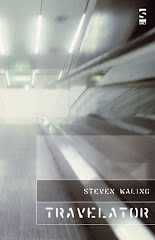
Planning the next book, even in the general terms in which I'm doing so at the moment, does give me the opportunity to look a little closer at what I'm writing, to see what it is that interests me, where I might be going. At the moment it's called "Travelator"; but watch this space; that title might well change yet.

Friday, September 09, 2005

Poetics

I got a really long response to my previous blog about influence. I'm not sure I got it all, but basically he was saying that poets need to have some kind of "poetics". I think that's right, we all need to have some idea of why we're doing what we're doing. Not, I think, so that we can go around feeling intellectually smug that we're doing the right thing, though. There is a kind of "poetics" that says, for instance, that "I think poetry should rhyme/be free verse/be political/be apolitical" etc that actually limits the writer because, instead of forming your own poetics, which can subsequently be developed/change over time, you're signing on the bottom line of someone else's manifesto. Maybe it's my Quaker dislike of creeds and formulae, but I'm not going to sign anything.

But I do think we should sit down and do some thinking about why we do what we do and what it is we want to do; even if it's only for a temporary period. Why, for instance, do I find myself increasingly dissatisfied with the poems I write which are straightforward narratives? Why do I feel the need to take a pair of scissors to them and cut them up and rearrange them, introducing a chance element into my poems?

Well, it's partly in order to stay interested; but it's also because I think reality is much more fragmented than a lot of poetry written these days. Memory doesn't operate sequentially, and life includes dreams, it includes thinking odd thoughts that don't seem to connect, it includes parataxis. Life doesn't work according to logical principles, and I want to acknowledge that. But on the other hand, it's not totally meaningless or chaos either; even if some or all of that meaning is invented rather than inherent, human beings are meaning-makers or discoverers.

The beauty of this blog is that I can start to work out my own poetics as I'm going along. And it will be a going-along kind of poetics; hopefully, it'll change a little with each new poem. And part of my poetics will be the idea that poetry can be enjoyable.

Speaking of which. Someone sending to Brando's Hat the mag thought that I meant "light verse," when I said I didn't like overserious poetry. I don't; "light verse" is largely trash and full of obvious rhymes and jokes you can see coming for miles. Not to mention the dull suburban subject matter. What I don't like is pomposity, "kiss-me-I'm-poetical" junk etc (for reference, read Ken Koch's Fresh Air and The Art of Poetry.

Saturday, September 03, 2005