Monday, August 20, 2007
Language + Science
The Iceland exhibition is based around a contact between Bury and the Safn gallery in Reykyavik (http://www.safn.is/) which is a private gallery with a collection of contemporary art including work by British artists as well as Icelandic artists. In the exhibition, there's a stone circle by Richard Long, Birgir Andrésson, Roni Horn and a wonderful set of etchings by Tacita Dean called The Russian Endings, apparently taken from actual postcards in Russia, which are pictures of things like ships sinking! It's worth the price of the bus ticket for that, but there's some great photography and a real sense of white space in the gallery that makes it very atomospheric.
The Language + Science exhibition is, if anything, even better. Here we have six mainly text-based artists, dealing with the interplay between language and science. One piece struck me: Evolution, by Carolyn Thomson, where the artist, using only the words found in individual chapters of the Origin of Species, has created two new stories (one from each chapter.) It's particularly interesting for me because my latest poem incorporates text from a Penguin 60 extract from Darwin, as well as an older poem of my own.
There's also some great poems by Philip Davenport, incorporating mathematical symbols and scientific words into what are basically a series of break-up poems. Tony Trehy has a wall-based piece, and a piece using blank canvases on the four sides of which he has written a poem, again incorporating scientific language. Shaun Pickard has one of his pieces incorporating descriptions of birds, there's a really interesting light piece, and a film of Hester Reeve reading the whole of Frankenstein while sitting on Mary Shelley's grave.
Both exhibitions seem to be exactly the right size. The second is more interesting to me as an increasingly more innovative poet, because of the use of language. They are all artists who are not afraid of using words for more than their representational uses. I was quietly inspired by this exhibition. It won't turn me into a visual artist, but it will help me to remember that words can be as plastic and abstract a medium as paint or marble.
I hope that at least some of my readers will make an effort to see these exhibitions, as I think they deserve to be seen. Small art galleries in small towns often put on splendid exhibitions that are not well-seen, and I think it's important to support them if you can.
Monday, August 06, 2007
Random thoughts
I've been reading some interesting poetry. Robert Shepherd in particular, whose big Twentieth Century Blues poem-serial I've never read a big bulk of. There's a lot of sexual politics in his poetry, which is not something I'd noticed much before, and the sex in his poetry always seems to concentrate on the seedy side. He's trying in his verse for what he calls a "poetry of saying", something akin to a poem which unfolds its meanings in front of you as you read, as you put your own voice into it. He opposes this to a poetry of the said, where the meaning is already on the page ready to be obtained: that's how he characterises the Movement poets, and most of the mainstream.
There is a lot of truth in this, though it's never the whole story. No poetry is entirely "said", even Philip Larkin and co., and I think there are lots of poets who are characterised as "mainstream" who are much more open to "saying."
I try in my own poetry to find out what is/can be said during the writing. I very rarely decide what I'm going to say before writing these days. In fact, it's difficult to do that anyway when you're making poetry from found material, as I have been doing; the found material determine the content, and whether it works or not. The recent sonnets have used material from adverts, streets signs, newspaper dating columns... but I recently stopped doing one half way through because I thought I was merely repeating myself.
I think I'm probably not going to write much this month, which is no bad thing. I have several things to prepare, in particular a new job at HMP Whatton, where I am going to be the writer-in-residence. This is quite a challenge - to do creative writing with prisoners - and I'm sure it's goiong to affect my writing in exciting new ways. But it's scary too; I've got the job for 18 months.
I met the sister of Terry Eagleton, Annie, recently at Earth cafe, where she bought a copy of the book. Maybe I should make more of these links with famous people...
Friday, July 20, 2007
Five to cherish
TRAVELATOR by Stephen Waling, Salt Press Waling was once
poet-in-residence in a chip shop and his poetry has a salty quality that makes
you want more. Salt churns out quality books like there’s no tomorrow.
Not bad at all. I was top of the list of five to cherish. He also wrote a very good article about the continuing importance of small presses in English writing, drawing attention to such presses as Shearsman as well as Salt. It's an indication of their increasing importance that Luke Kennard, Melanie Challenger and Eleanor Rees all got nominated for the Forward Prize this year. Nothing too avant garde, but both Luke Kennard & Eleanor Rees are very interesting young poets with an experimental edge, and in Kennard's case, an absurdist sense of humour.
I did a storming reading at the Central Library last Thursday - there were people hanging from the rafters and I sold some hardback books. I read with Chloe Poems - who is a performance poet quite prepared to stretch him/herself into new territory with a set of poems about Manchester that captured some of its vibrance as well as some of the annoying aspects of all this "new Manchester" we're supposed to so admire (all shiny new flats and not a poor person in sight.) I read some of my oddest poems, and they went down well.
Eleanor Rees was very good in Liverpool the day after. Another Salt hardback - very beautiful - and intriguingly complex poems set in a kind of magic-realist version of Liverpool.
Thursday, June 28, 2007
Updates
This Saturday there's another paperplanes workshop at Fuel, 11.30 - 3pm.
I have a reading with Chloe Poems at Manchester Central Library on 12th July at 1pm. It's going to be interesting. Chloe Poems is one of the few reasons why performance poetry isn't yet entirely dead, despite what the recent issue of Poetry Review thinks. There's a magazine that since its recent flirtation with avant-gardism has gone scuttling back to its nice little suburban garden of verse. Though it does have a token poem from Ian Davidson in the latest issue.
I've recieved Poetry London, Rialto and Smiths Knoll recently. All fairly decent, mainstream mags which all have fairly decent mainstream poems in them. Smiths Knoll often has good little poems in them. Poetry London is better this issue than the last; Ciaran Carson's two are very good.
I also recieved a lovely little pamphlet from Geraldine Monk, called Racoon. A sequence about a trip to America, I guess; and I love the way her poems move and sound.
I've started writing prose poems based on Chinese Fortune Cookie sayings. I shall have to see where this one takes me. As Frank O'Hara might put it - prose poems, I'm a real poet!
Wednesday, June 13, 2007
A Plague on Light Verse
I must be missing a circuit in the brain: maybe the cucumber sandwich circuit that sees writing verse as a nice little pastime equivalent to macrame or darning socks. Ron Padgett's "Nothing In That Drawer" creases me up, though (it's the same phrase, 14 times - a sonnet I guess!) Kenneth Koch can have me in stitches, and so on.
"Light verse" just has the flavour of weak tea served in a vicarage, with doilies and little cakes. A really good funny poem has more of the Lenny Bruce about it; though how many people do write genuinely funny poems? Poems, that is, that are not just gags wrapped up in verse? Not many, I suspect. Much so-called performance poetry is essentially light verse. Oh, it sounds a bit punk because the poet is shouting it through a microphone, but it trots along on its little metrical feet in just the same way as a Pam Ayres poem.
And I like "rude" poetry even less than "light" verse. Stuff that thinks that it's funny to leave a gap where a swearword should be, or the word "cock" or something. If you're going to talk about sex, don't be so fucking coy. At least Chloe Poems, for instance, isn't coy about sex. She comes right out and says the words, doesn't hide under innuendo.
I'd like to see/read/hear some genuinely funny poetry sometime: but I don't think it's going to come from a mainstream still addicted to safety, or a performance scence addicted to giving the audience only what it wants. A performance scene that still appears to worship at the feet at that arch light-versist and sentimentalist, Roger McGough. (Well, he is Liverpudlian: what else would you expect but sentimental guff from the city that still hasn't gone past the Beatles?)
Thursday, June 07, 2007
Elitism vs The Common Touch: A Few Thoughts
But it all comes down to whether Woolf was elitist in her high art disdain for Bennet's "common touch."
Or does it really?
Personally, I'd rather read Woolf than Bennet, just as I would rather read Ashbery than Armitage. Armitage is the contemporary Bennet of poetry: producing well-written popular (if not strictly populist) poetry that most people can identify with at some level. You know what an Armitage poem is about. Ashbery's poems, I guess, are more to do with the movement and the clutter of his own mind. They're not "about" anything, in the sense that they have a single definable subject. So who's being the more elitist?
You could say that someone who writes "populist" literature is simply writing for the usual lower-middle class expectations of the "general reader", but who is Ashbery writing for? People interested in "high art", whatever that is? But who are those people? Some of them, like me, are, frankly, working-class to the bone. But we just happen to like something rather different from the usual diet of realism and fairly naturalistic language. We like the sound of words for their own sake, the juxtaposition of words and phrases that aren't "supposed" to go together. We might have some critique in mind about the way language is used to uphold the status quo. But even Andrew Motion is aware of that function of language.
What made Woolf a modernist and Arnold Bennet an anti-modernist? I still haven't really puzzled it out, but I don't think at route it's to do with elitism. I suspect that Bennet had as many small-minded prejudices as did Woolf, probably to do with the working-classes and coals in the bath. Woolf was definitely eltitist; she was upper-middle class. We all have a tendency to look down on others.
But at heart, modernist writers are just interested in different things. I find it difficult to read novels that have too much story in them; the last great novel I read was by WG Sebald and seemed to involve a lot of walking around and not much actually happening. What goes on in the mind of his character seemed much more interesting to me than some kind of event happening.
The same is true of the poets I like: they're not giving me little stories, or little insights into the world; they're giving me both the moving of their minds, and a sense of language as something fluid, ever-changing and musical.
A lot of the first generation of modernists were elitist; but less so than their populist cousins? HG Wells, for all his popular novels and his socialism, was no less elitist than Woolf; both were advocates of getting rid of inferior specimens in the human race.
In the end, what interests you as a writer, whether you want to follow in Woolf's steps or Arnold Bennet's, is down to far more interesting factors than looking down your nose at all those "populist writers" and thinking you're special because nobody reads you.
Saturday, June 02, 2007
Thursday, May 03, 2007
50 Heads: Tony Trehy (Apple Pie Editions)
The poetry too is intense and formidable, full of scientific, mathematical, philosophical and other specialised vocabulary, off-putting, I suspect, to the casual reader he obviously doesn't want, but rewarding to those who are prepared to wait for the insights this writing can give. Written in prose, each poem begins with 0 and ends with 1, as in probality measurements where 0 is no probability and 1 is certainty. Nothing, of course, is certain, even reaching the end of either this book or a single poem. There are 49 poems, so the 50th head has to be the reader. Here is Houses:
0. Vitruvian in determinedly outside. Of somewhere else, empty rooms, once
empty, somewhere someone else, something somewhere someone else. Madeiraised. Nuclear unit composition in a hidden place of imbalance and ill-considered.
Cartesian headphony coffin lining family rituals, colourless not like sleep.
Euripides women carrying the news of loss. Vicariance perversely rotating,
inheriting weak model fragments I couldn't care less, room vocabulary of windows
of geometry generated in machines designed for the purpose more fullerne than
their products. Renormalisation within building regulation would in ths case
would be a fine object, a still life. Changing light: 1
On first reading this, I didn't understand a word, but I was fascinated by the sound of the words and the oddness of phrases and sentence fragments, how they clashed, flowed into one another and slipped from one register to another seemingly at random: one minute we're as uptodate as "nuclear unit composition", then we're talking Euripides. One minute, "I couldn't care less" (demotic), the next "renormalistion with building regulation" comes in. Then, as I typed it out, it occured to me that here is a poem about those faceless middle-class estates that so many people live on, and about the "coffin lining family rituals" we all put up with in the capitalist hegemony of British society.
Trehy sees himself in opposition to what he calls in his publicity "the moribund state" of British poetry, limited as he claims to special occasion anthologies, radio entertainment, advertising copy or curriculum add-on. While I suspect he rather overstates his case, his anger at it has produced probably one of the most innovative books of poetry I've read this year. He sees himself in the tradition of language artists and poets such as Hester Reeve, Caroline Bergvall and Philip Davenport who see the page as an arena of action, and poetry as about expressing the uncertainties of the present as much as it is about the past.
Whether this rhetoric is somewhat overstated or not, (there's a lot more interesting goings-on in contemporary poetry than the binary oppostion of mainstream verses post-avant) this is a fascinating collection of prose poems that I will be returning to again. But it's not an easy read; it won't give up its meanings on first reading like a Simon Armitage poem. It'll make you think, if you let it.
Saturday, April 21, 2007
Travelator & news.
Paperplanes now has its own myspace page at http://www.myspace.com/mypaperplanes - not much on as yet, but we'll start putting a few things on eventually. We're doing another workshop on 28th of April in Fuel Cafe, Wilmslow Road, Withington, Manchester, 11.30-3.00 - if you want details send me a message, and you're e-mail, and I'll get back to you (I won't keep the e-mail or put it up on the blog, by the way.)
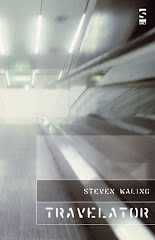
The book is looking good - the cover is terrific:
http://www.saltpublishing.com/assets/covers/648/9781844713141.jpg
Monday, April 02, 2007
The Problem With Poetry London
Oh no, it's the London magazine.
I'm sure there are lots of great poets in London, but none of them ever gets into the London magazine. Instead we get something like this, from Ruth O'Callaghan:
On some days a plash of oars
breaks the sleek of water
and a ripple will rim towards us
where you can almost imagine the poet thinking, doesn't that sound poetic? "Plash of oars", "sleek of water": so Heaneyesque, except who except poets use language like that in anything other than poems?
But that's Ok, it's not a serious problem; but this poem then starts getting "serious" and talking about "history", and you know that we're in the realm of symbolic hidden oarsmen and we're going to learn about something.
Or there's Sean O'Brien, who has translated Dante and doesn't let us forget it, so a poem about drains becomes - you guessed it - a metaphor for the underworld. He also wants us to know that he knows some big words - so here's the first line: "Sites of municipal vaticination." Drains have become sites of "prophesy", or an "act of prophesy". Later on we get more references: Barbaricchio's crew and "peristalsis". Now, I've nothing against long words; but why are they there? To add something to the poem or to show off? That first line sounds ugly; it has all the melopoeia of drumkit being kicked over.
Most of the poems are not that bad, thankfully; they're just, well, dull. Lots of clever images (windows like boiled sweets for instance), but lots of poems that proceed from A to B and tell nice little stories and are very personal. Marilyn Hacker - great translator of Francophone poetry that she is - cannot rise above the pedestrian narrative, though it does again get clever in its form (the last line of one verse becomes the first of the next...) Okey, it's a reaction to the Isreali incursion into Gaza, so it's Important - but again, the form is there to say "look at me, I'm a poem, aren't I clever?" It doesn't add anything, and the whole thing is too wordy by far (just thinking about what Lorinne Neidecker would have done with such a subject makes me wish to read her again.)
Cleverness, showing off, long words that don't add anything, I keep wondering what's wrong with me that none of the poems in this magazine impress me with their need to exist. They seem so full of words, but empty of any music. I've haven't even mentioned the horrendous Jeffery Harrison, who sounds like a pale imitation of Billy Collins. As if one Billy Collins weren't bad enough.
Ah well, back to John Ashbery.
Thursday, March 22, 2007
Scott Thurston & Allen Fisher - Matchbox Ist Birthday
The room was above the main pub, which is under one of the arches of railway between Piccadilly and Oxford Road station; so the reading was punctuated by the percussive sound of trains going past above our heads. The place is usually used as a club, and had a very late '80's - early 90's vibe to it. It reminded me of places like The Venue. There was a good crowd - mainly students and some folks familiar from the Manchester writing scene such as Adrian Slatcher, and one man who tried to participate very vocally. I'm not sure how much of the rather abstract and not exactly easily accessible verse he got; but he was dealt with magnificently by both writers, and seems to have enjoyed himself.
Scott was on first; the first time I've seen him perform. I read his book Hold (Shearsman) with some interest, and it was good to see him perform. His poems I first found difficult, as I often do with avant poets; but as I read them, they began to coalesce into something, if not exactly solid, then very full of barely-held in emotion. This was the case with his reading; and the way he loped around the reading area added to the sense of something untamed about his writing. I think of the three long pieces he read, I most liked the third, which seemed to have an urgency about it that was really exciting, even when he read a section out in Polish! (Which he then translated.) The long poem about dance that came before I was less sure of, and would have to see it on the page to decide; but it was still enjoyable nevertheless. I liked it at the time he read it, though, and there were passages where the phrases in the poem were almost dancing around each other with a wonderful abandon.
Allen Fisher is a poet who I have only occassionally dipped into, though he has a considerable reputation among the avant garde in this country and abroad. His poems are not always easy to get a handle on immediately, though that of course ought not to be a reason to avoid reading him. Now I've seen him read, I shall probably continue to read more; his reading again was very good and his choice of poems - mainly from his long-running series Gravity as a consequence of shape (Banda, African Boog and newer poems) was not so off-putting as to have me running from the hills. In fact, his reading probably enabled me to "get" his poems more; not in the sense of being able to tell you "what they were about," but in the sense that one looks at an abstract painting and gets a feel for its shapes, its textures and its own internal music.
Which is probably how one should see poetry anyway; not as something with some kind of Point It's Making, some Holy Insight into the fact that I visited Blackpool last week (I didn't, by the way), but as a network of textures and feelings and ideas that come off the page and lead you to your own thoughts. There was a time when I didn't get this point, when I was trying to Be Significant; but somehow by dropping the pose I seem to been able to do something more significant.
Monday, March 12, 2007
Don't Start Me Talking
In many ways, this is a historic book and tremendously exhilarating to read. I can't get enough ot it - I keep rereading bits of it. It's a series of interviews with contemporary poets - who are all innovative and able to talk about it. There are so many ideas running through it that it's hard to keep up at times, and it has been of tremendous encouragement to a poet like myself who often feels himself to be rather on the fringe of the innovative community.
Or I should say, communities, because there do seem to be a least two: the London group centred around Bob Cobbing, and the Cambridge group centred around JH Prynne, who isn't interviewed but some of his students/colleagues are (in particular, John Hall and Andrew Crozier.) I understand that in the past there were rivalries between these two, and the London group do seem to be distinguished by a perhaps punkier, more anarchistic approach, whereas the Cambridge group seem somewhat more straightlaced.
One can see from these interviews just what an enormous effect The New American Poetry, in particular Black Mountain poets such as Olson, Creeley and John Weiners, had on these British poets; but also there seems to be mention of a lot of improvised, free jazz (Derek Bailey & Evan Parker for instance), European surrealists such as Peret and alternative British traditons from ranter Abiezer Coppe to Quaker Basil Bunting. A lot of the writers interviewed are part of that ongoing project of innovation that began in the 60's and are very important to an understanding of English poetry during that period, and, with the younger writers here, continuing into today.
They don't always come off well: Eric Mottram's prejudice against "pop music" just seems like a blind-spot, and sometimes the anti-mainstream bias comes across as slightly petty (the mainstream is far more diverse than post-movement anecdotalism would have you believe.) Nevertheless, it is an exciting book; and one I'll be reading more than once.
One big gripe, however. In a book of 21 interviews, you'd expect a fair number of women writers among the men. But there is one woman in this book: the no doubt considerable Elizabeth Bletsoe. No Denise Riley, Wendy Mulford, Elaine Randell, Harriet Tarlo, Geraldine Monk, Maggie O'Sullivan, Caroline Bergvall, Frances Presley, Caryle Reedy; and I'm sure I've probably missed someone important out; but even just a few of these names even would have balanced out the ovewhelming smell of male testosterone here. It seems dreadfully unbalanced without their voices added into the mix.
So, although, I highly recommend this book for what it does give, I can't wholeheartedly endorse it. There's a rich fund of stories, ideas, techniques in this book; and lots of interesting avenues for exploration; but there could have been so much more. Perhaps we should have a second volume: twenty female interviewees, with a token male interviewee?
Monday, February 26, 2007
The Genuine and the Artifice
Secondly: Some interesting experiences this week. I went to two readings this week, one as part of Viral Signs at Salford University, and one at Manchester Central library, launching the latest issue of The Ugly Tree.
They were contrasting in two ways. Phil Davenport at Salford read and discussed his very avant-garde poetry, much of it with a visual basis or at least approaching the condition of contemporary art. His Imaginary Missing Persons, for instance, are made from cut-ups from missing persons adverts in The Big Issue and his own journal, and he wrote a whole series of poems by cutting heart shapes out of a book of porn "readers' letters". There were others, such as a poem taken from what he'd heard a man say in an airport, but these are what struck me at the time. What struck me most was how moving these poems were, though their techniques seemed on the surface to be terribly artificial. He said that he thought it right if he was going to be using material that was about vulnarability to expose his own vulnarability in the process.
The second reading - or performance is a better word - was the Ugly Tree performance the day after. Very lively, sometimes loud, and very entertaining. But also very expected. There was a poet who tried to shock us with horror poems, a bit of feminist rewriting of myth with a lot of vocal over-emphasis, a poem about live fast die young leave a beautiful corpse, and a poem about rock and roll where the poet thumped the podium and got us all to join in.
The one poem that stood out for me, however, was a poem by Tony Walsh called (I think) Girl, Like, y'know which was in the voice of a 17 year old girl who had made a mess of her life. Again, it was a poem about - and expressing - vulnarability. Linguistically, it took an expression of inarticulacy - the expression "like, y'know" - and turned it into an expression of great depth of feeling. You felt that, for a few moments, this tall, very male performance poet had become this poor 17 year old pregnant girl whose boyfriend beats her up. Again, the situation is artificial: but the artifice has revealed more than all the supposed "authenticity" of the rest put together.
A lot of poetry is about posturing of one kind or another. Whether it's the performer saying look at me I'm going to shock you/I'm a rock and roll rebel, or the page poet asking you to admire the amazingness of his images/his perfect sonnet sequence, it's so often not about truth as it is about positioning, posturing, ego.
I'm as guilty as the next man, I guess; I have an ego as big as anyone. Bigger in fact. I have the biggest ego of anyone I know, he says, egotistically. But when I get it right, I hope at least to be able to find something genuine among the artifice.
Friday, February 16, 2007
Being bold
By which I think he meant that they pursue tried and tested techniques of writing, that they never try anything they've not really tried before; and they stay within certain boundaries with their work. They never try anything ambitious. Not always true, of course; but if you read a lot of poetry, as I do, you do seem to find a lot of the same kind of shapes (regular stanzas, lines all the same length, everything correctly punctuated) and subjects (personal stuff mostly, with occassional forays into history, or even very subtle, so subtle you almost miss them, political references). Emotionally, let's not whatever we do, go over the top.
It's good to read poets who do take chances, though. These can be anything from formal challenges, forays into abstraction or the use of open-form techniques, or language poetry, or even concrete or viso-poetry. I like the use of sound in the work of Geraldine Monk, I like the way some poets' poetry goes over my head in terms of subject matter but still keeps my attention because it sounds interesting. Or a poet like John Siddique, who takes risks with feeling: whose work veers away from sentimentality at the last minute in often very personal poems.
I reached a crisis in my own work where I had to do something drastic or give up, about a year and a half ago. I knew how to write poetry; but I could do it in my sleep and the poems I wrote sounded like they were written by somebody half-asleep. So I took a pair of scissors to my poems and cut them up, or a wrote them "backwards" or I mixed two poems in one. I made one poem out of lines culled from rejected poems. Suddenly, like when I began, I didn't know what I was doing anymore and my writing began to excite me again.
Being bold is good for the soul, methinks.
Wednesday, January 24, 2007
Writing Workshop
a smorgasboard of ideas to improve your writing from Steven Waling & Tony Sides
For poets, storytellers, scriptwriters, beginners or more experienced
Upstairs at Fuel Cafe, Wilmslow Road, Withington, Manchester (41, 42, 43 buses out of Piccadilly Gardens, get off by Withington Library, and the cafe's across from the Methodist Church), Price: £10/£7.50.
Sat Feb 3 11.30am - 3pm.
Wednesday, January 10, 2007
Jazz & Poetry
"You may have read about the 1970s, the decade in which, according to many
histories of jazz, not much of interest was happening. Maybe that received
wisdom temporarily triumphed over both memory and expectation but, as I should
have known, there was a lot of energy being expended in this group (and
elsewhere on the British scene). On the verge of a comeback to wider acceptance
after beneficial dabbling in free-jazz waters, Tracey plays like a man possessed
and his colleagues have to do likewise in order to keep up. This must have been
Stan's first self-financed album, following a successful launch of his Steam
imprint with the initial reissue of Under Milk Wood and, originally released as
Captain Adventure (a single 48-minute LP), it's now augmented with no less than
68 minutes of previously unreleased stuff from the same night at the 100 Club.
The four long tracks of the issued version contained a fast modal-minor piece, a
loose major blues, some fast rhythm-changes (the title-track) and a beautiful
Ellingtonian ballad, 'Doin' It For Art'. The wide-open nature of the performance
and the spontaneity of interchange between all the players is exemplified, if
anything, even more so on the new pieces, which include an improvised answer to
'Friday The 13th' (called 'Friday The 31st'), more modal material and more
blues. The one songbook item, 'Lover Man', is completely dissected by Tracey
alongside Themen's slightly more rhapsodic approach quoting from 'Parker's
Mood', and there's even a Tracey standard ('Afro-Charlie'), written to feature
Bobby Wellins and not otherwise recorded with Art, I think. The contributions of
Green and Spring are a revelation if you've forgotten them in this context but,
choosing one thing worthy of being singled out, it's the joy of hearing the
hugely underrated Themen at greater length." Brian Priestley. Jazzwise
Well worth my sister's searching for it on the Internet.
I've also just been doing some reading, including the '70's collection of Eric Mottram, A Book of Herne, and it occurs to me that there was a consensus from the mainstream (well, Andrew Motion & Blake Morrison to be precise) that nothing much was happening in the '70's poetrt wise too. Yet this dense, Black Mountain influenced delving into British mythology that takes in references as diverse as Harrison Ainsworth and Jim Morrison proves them wrong. There was a lot going on. Unlike Stan Tracey, however, not much if anything of Mottram's work is available. I found a website, but as yet no poetry on it: http://www.albany.edu/mottram/
How many other undiscoevered treasures of British poetry are there out there? Lots and lots, I imagine; and it's great that some publishers have managed to bring some of it back into circulation. But like British jazz, which some have thought to be almost an impossibility, British modernist writing of the '70's is still hard to find. Maybe not all of it is worth finding; but some, like A Book of Herne are worth discovering again and placing into the canon of British poetry.
Thursday, December 21, 2006
Poems by Martin Stannard
ANOTHER NIGHT
Oh, my silly head has been in a bucket
But things are better now. I pulled it out of the bucket
And stuck it in this bag, with some fruit. Fruit
Is good for me, and looking at girls is good
For a moment or two, then it palls. Then it un-palls,
And my head is now in the clouds, and here comes
An aeroplane so I duck, and I am okay for a moment,
But only for that. A moment can take so long.
It would be awful to be hit on the head by an aeroplane,
And it would also be unusual. I like
The idea of the unusual happening, so long
As it doesn’t hurt. Nothing should hurt,
Pain is bad, my forehead is sunburned, I can’t sleep,
What am I thinking about tonight? How pathetic
Everything feels when I feel like this, my love.
Oh, my heart is lost for good this time. I try
And read The Times but I don’t feel like
Reading papers, although I enjoy the crossword,
Word games, and stuff to take your mind off stuff.
ABOUT BEAUTY
Of what one might trade for happiness
I cannot think today. Goodness knows
Where we go from here. All night I sat up,
Tried to puzzle it out, such a long distance
Alone. I was trying to think of one thing
But all I could think of was loads of things
I didn’t want to think of at all and had no idea
Even from whence they came. I daren’t
Think about beauty, it freaks me out.
By beauty I don’t mean horses, or those
Trees in a wood. Sadness follows me down
An alley. Once upon a time things happened
Then I had a dreadful riding accident. Or
Perhaps it was a dreadful writing accident.
It doesn’t make any difference, life turns out
How it’s supposed to turn out, and nobody
Takes any notice, being too busy with
Their own life to bother about yours.
IN THE WOODLAND
My wardrobe is made out of some off-cuts
From a tree. The clothes are rubbish but the birds
Who live there sound pretty happy. Today
In the charity shop I bumped into
Charity, who I hadn’t seen since the Church Social.
She looked scrumptious, like a vegetable samosa.
In all the world
There are probably only a handful of people
With whom you are destined to spend
The rest of your life. If only I had not been
Wearing this shirt. If only not this hat.
In the woodland, which is more of a thicket,
It’s easy to lose
Much more than yourself. I have never
Seen a woodpecker there. I hear lorries, though,
And chainsaws, and barking of dogs, and iTunes.
I wear out my Wessex shoes, you your military outfit,
Which reminds me I meant never to become involved
With any one else’s thoughts, ever again,
Until I had resolved to resolve all my inner conflicts.
At the moment, though, everything is in abeyance.
It makes me happy, and I don’t care what
You think, or at all.
Charity said she would meet me
Under a clock. It was only when I got home
I realised that “a” clock is different from
“The” clock. Eventually you get so
You can’t be bothered. Some years ago I fell in love
And have only in the last week or so come off
The antibiotics. It’s not worth trying to explain.
RETURNING TO THE SCENE OF ONE’S BIRTH
1.
There are lots of things I want to keep from the people
I’m playing with. Nurse, bring me my surgery mask, please.
I have nothing against enjoyment, as such.
Bird watching is one way. Bird watching is two ways.
Absorb the news. No, I have no idea who writes it.
All I know is to hide before the big scary man comes
Lurching along all dribbly. Then, after they’ve told us
The TV weather, along comes a full and tiresome evening,
As good a reason as any to procreate recklessly.
2.
All the people who like sex a lot stand on one side of the yard
And all the people who don’t care for it stand on the other side.
A few people are scurrying to and fro from side to side etcetera.
I’m up on a teetering chair trying to see out the window.
3.
It’s awfully quiet for busy. I can remember as a kid
Getting the wrong idea about strip lighting as I sprawled
In the bed and contemplated the ceiling but it was an okay feeling.
There goes a trolley but it has no cakes on it.
In trays we planted the seeds of revolt but they didn’t take root –
It can be frustrating waiting around for trees.
I’m only in favour of freedom
Of information if one makes allowances for secrecy.
© Martin Stannard
Monday, December 04, 2006
Poems by Tinashe Mushekavanhu
We stopped at every station
Bakerloo Piccadilly Hammersmith Jubilee Victoria Waterloo
I had no idea where I was going,
I was following the train where it was going
Once the train halted for 10 minutes
In a dark dark dark tunnel, Is hell so black?
Panic panic panic
I thought we would never get out of this merry go round
We sat in a pause anticipating, anxious, and frightened
10 long minutes
My ears were stuffed with black earphone stubs listening to a Shona song
Pindurai Mambo, Give us Answers Lord
A girl opposite me caught my eye, she did not look away
I smiled. She didn’t.
It was not her pierced navel or pierced lip that disturbed me,
I remember, it was her posture
The girl was big and composed like a piece of sculpture
I wanted to caress it, feel its velvet texture, its stone coolness
But
someone coughed. The air in the train was thick
And finally a light appeared, I had to drop out
At the next station
Reading Hemingway sitting in Regent’s Park
The sun was up. The time was 12:15.
I had checked out of the International Students House.
It was a boring Sunday.
Fountains splashed on noon-warmed pigeons, someone took a picture,
A squirrel parachuted from a tree.
Myself bored stiff.
I was reading Ernest Hemingway’s Men Without Women
A female jogger passed by; I could see the outline of her G-String
Oh Christ-mas! Mama used to say, ‘Never swear using the Son of God.’
I didn’t sleep well last night; a woman was pursuing me in my dreams,
My vest was soaked in sweat, my boxer shorts mapped with dried semen,
It was the smell of sex!
Midas voice
My first day in London
On an inner city bus, I sat next to a young black woman
Assuming she was English speaking like the rest of the city
I decided to ask for directions in English
“E-eh excuse me
e-eh
I don’t know
where e-eh
I am e-eh going
but I e-eh…?”
Stupid me, I was in the middle of England but the Shona daemon had followed
me
“Bhudhi muri kuda kuenda kupi kwacho London yakakura?”
She smiled showing front gold teeth
Long artificial black hair covering part of her face
Things she had obviously picked in London
We ended up sleeping together at her flat
A badge was pinned on her uniform
NETSAYI MASIYAMBIRI, a nurse at Princess Grace Hospital
We came from the same rural village under the same chief back home
in Zimbabwe.
Tinashe is from Zimbabwe, and is currently doing a degree in creative writing at the University of Wales. His poetry was one of the standouts of the Crossing Borders project for me, because of its directness and straight-talking, very much in the tradition of Dembudzo Marechera. There's something of Frank O'Hara in these poems about his first encounter with London: a kind of Zimbabweann version of I-do-this-I-do-that. Also, Ginsberg and the Beats. Its very roughness, the fact that he hasn't made some neat and ordered out of his experiences (as a quietist English poet might) is what attracts me to these poems.
Saturday, November 25, 2006
Elizabeth Bishop
There's something about Elizabeth Bishop's meticulousness that is universal - to count poets as diverse as Ron Silliman, James Schuyler and Sean O'Brien as fans is quite an acheivement. She wrote her poems sometimes over ridiculous lengths ot time, and there's nothing spontaneous about her work, yet the flow as smoothly as riverwater from sentence to sentence, image to image. I love the risk of a poem like "The Moose", where it takes ages to get to the ostensible subject, but nobody minds because the eye of the poet is observing everything with the same intensity, from the people on the bus to the landscape passing by.
The wonderful "Visits to St Elisabeth's" was read by Matt Welton - himself an intriguing poet, interested as such in the shape and sound of poetry as its subject. He didn't tell us it was about Pound, incarcerated in a mental hospital for his wartime broadcasts for the fascists in Italy. He drew attention to the poem itself - its use of repetition and its "The House that Jack Built" form.
The events at the library are often quietly terrific, and it's a shame I don't get along to more. Of course, when my book comes out, I want my launch there.
Saturday, November 04, 2006
One day, the poet found himself with a dying poem. So, out of sheer frustration, he took a pair of scissors to it and began to cut the poem up and rearrange it, without looking at what he was doing. Suddenly, a poem that had been destined for the file marked "worthy but dull" sparked to life again, and he found himself excited by the possibilities of language again. Since then, this technique - and other uses of chance - have come to be increasingly important in his work. Constantly looking for the wonderful in the ordinary, the beautiful in the demotic, he is still essentially a lyric poet but in this book, he messes up the lyric's hair, exploring the the chances and encounters of modern life in vibrant, exploratory poems. A major section of the book are the Travelator Sonnets, inspired by Ted Berrigan's pioneering Sonnets and the boxes of Joseph Cornell, cut-and-paste sonnets exploring nostalgia, travel and the chance encounters of modern life in 14 lines. Other poems explore his life in Manchester, his travels to Europe and Africa and his relationships, and there is a section of early poems that explore similar themes.
I hope it encourages people to buy the book and doesn't sound too pretentious.
You can find some of the Travelator sonnets on Issue 9 of Shadowtrain: www.shadowtrain.com if you want a preview of the book.
Thursday, October 19, 2006
Not Liking Auden
The most interesting, however, was when we started talking about the famous poets we didn't like. We both agreed we didn't like Glynn Maxwell's poetry, but I said that I didn't like Auden much and he said he did.
Auden? I don't like Auden? But surely he's one of the major British poets of the 20th Century? Yes, he is, and no doubt a great one, but I just can't read him...
This isn't about whether they are "good" or "bad" poets. I can recognise Auden as a good poet - but for some reason, I just don't like his poems. Maybe it's that feel schoolmarmish to me - I don't really know. I'd make an exception for Funeral Blues but only because I have a rather shameful love for Four Weddings & a Funeral. I've had the same problem with Olson from another perspective - great poet, but it just doesn't work for me.
Admitting you don't like someone that everyone else thinks is great feels like letting out a great secret. It feels slightly sinful to not like a poet with the reputation of Auden; like saying you don't like Shakespeare (I do, actually.) But I think it's good to let these things out of the bag. Great cultural icons sometimes seem to be beyond criticism, and little old me couldn't possibly measure up to them. Well, maybe I can't be as skillful a poet as Auden undoubtedly was, but that doesn't mean I have to pretend to like something I don't.
So I'm coming out of the closet: I don't like Auden. I do like MacNeice, however. Louis MacNeice was, for me, the best of that bunch. I could happily take his poems with me to a desert island and spend my time reading them.
Monday, October 02, 2006
Library day
It was good to realise that there are people in libraries trying to promote writing and reading, even within budget constraints. I met people from Wigan, Bolton, Bury, Tameside, Cheshire and other parts of the North-West - as well as a few writers I've never met before. And someone I've met before that I'd forgotten I'd met. Apologies to her - I seem to have senior moments with gay abandon these days.
We came up with some nice ideas - including one for a kind of poetry tribute band - called perhaps "Huge Ted?" - to read favourite poems by other writers. Poetry's often put on a pedestal in many ordinary readers' minds - one it doesn't have for poets themselves - and they feel scared by it. Breaking down those barriers is always difficult, challenging and necessary. I'll have to follow up some of these contacts, do some kind of project - especially with my new book coming out, these contacts are invaluable.
Libraries have always been tremendously important for me - sources of good books, information, even computors these days. And records, CDs etc. It seems that some libraries at least are trying their best to encourage new readers and bring people into the sometimes imposing buildings that a lot of libraries still seem. I'm in one now - an elegant Edwardian local library that is both well-preserved and well-used.
I should have taken some books - unfortunately, out in a rush and all that, they stayed at home, apart from my reading copu.
Tuesday, September 26, 2006
Discovering/Recovering British Jazz
Another place where America thinks it's the best and British people are inclined to agree with them is in the jazz world. Of course, Americans (African Americans mainly) invented it, so they ought to be best at it. There's a lot of great music came out of American jazz - from its origins in New Orleans to such greats as Coltrane, Miles Davis, Mingus, Coleman, Monk.
But then it came to Britain, and in that way jazz has of both transforming and being transformed into something new and strange wherever it goes, it took root here. Not that many people in this country are aware of it; but there are some great British jazz musicians who can equal the achievements of any American, except possibly for a handful of the very greatest.
Take saxophonist Joe Harriot, for instance, who refused to go to America because he thought he didn't need to. He came to Britain, where his invention of free form jazz was at least as radical - in its similarity to and in its difference from - as that of Ornette Coleman. There's much to be said about him, about how he's been allowed to fade into invisibility since his early death.
Or Tubby Hayes, who could blow everyone else away, and whose Mexican Green is one of the great British jazz albums. Or the still-playing phenomenon of Stan Tracey - whose Under Milkwood suite is one of the seminal moments in British jazz. It's a very British album - in its lyricism, its feel for the intimate landscape of sound. American jazz is often very urban, spiky and assertive; British jazz insinuates its way into your soul. It doesn't shout often; but it speaks with great depth of feeling.
I've just been listening to an extraordinary album from the early 70's, Troppo by pianist, composer and band leader, Michael Garrick. It's a frighteningly good album, full of extraordinary playing from such people as Don Rendall and Art Themen on tenors, Henry Lowther on trumpet and Dave Green on bass. Then there is Norma Winstone on vocals - whose voice soars and swoops through every track. One track stands out: Fellow Feeling, where Coleridge Goode, Joe Harriot's regular sideman, takes over on bass. There's a section of the tune where Winstone and Goode's swooping wordless humming and Goode's bowed bass are soloing and duetting off each other in such unity that you feel like you've been taken into a new world, where everyone walks around with one less skin on them.
I've only just begun to explore this music that we've been so good at hiding from ourselves for so long. Britain, whether it knows it or not, has been and still is a great jazz nation. Maybe if there's a Ryder cup for jazz, we might just give the Yanks a run for their money.
Monday, September 18, 2006
News
It seems I'm about to join the Salt stable. One of the leading new publishers of an incredible variety of poetry and criticism, from the feircely avant-garde to the interestingly mainstream, it feels like a real privilege to be part of their organisation. See what I mean at their website: www.saltpublishing.com - one of the best poetry sites on the web methinks.
The book will be called Travelator and will include lots of new stuff, and maybe the odd old poem that I can still read without cringing.
I still keep slapping myself to see if I'm dreaming.
Monday, September 11, 2006
Englishness
1) there's more than one "England," and they're often opposed to one another.
There's the England of the rural South-East, all chalk downs and nostalgia for the past, and the England of the future, all coffee-bars and glass-fronted offices.
There's the urban experience of the industrial North and the suburban experience.
There's the tough-as-nails landscape of the north and the seemingly softer South.
There's the England of the immigrant - from the Jews who've arrived here since they were allowed back in the country (18th Century?) to the England that the Polish plumber (yes I know that's a cliche) meets on his arrival in Stoke-on-Trent.
There's the England of the radical left - the Diggers, the Quakers, etc and the England of the Anglican Establishment.
There's the England of the empirical down to earth Movement poets and the England of the neo-Romantic imagination (from Dylan Thomas to Peter Redgrove and beyond.)
2.) Everybody's nostalgic for something. Nostalgia is where a lot of poetry comes from, but it can be dangerous if over-valorised.
Saturday, August 26, 2006
FOR THE WEEKEND
Everywhere the same man washes his car.
Indeterminate, in all the cul-de-sacs,
hours stretch from one galaxy to the next.
Long weekends are a wet black hole
where the tree that bears no fruit's cut down
and neighbours fall in love with themselves
then rise unrefreshed at 11 or 12.
More at least than these carbonised words
for all this effort in the kitchen. A recipe
ought to have something to show for it.
But those days I was able to lie abed,
tell huge whoppers all night, are gone.
I thought we'd all be editors someday,
not yet wanting to be tied down.
Saturday, June 10, 2006
Poems by Henry Muguluma
In Transit
Some shout and some quiet as
We squeeze
in a taxi whose
Number we didn’t read and
Whose mechanical state
We can’t tell, trusting
The unknown driver who
Seems more
into his wasiwasi
Than his passengers and
A conductor who begged
Us to board and now barks
For the fare as if we were
To escape
through windows;
One-way, two-way, roundabout
Stage, stopover,
refuelling
Overtaking and being overtaken
Bumps, potholes, corners,
jam
Parking on driveways and
Driving on parkways
Traffic
stopping us for those
Who won’t stop for us
Past familiar faces and
places,
Unfamiliar places and faces
Signposts pointing us where
They have never been
Seeing so much to take with us,
So much we
can’t take with us
Trees running, even houses
Away in the opposite
direction
Some traveling miles for smiles and
Some hating the
journey they make
But heaven or hell, we’re all
Dying to get there.
Confession
Again yesterday evening
I grabbed a cheap one
off
A bunch in Kisenyi.
So tempting in her yellow
Sun-scorched
smooth
Cotton coat with
A black brown cap.
Pulled her closer and
Her perfume stirred the monkeys.
Ripe, innocent.
Could feel the
eyes of
The hungry woman by
Her full basket
But for hunger, I
Devoured her, all
Of her, leaving no
Sugar for pancakes.
Do
you also like
Bananas?
Konyi’s Harvest
When
he finally marched to Freedom Square
Eyes didn’t see him,
Ears didn’t
hear him,
Hands didn’t salute him,
Legs didn’t attend his swearing-in:
They all stayed back in
Gulu, Kitgum, Lira. Busy
Burying the
dead.
I worked with Henry on the Crossing Borders project, and he came on leaps and bounds as a poet.
Saturday, June 03, 2006
Reading
Saturday, May 27, 2006
Sonnet
Here's my reply to those who say sonnets are old-fashioned:
It is of course a sonnet:
someone asked why write a sonnet these days/
my reply? His peircing pince-nez/
dear ted, it's 12.33 pm a sonnet is a shape/
for thought/
all I hear is amateurish crap/
quick a lost poem before i go off my rocker/
for lost read last, for last read list/
only six more lines to go/
i'm writing a sequence of sonnets at the moment/
dear ted, are you spinning?/
soq is mostly boredom dressed up in a nice suit/
seems like a combination of all three to me/
the sonnet an ideal, a small explosion/in the box of your ear. dear ted hello
Friday, May 26, 2006
Pacific Overtures
I met the musical director, who didn't take much to the version of Sweeney Todd I'd seen in Manchester, with its singers also being the musicians etc... Now, I liked that; though I can see it wasn't the "correct" way to do it. Not being a fully trained musician, however, has its advantages. I've always thought that if something is done wrong but done in an interesting way, it's better than something done right in a boring way.
Not that Pacific Overtures in Leicester was boring: it was very good. Leicester itself is an interesting place, much better than I'd imagined. We stayed in a chintzy hotel, but there was a few really interesting buildings around, and we visited the New Walk gallery, which has an interesting collection of German expressionist paintings, including a lovely Franz Marc. There was also a small exhibition of drawings that included three drawings by Brenda Chamberlain - someone I'd seen connected with Forty's poetry but knew nothing about. She apparently killed herself in 1971, which is tragic; but she seems to have been an accomplished artist as well as a poet. Anyone out there knows anything about her, do get in touch.
There was also an Eileen Agar frottage which was lovely; and the main collection had a great Paul Nash, and a John Tunnard. All in all a good visit. Leicester seems to be the kind of place that you might not visit just to see for itself. You'd go there for a conference, or to see a musical, and you'd spend some time looking round its museums and enjoy yourself. But you wouldn't, for instance, visit its cathedral for its own sake, unless you were a Richard III fanatic and wanted to see the memorial stone laid in the apse.
Friday, May 19, 2006
I've been a little slack on reading recently, but I finally managed to finish John Ashbery's Where Shall I Wander; for some reason, I hadn't quite got round to the last few poems. There are some great poems in the book, like Wolf Ridge which seems to reference the New York School period when everybody was friendly with one another. He's very funny in places, and nostalgic, thinking of death and suchlike (he's about eighty now I think) but remains faithful to his lack of subject matter technique. Or rather, it's not that he doesn't have a subject; he has lots of them at the same time. You can't say about an Ashbery poem, this is about "Jesus healing a woman" or "a visit to the gay bar," though in any one poem he may make reference to them both at some point. I have a little article by Meghan O'Rouke which says that his poems are basically about feelings not subjects; though of course, feelings are subjects, and you really can't say of any of his poems, this one's about feeling nostalgic, or this one's about feeling grouchy, though again, both those feelings might be in the same poem.
Anyway, one thing that bugged me recently was a remark someone made on the Ron Silliman blog comments book. Why would anyone want to write a sonnet anymore? someone asked. Well, the simple answer is because they think they can do something with it. I've written nine sonnets over the last two years, and it looks like I'll be writing a few more over the next few months. Not much rhyme, lots of cut and paste and chance technique, so it's more Ted Berrigan than George Szirtes, but hey, that's me. I like the limitation of space, and the feeling that a sonnet can be a kind of controlled explosion of thought and feeling. I like to think that some of them have the virtues of a traditional sonnet, like a volta or a closing couplet that opens the poem out, but I guess some of them are just not going to keep many of the rules at all.
Freedom and constraint is, I guess, what it's about. What can you do in a small space? How free can you be in a box? Poets have always had barriers to push against; it's what makes poetry interesting. Total freedom is boring.
Friday, May 12, 2006
Surprise
Anyway, interesting discussion that gets a little heated over at www.thepoem.co.uk: is there sexism in poetry publishing. Well, I guess for me the answer is, "yes and no". I don't think there's anybody out there actively discriminating against women poets, any more than I believe that there's anyone actively discriminating against black poets.
But what do we expect when we read a poem? I was reading something that Sheila Murphy was saying in an interview in Binary Myths (published by Stride a few years ago) the other day, and one of the things she looks for is "surprise." How many editors are looking for "surprise", rather than for something which is familiar to them, which will fit into preconcieved notions of what a poem should look like or sound like?
That's where the discrimination comes in: somewhere at the level of expectation. If you expect a poem to sound like, say, a regular anecdotal half-pager, rather than, say, one of those very tight but incredibly full poems of Lorinne Neidecker, or if you expect a poem to be full of clever show-offy metaphors, then that's what your choices will look like. I suspect that the editors of most of the mainstream poetry publishers are not looking far out of their chosen boxes for work.
But personally, I'd rather have a poem that surprises me than one that confirms what I already know.
Saturday, May 06, 2006
Events
I'll also hopefully be reading at What the Papers Said, at the Lloyds pub upstairs room at 8pm on Wednesday 24 May in an evening of satirical comedy, poetry and music including Steve O'Donoghue, Dave Pullar, Claire Mooney & others. I think it's also open-mike, so unless you hear from me otherwise, bring yourself and your poems along.
Further details, as well as details of other events, can be obtained from www.chorltonartsfestival.com.
Saturday, April 29, 2006
Future Welcome
The theme of the anthology - that of the future - is sufficiently broad enough to take in lots of approaches, from science fiction to Tim Cumming's "relentless enthusiasm of American newscasters". It's one anthology I'm proud to be in because there's so much good writing in it. David Prater's Inna for instance, with its unpunctuated lines leading you down the page:
you may never have even lived in
this world on these planets your
orbs dig a furrow for my desires
i zoom in using alien technology
take soil samples & then am gone
It somehow reminds me of all those science fiction novels I read as a kid, full of terms like "server farms". It's good to see a mixture of prose and poetry, though as usual I'm way behind on the prose. There's mixture of styles from Language influenced to straight forward lyric, which I think is down to its editor, Todd Swift, who likes to mix things up.
I'm not going to quote a lot of it, but I will quote one that I really like. I've a fondness for really short poems, and Hal Sirowitz's Hiaku tickled me pink:
The future
is the past
gentrified
Other highlights include Sina Queyras, Jason Camlot, Hilary Menos, Todd Colby and so many others. It's also got my poem Every Planet Has a North.
I'd recommend you get hold of it now, from www.dcbooks.ca.
Monday, April 24, 2006
I've never really been very good with theories and ideologies etc. I've always been political - pacifist, left-of-centre, liberal-minded etc... and I've never thought that such things don't matter. But as for actually using my poetry to get my ideas across, I can't do it. All that evangelical religion early on, with its guilt-inducing pressure to evangelise, did for that. So I can write from my experience, but I find it difficult if not impossible to write from my ideas. Those ideas could be religious; I want to write about those times when I was very religious and very fundamentalist even, but I find it difficult to get past criticising the ideas to the actual experience.
Religious poetry is difficult anyway; how do you express religious ideas in poetry that doesn't sound like it was lifted from Hymns Ancient & Modern? Or that doesn't sound like a catalouge of New Age vagaries? I still haven't worked that one out, even though a few of my poems have been religious. I didn't plan them that way though; I just wrote them and found out what they were about.
Which is probably my best way of working: not having an idea of what I'm going to say before I write it. I might be writing about a specific experience, but I don't know what I'll say about it. Will I even end up agreeing with myself?
Wednesday, April 12, 2006
Dusty in Memphis
Well, it has the virtues of neatness, even if it was all a lot more complicated than that. My first readings of Ashbery, for instance, were exercises in incomprehension. But it has some truth in it. On the www.thepoem.co.uk discussion board, Eva Salzmann says that she became fascinated with British poetry, maybe for similar reasons? Because, perhaps, it was different to what was familiar?
It's at least part of the picutre, I feel. There are lots of other reasons too, but the desire to escape from the stifling bonds of one's own upbringing is surely one of the reasons we become artists in the first place. We want to be "different", like the boys from Liverpool who grew up to be the Beatles by imitating their heroes in America.
*
I read again at the Trof last night. There was quite a lot of poetry; although I'm not sure I'd call Thick Richard poets. Pale imitators of John Cooper Clark who actually still use the word "punk" and think that taking dope is still cool. Then there was Angry Sam, a good performer from Brighton with a silly name. It sounds like a punk children's TV puppet: Postman Pat, Fireman Sam and Angry Sam. But he sounded like he cared about words.
Friday, April 07, 2006
I've been reading a lot of novels: Kurt Vonnegut's Mother Night, Martin Booth's penulitimate novel The Industry of Souls, and I've just started on John Murray's Murphy's Favourite Channels. The Martin Booth one left me feeling sad at the end - that I had to leave the company of the main character. He was Alexander Alanovich Bayliss, an Englishman who had been caught up in the Russion gulag for twenty years, but who stayed in Russia rather than come home. It was very well written - and there's some lovely incidents in it - of eating mammoth steak in the frozen tundra, for instance. I'm not sure it's even possible, but Martin Booth made it seem so while I was reading. It's published by the publishers Dewi Lewis in Stockport - another example of a small independent regional publisher picking up on a mid-list writer who really ought to be better known. The John Murray has already had me giggling on the Metro. Very funny.
I did a workshop on Wednesday in Bolton with the Bank Street Writers, where I talked about rhyme metre and free verse. Really nice people, and a good discussion. They asked what "prose poetry" was, which kind of stumped me because I don't know enough about it. I should probably look more into it.
Anyway, I sold some copies of Calling Myself On the Phone - all the ones I took in fact - and that's no bad thing.
Wednesday, March 22, 2006
Reading Matters
I'm not sure what I think of him on the whole. But I'll reserve judgement for now.
*
I've been doing a lot of reading recently. Chris McCabe's The Hutton Enquiry is also on my list. He's a youngish poet, originally from London, who now lives in London. Very lively, with a political edge and a kind of spikiness that I don't often find in poetry. I don't mean by that that he's one of those Charles Bukowski wannabees always writing "from the street", though he does have a very urban feel to him. Again, I'll try and do something more in depth later.
*
I've been trying to write as well. Half my poems these days seem to turn into unrhyming "sonnets" of one kind or another.
*
Then there's Lynette Roberts, who's proving to be a rather lovely find. What was it about the '40's that the Movement found so objectionable? There are a few characteristics: the use of the "I" for instance in lines like "I, in my intricate image..." (Dylan Thomas) where the "I" almost becomes a floating signifier, a sailor lost in the sea of selves. Then there's the seeming over the top image of lines like "Shall I make my disasters clear?" (Nicholas Moore) where the Movement poets wanted to return after the war to a kind of reticence about feelings.
It's good to see them republished, though. It feels like a gap in English poetry (a whole decade's gap) is finally being filled.
Wednesday, March 15, 2006
More on Readings & '40's Poetry
The other was the Trof, a bar, between lots of singers and a couple of other spoken word artists, including an interesting black poet whose accent sounded African. There was much more noise, and the whole thing was much less polite. Everyone was younger (students mainly) and there was a DJ playing everything from Kraftwerk to Kate Bush, ending up with The Fall's Hip Priest, still out-rocking the opposition twenty-odd years on. I read some of my more "performable" poems, and got a heckler. Then someone said I was better than Ted Hughes! Nice...
Two illustrations of the context where poetry can take place these days; it can either be treated with reverence as a kind of secular religious practice. The Village Hall is usually used for Tai Chi, so the metaphor is appropriate; we even had to take off our shoes. Or it can be thrown into the lion's den of noise that is a student bar. Somehow, through it all, the poetry comes through. Maybe I'm schizophrenic or something, but I enjoy both. I'm not so keen on slams, because of the competition element (capitalistic as it is) but I like the fact that both kinds of venue exist.
***
As well as reading in public, I've been rediscovering another neglectorino: the 40's poet Lynette Roberts. It seems that the 40's as a poetic era is being finally rediscovered, and I do wonder what it is that's prompting this. There's something in the air, perhaps. A lot of these poets seem to be writing out of an emergancy, a sense of not doom as such but certainly of big events that the individual couldn't control happening elsewhere, or even in front of their faces. There's a poem in the new Carcanet Collected Poems about a bombing raid on the East End of London, for instance.
Perhaps our own sense of emergancy: the Iraq War and its aftermath, 9/11, the London bombs last year etc, have made poets and readers look to the 2nd World War to see how poets then responded to the times. Whatever the reason, it's good to be able to read Burns Singer, Lynette Roberts and Nicholas Moore again; to see a full collection of WS Graham etc.
Friday, March 10, 2006
Wanting an Audience
But we also don't want to "give the public what they want." We want to challenge their expectations, perhaps, alter their perceptions of the world etc... We want to be original, originality being the big idol of art since at least the Romantic movement. The more post-avant, modernist, post-modernist we are, the more we want to disrupt expectations, disorient readers, challenge them to, as it were, write their own meanings into our poems.
But then we don't want to disorient them so much that they don't come back, and so we're constantly torn with between the desire to be original, challenging etc. and the need to find an audience to read what we write. So we write for the kinds of people who will like the kinds of things that we like to write. If you write rhyming doggeral, you will find a willing audience who like that stuff; if you write viso-poetic works, you will find a willing audience for that too. We group ourselves into camps because we all like to be accepted by people, at the same time as we like to think of ourselves as challenging others. We create our own "us" and "thems".
I was listening to a Gang of Four compilation recently and reading about how they put together songs according to certain rules of democracy. They were trying to resist the consumer society's demands to please the audience; but they were also acutely aware of being part of it. They were purists aware of their own impurities, unlike those rock and roll heroes who think that a guitar solo is, by itself, an act of rebellion, rather that something that lots of perfectly unrebellious folk expect from rock and roll. As the phrase about turning "revolt" into "style" has it, it's not something any of us can escape. Even the most uncompromising follower of Prynne needs an audience, and will probably find one.
Gang of Four made paradoxically moving records by using what is on one level a very cold and calculated method, because through them, they expressed their own frustrations with the process, their own uncertainties. Too self-aware to be fooled by the rock and roll hero stances of other bands (like the Clash) but also wanting to rock out themselves. Wanting an audience and wanting to disorient the audience. Wanting to be original, and knowing that complete originality is a chimera. Wanting to defamiliarise, and wanting to bring the audience into your world.
I suspect that those of us who want to be "serious writers" all find ourselves in this dilemma, or maybe a series of dilemma. We'll find different solutions and positions along that spectrum; and that's why I find the whole avant-mainstream fascinating.
Wednesday, March 08, 2006
If your breasts are too big
you will fall over
unless you wear a rucksack
deserves to be remembered.
***
Talking of being remembered, I thought I'd post my favourite poem by Nicholas Moore, 40's poet and neglectarino supreme:
ANECDOTE AT THE PURPLE MOCCASIN
'Ingenious as it may seem, the Emperor Caligula
Was in the habit of sharing his bath with a tiger.
Its huge muscles gleamed; and the black stripes on the orange
Fur brought him lascivious delights. Its vigour
Reminded him of his manliness and of
The manliness of all emperors.' I smiled.
Anecdotes flew from Mr. Tabbeney's mouth, but
Could they be true? His surmises were all wild;
The strangest creatures populated his fancies.
'And when his bath was over, the Emperor would laugh,
And his wife, who loved to hear him laughing, would come in,
Beautiful as a re-touched photograph,
Her bronze hair strung in waves upon her shoulders.
And she would kiss him, naked as he was.'
'And what about the tiger in the bath?'
I asked. 'He sat and watched them. In his paws
He trapped the soap, then chased it like a fish
Around the slippery walls. He would seem to grin
At Caligula and his mistress, happy
In the warm water, impervious to the din
Of her kisses and faithful sounds, gay as a child
In the water. He was tame. And his stripes were the blackest of black.'
I conjured up the scene, the emperor, his mistress
And the tame beast, and I gave this man a look,
Observing the spots on his coat and his unpressed trousers,
The dirty, small ends of his moustache, his cigarette-stained fingers.
Anecdote, I thought, anecdote. And is
Every anecdote a meeting ground for strangers?
Nicholas Moore, 1950
It's a beautifully unexpected piece; I love the anachronism of that "beautiful as a retouched photograph," and the details of the strange man telling the tale. It came from his second major collection, Recollections of the Gala, in 1950.
If this poem were included in some of the major anthologies of 20th Century poetry, I'd think a lot better of them.
Monday, February 27, 2006
Becoming the Poet I Am
Some of it is down to personality. TS Eliot could never have written something as "wild" as "Howl" because he just wasn't Allen Ginsberg. But if I'd stayed in Accrington, or if I'd done an English degree rather than a Theology degree, I would be a very different writer than the one I am now. If I hadn't discovered old copies of the Poetry Review full of terribly avant garde poetry I didn't understand, if I hadn't discovered the poetry of John Ashbery and Frank O'Hara...
...I might have stayed with Philip Larkin and Ted Hughes, with the poets in my local library or available at the local bookshop. Of course, you might need an investigative spirit even to crack open the spine of a writer you're not familiar with, but they have to available to you in the first place. If you never go into a second hand bookshop, you're never going to find that copy of George Macbeth's The Cleaver Garden. But there has to be a second-hand bookshop for you to go in.
The problem with a lot of the non-mainstream poetries in this country is not its incomprehensibility; but its unavailability. If there's a large Waterstones, and it's got a good stock, you might nowadays find the odd Shearman or Salt book in there; but West House? Equipage? Barque? Highly unlikely. I guess the same could be said for presses like Enitharmon, Peterloo or Smith/Doorstop. It's harder and harder these days to discover the outre, the out of the way, the not very popular.
There is the Internet, of course, and there's a lot of it out there. But the Internet is largely unregulated, and again you only come across the good stuff by accident or recommendation. You can't get a recommendation unless you know someone, who knows someone who knows someone... If you live in the city, there are groups you can go to, you can make friends. But how do you do that if you live in the boondocks?
Becoming the poet I became has been a long and twisted path, involving a lot of discovery, a fair amount of incomprehensability and a fair amount of amazement. But at times, it's been frustrating, trying to track down writers and books. There's lots more out there, I'm sure. As Captain Picard might put it, "Let's see what's out there."
Thursday, February 23, 2006
Kelvin Corcoran
One example of this has to be the poet Kelvin Corcoran. I first came across him by accident: a copy of one of his early books in Frontline Books, a radical bookshop co-operative that used to exist in Manchester. It was either TCL or Qiryat Sepher which I bought first, and later I found Melanie's Book in a second hand bookshop. Yesterday, I obtained the New and Selected Poems, published by Shearsman Books, and it's an absolute delight.
The division is often ridiculous because it is assumed that all non-mainstream poets must be terribly difficult and extreme. But there's as much - and in many ways, very much more - variety in the non-mainstream as the mainstream. Kelvin Corcoran is - supremely and unashamedaly - lyrical in his concerns. Take this example from Melanie's Book:
Hilversum
Saxon mouth, telling us how to live,
over the scabby allotments back there
but for the warmth in the name
even my sister, what do you expect?
It leaps up from the long table into your face:
at 1.20 dread wind slips into town,
at 1.20 total loss holds me.
There's no stepping back from here.
Standing outside the house I
thought we were dark bodies
walking, through the light of facing windows;
another family lives there now.
It means don't believe that broadcast,
the time of your life or.
Roll the sylables around your head for awhile. It's even a sonnet; not one that gives out its meaning too easily, it needs some working out; but it's as good as anything I've read this year. It's lyrical and it has a mystery about it that you want to explore. His use of the unrhymed sonnet throughout this collection is noticeable; I think he has a deep awareness of form, of that Poundian sense of condensare, of every word counting to the whole.
There's a political edge to his poetry which doesn't impinge or preach but which is a quietly insistent pulse of care throughout the book; or at least, the poems I've so far read. The latest poems have a Greek setting, and often invoke or write about the gods. This might seem old-fashioned, but it perhaps reveals something of his roots in modernism and his interest in Greek poets such as Cavafy. There are poems that refer directly to the refugees who regularly wash up on the shores of Europe, drowned through unscrupulous traffickers or upturned boats.
His earlier poetry is perhaps slightly too concerned to establish his non-mainstream credentials. No-one but a non-mainstream poet would talk of "the hot symbolism of dawn", for instance: a line too proud of its own awareness. But he soon grows out of that. The politics are perhaps a little too earnest early on; but they're a young man's poems so we can forgive him.
I haven't finished reading this book yet, so these are only interim statements. There are some terrific poems in this book: poems like The Empire Stores and A Shelley Poet. He makes me think; but he also makes your head sing with sound. And to think, if I hadn't found him in a small radical bookshop that no longer (alas!) exists, I would have missed him. That's why it's important to step out of the mainstream: just think of what jewels you're missing by sticking to the tried and the tested!
Monday, February 20, 2006
Readings
But it's the readings I really want to talk about. Firstly, there was Anjum Malik, who is really a performance poet, who also happens to write for the radio. She may well be very good at that; she's got a serial on Woman's Hour and one on the Asian Network. Her poetry - well, lots of coy sexual references in poems about fish and chips, and the occassional serious poem with a message. A good performance, technically; but I didn't appreciate being jollied along and told to say "wa wa" if I liked something. It may be popular in Asian poetry circles; but the material wasn't really strong enough or challenging enough for me. It was OK as far as it goes; but that's not very far.
Then a reading in the Whitworth, with Grevel Lindop as the star guest. Now, he is a good poet; I liked the one about the six lemons, for instance. They were very well-constructed, basically School of Quietude but done with craft and a certain amount of depth of thought. I liked his reading. There were three other poets, who I won't embarass by naming. The first was the kind of woman one imagines drinking tea in a tea-shop in Buckhamshire while solving a murder in the vicarage. Very Home Counties, and she used the word "beau" in a poem. Now there is a word that really ought to have been taken out and shot in 1914, along with the perpetrators of that dreadful war. Poems about art, the kind of art that people in Cheshire like that doesn't frighten the horses.
Then there was a young woman on the MA course at MMU, who was very shy and not very loud but from what I could gather, very interesting and promising. She needs to practice using a microphone, and maybe be given some training in standing before an audience, but otherwise she might go far. Her poems had long, interesting sounding titles and actually seemed to go somewhere.
The third woman poet was a middle-aged woman who read something from memory that was in the voice of a woman who was possibly in love with someone, and there was one good line: "so what if there's no moon, let's make one." She hummed between each section, which made her seem even more soporific, and the whole seem rather sentimental.
So: two out of four ain't bad really. None of them, though, really challenged any boundaries. It was a very polite do with some mildly diverting folk at the beginning and the end, just the kind of thing you'd expect in a very respectable gallery setting. It would have been fun to see what a Geraldine Monk or a Bob Cobbing would have made of the place.
Wednesday, February 15, 2006
I still get a buzz from seeing my name in print.
Meanwhile, I'm still looking for more suggestions of English neglectorinos.
Saturday, February 11, 2006
English Neglectorino's
Some of these poets seem to have disappeared recently: George MacBeth died of motor neurone disease, then seems to have been forgotten until Enitharmon's Selected Poems. This was edited by Anthony Thwaite, and while useful, only showcases his more sensible formalist side; there's nothing of the hit-and-miss playfulness and games-playing side of him as seen in his Unwin Collected Poems, and nothing of his longer poems or experimental autobiography such as My Scotland.
Lynette Roberts has recently been published in a handsome edition by Carcanet, of course, and the forties poets might just be about to re-enter the canon a little. Their voice - anxious, committed and often more interesting than the Movement poets that pushed them out of the way - has been missing from contemporary poetry for too long.
Geoffery Holloway seemed to be stalwart of the small-press scene, and apart from two early Anvil volumes, never made it beyond that. But there was always something about his poetry that wasn't well-behaved, and he was always readable and often funny and wise at the same time.
Sometimes these neglected poets died, or became ill, or stopped writing too early to establish a reputation. Such was the fate of Nicholas Moore - though he later took up writing again, but by then the poetry world had moved on, and he never found a major publisher again. Lynette Roberts stopped writing when she got religion, then became ill as well. Rosemary Tonks is another poet who is neglected - two books, a couple of novels then she got born again. Why does being born again stop you from writing?
There are plenty of others I could name. Stanley Cook, Frank Redpath among the School of Quietude, early Denise Levertov perhaps, and of course Mina Loy. Derryn Rees Jones I think has recently been seeking to reassess Edith Sitwell. The surrealists, in particular Philip O'Connor. I'd be interested in any names of British poets (they have to be dead, by the way, and twentieth century) that my readers think are unjustly neglected.
Saturday, February 04, 2006
George Oppen's Psalm
Psalm
Veritas sequitur . . .
In the small beauty of the forest
The wild deer bedding down —That they are there!
Their eyes
Effortless, the soft lips
Nuzzle and the alien small teeth
Tear at the grass
The roots of it
Dangle from their mouths
Scattering earth in the strange woods.
They who are there.
Their paths
Nibbled thru the fields, the leaves that shade them
Hang in the distances
Of sun
The small nouns
Crying faith
In this in which the wild deer
Startle, and stare out.
The concision, the beauty of the images, that wonderful opening out into a kind of secular faith at the end, is truely mindblowing. Not a very critical statement that. George Oppen was one of the leading members of the so-called Objectivist movement in America, and I guess this would be an example of that type of poetry. Except in another sense, it's just a beautiful nature poem. It's also - in that last verse - about celebrating the ordinary words, the everyday language, about finding spiritual value in the world around us, rather than the high-falutin'. In that sense, it's an incarnational poem: it doesn't find meaning by looking up at the skies, it finds meaning by looking at the dirt.