Monday, December 04, 2006

Poems by Tinashe Mushekavanhu

Underground

We stopped at every station

Bakerloo Piccadilly Hammersmith Jubilee Victoria Waterloo

I had no idea where I was going,

I was following the train where it was going

Once the train halted for 10 minutes

In a dark dark dark tunnel, Is hell so black?

Panic panic panic

I thought we would never get out of this merry go round

We sat in a pause anticipating, anxious, and frightened
10 long minutes

My ears were stuffed with black earphone stubs listening to a Shona song
Pindurai Mambo, Give us Answers Lord

A girl opposite me caught my eye, she did not look away
I smiled. She didn’t.
It was not her pierced navel or pierced lip that disturbed me,
I remember, it was her posture
The girl was big and composed like a piece of sculpture
I wanted to caress it, feel its velvet texture, its stone coolness
But

someone coughed. The air in the train was thick

And finally a light appeared, I had to drop out
At the next station


Reading Hemingway sitting in Regent’s Park

The sun was up. The time was 12:15.
I had checked out of the International Students House.

It was a boring Sunday.

Fountains splashed on noon-warmed pigeons, someone took a picture,
A squirrel parachuted from a tree.

Myself bored stiff.

I was reading Ernest Hemingway’s Men Without Women
A female jogger passed by; I could see the outline of her G-String

Oh Christ-mas! Mama used to say, ‘Never swear using the Son of God.’

I didn’t sleep well last night; a woman was pursuing me in my dreams,
My vest was soaked in sweat, my boxer shorts mapped with dried semen,

It was the smell of sex!


Midas voice

My first day in London

On an inner city bus, I sat next to a young black woman
Assuming she was English speaking like the rest of the city
I decided to ask for directions in English

“E-eh excuse me
e-eh
I don’t know
where e-eh
I am e-eh going
but I e-eh…?”

Stupid me, I was in the middle of England but the Shona daemon had followed
me

“Bhudhi muri kuda kuenda kupi kwacho London yakakura?”

She smiled showing front gold teeth
Long artificial black hair covering part of her face
Things she had obviously picked in London

We ended up sleeping together at her flat

A badge was pinned on her uniform
NETSAYI MASIYAMBIRI, a nurse at Princess Grace Hospital

We came from the same rural village under the same chief back home
in Zimbabwe.


Tinashe is from Zimbabwe, and is currently doing a degree in creative writing at the University of Wales. His poetry was one of the standouts of the Crossing Borders project for me, because of its directness and straight-talking, very much in the tradition of Dembudzo Marechera. There's something of Frank O'Hara in these poems about his first encounter with London: a kind of Zimbabweann version of I-do-this-I-do-that. Also, Ginsberg and the Beats. Its very roughness, the fact that he hasn't made some neat and ordered out of his experiences (as a quietist English poet might) is what attracts me to these poems.

Saturday, November 25, 2006

Elizabeth Bishop

I went to a celebration of Elizabeth Bishop that was very well-attended in Manchester Central Library yesterday lunchtime. There were readings by various people, a short talk by Micheal Schmidt - and the opportunity to hear the poet's own voice in a recording. That last was invaluable - it's funny how the poet's voice does make a difference to one's reading of the poem. But now, when I'm reading poems like "Crusoe in England", her marvelous reimagining of Defoe, I'll hear that New England drawl, and the way she doesn't pause at line-endings as you might expect her to.

There's something about Elizabeth Bishop's meticulousness that is universal - to count poets as diverse as Ron Silliman, James Schuyler and Sean O'Brien as fans is quite an acheivement. She wrote her poems sometimes over ridiculous lengths ot time, and there's nothing spontaneous about her work, yet the flow as smoothly as riverwater from sentence to sentence, image to image. I love the risk of a poem like "The Moose", where it takes ages to get to the ostensible subject, but nobody minds because the eye of the poet is observing everything with the same intensity, from the people on the bus to the landscape passing by.

The wonderful "Visits to St Elisabeth's" was read by Matt Welton - himself an intriguing poet, interested as such in the shape and sound of poetry as its subject. He didn't tell us it was about Pound, incarcerated in a mental hospital for his wartime broadcasts for the fascists in Italy. He drew attention to the poem itself - its use of repetition and its "The House that Jack Built" form.

The events at the library are often quietly terrific, and it's a shame I don't get along to more. Of course, when my book comes out, I want my launch there.

Saturday, November 04, 2006

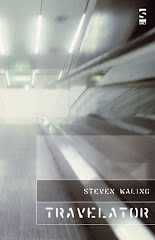
This is the blurb I wrote for my forthcoming book:

One day, the poet found himself with a dying poem. So, out of sheer frustration, he took a pair of scissors to it and began to cut the poem up and rearrange it, without looking at what he was doing. Suddenly, a poem that had been destined for the file marked "worthy but dull" sparked to life again, and he found himself excited by the possibilities of language again. Since then, this technique - and other uses of chance - have come to be increasingly important in his work. Constantly looking for the wonderful in the ordinary, the beautiful in the demotic, he is still essentially a lyric poet but in this book, he messes up the lyric's hair, exploring the the chances and encounters of modern life in vibrant, exploratory poems. A major section of the book are the Travelator Sonnets, inspired by Ted Berrigan's pioneering Sonnets and the boxes of Joseph Cornell, cut-and-paste sonnets exploring nostalgia, travel and the chance encounters of modern life in 14 lines. Other poems explore his life in Manchester, his travels to Europe and Africa and his relationships, and there is a section of early poems that explore similar themes.

I hope it encourages people to buy the book and doesn't sound too pretentious.

You can find some of the Travelator sonnets on Issue 9 of Shadowtrain: www.shadowtrain.com if you want a preview of the book.


Thursday, October 19, 2006

Not Liking Auden

I had an intriguing conversation with Peter Sansom yesterday, in which we covered many subjects. I'd met him in Manchester after he'd been to a meeting with primary school teachers. We went for a cup of tea and chatted while he waited for his train to Sheffield.

The most interesting, however, was when we started talking about the famous poets we didn't like. We both agreed we didn't like Glynn Maxwell's poetry, but I said that I didn't like Auden much and he said he did.

Auden? I don't like Auden? But surely he's one of the major British poets of the 20th Century? Yes, he is, and no doubt a great one, but I just can't read him...

This isn't about whether they are "good" or "bad" poets. I can recognise Auden as a good poet - but for some reason, I just don't like his poems. Maybe it's that feel schoolmarmish to me - I don't really know. I'd make an exception for Funeral Blues but only because I have a rather shameful love for Four Weddings & a Funeral. I've had the same problem with Olson from another perspective - great poet, but it just doesn't work for me.

Admitting you don't like someone that everyone else thinks is great feels like letting out a great secret. It feels slightly sinful to not like a poet with the reputation of Auden; like saying you don't like Shakespeare (I do, actually.) But I think it's good to let these things out of the bag. Great cultural icons sometimes seem to be beyond criticism, and little old me couldn't possibly measure up to them. Well, maybe I can't be as skillful a poet as Auden undoubtedly was, but that doesn't mean I have to pretend to like something I don't.

So I'm coming out of the closet: I don't like Auden. I do like MacNeice, however. Louis MacNeice was, for me, the best of that bunch. I could happily take his poems with me to a desert island and spend my time reading them.

Monday, October 02, 2006

Library day

I went up to sunny Preston this weekend, where there was a networking day for writers and librarians. I got there late, due to not sleeping well the previous night; but apart from some introductory remarks, I don't seem to have missed much.

It was good to realise that there are people in libraries trying to promote writing and reading, even within budget constraints. I met people from Wigan, Bolton, Bury, Tameside, Cheshire and other parts of the North-West - as well as a few writers I've never met before. And someone I've met before that I'd forgotten I'd met. Apologies to her - I seem to have senior moments with gay abandon these days.

We came up with some nice ideas - including one for a kind of poetry tribute band - called perhaps "Huge Ted?" - to read favourite poems by other writers. Poetry's often put on a pedestal in many ordinary readers' minds - one it doesn't have for poets themselves - and they feel scared by it. Breaking down those barriers is always difficult, challenging and necessary. I'll have to follow up some of these contacts, do some kind of project - especially with my new book coming out, these contacts are invaluable.

Libraries have always been tremendously important for me - sources of good books, information, even computors these days. And records, CDs etc. It seems that some libraries at least are trying their best to encourage new readers and bring people into the sometimes imposing buildings that a lot of libraries still seem. I'm in one now - an elegant Edwardian local library that is both well-preserved and well-used.

I should have taken some books - unfortunately, out in a rush and all that, they stayed at home, apart from my reading copu.

Tuesday, September 26, 2006

Discovering/Recovering British Jazz

Isn't it a shame that we British are so crap at doing justice to our own achievements? Well, except for sporting achievements, and even there, we're more concerned with not winning the world cup than with winning the Ryder Cup for the third time in a row. Not that I'm a golf fan - or a fan of any kind of sport. Nevertheless, a twinge of delight went through me when I heard that we'd beaten the Yanks into a very ignominious second place.

Another place where America thinks it's the best and British people are inclined to agree with them is in the jazz world. Of course, Americans (African Americans mainly) invented it, so they ought to be best at it. There's a lot of great music came out of American jazz - from its origins in New Orleans to such greats as Coltrane, Miles Davis, Mingus, Coleman, Monk.

But then it came to Britain, and in that way jazz has of both transforming and being transformed into something new and strange wherever it goes, it took root here. Not that many people in this country are aware of it; but there are some great British jazz musicians who can equal the achievements of any American, except possibly for a handful of the very greatest.

Take saxophonist Joe Harriot, for instance, who refused to go to America because he thought he didn't need to. He came to Britain, where his invention of free form jazz was at least as radical - in its similarity to and in its difference from - as that of Ornette Coleman. There's much to be said about him, about how he's been allowed to fade into invisibility since his early death.

Or Tubby Hayes, who could blow everyone else away, and whose Mexican Green is one of the great British jazz albums. Or the still-playing phenomenon of Stan Tracey - whose Under Milkwood suite is one of the seminal moments in British jazz. It's a very British album - in its lyricism, its feel for the intimate landscape of sound. American jazz is often very urban, spiky and assertive; British jazz insinuates its way into your soul. It doesn't shout often; but it speaks with great depth of feeling.

I've just been listening to an extraordinary album from the early 70's, Troppo by pianist, composer and band leader, Michael Garrick. It's a frighteningly good album, full of extraordinary playing from such people as Don Rendall and Art Themen on tenors, Henry Lowther on trumpet and Dave Green on bass. Then there is Norma Winstone on vocals - whose voice soars and swoops through every track. One track stands out: Fellow Feeling, where Coleridge Goode, Joe Harriot's regular sideman, takes over on bass. There's a section of the tune where Winstone and Goode's swooping wordless humming and Goode's bowed bass are soloing and duetting off each other in such unity that you feel like you've been taken into a new world, where everyone walks around with one less skin on them.

I've only just begun to explore this music that we've been so good at hiding from ourselves for so long. Britain, whether it knows it or not, has been and still is a great jazz nation. Maybe if there's a Ryder cup for jazz, we might just give the Yanks a run for their money.

Monday, September 18, 2006

News

Exciting news on the publication front.

It seems I'm about to join the Salt stable. One of the leading new publishers of an incredible variety of poetry and criticism, from the feircely avant-garde to the interestingly mainstream, it feels like a real privilege to be part of their organisation. See what I mean at their website: www.saltpublishing.com - one of the best poetry sites on the web methinks.

The book will be called Travelator and will include lots of new stuff, and maybe the odd old poem that I can still read without cringing.

I still keep slapping myself to see if I'm dreaming.

Monday, September 11, 2006

Englishness

I've been thinking about Englishness, and what it means to me. Not yet come to any conclusions, of course; but I do have a few interim thoughts.

1) there's more than one "England," and they're often opposed to one another.

There's the England of the rural South-East, all chalk downs and nostalgia for the past, and the England of the future, all coffee-bars and glass-fronted offices.

There's the urban experience of the industrial North and the suburban experience.

There's the tough-as-nails landscape of the north and the seemingly softer South.

There's the England of the immigrant - from the Jews who've arrived here since they were allowed back in the country (18th Century?) to the England that the Polish plumber (yes I know that's a cliche) meets on his arrival in Stoke-on-Trent.

There's the England of the radical left - the Diggers, the Quakers, etc and the England of the Anglican Establishment.

There's the England of the empirical down to earth Movement poets and the England of the neo-Romantic imagination (from Dylan Thomas to Peter Redgrove and beyond.)

2.) Everybody's nostalgic for something. Nostalgia is where a lot of poetry comes from, but it can be dangerous if over-valorised.

Saturday, August 26, 2006

Not been around for awhile. A bout of the blues, the probable collapse of Brando's Hat the magazine and other such things has kept me away. I shall hopefully get back to having something to say soon. In the meantime, here's a recent poem:

FOR THE WEEKEND


Everywhere the same man washes his car.
Indeterminate, in all the cul-de-sacs,
hours stretch from one galaxy to the next.

Long weekends are a wet black hole
where the tree that bears no fruit's cut down
and neighbours fall in love with themselves
then rise unrefreshed at 11 or 12.

More at least than these carbonised words
for all this effort in the kitchen. A recipe
ought to have something to show for it.

But those days I was able to lie abed,
tell huge whoppers all night, are gone.
I thought we'd all be editors someday,
not yet wanting to be tied down.

Saturday, June 10, 2006

Poems by Henry Muguluma

I’m Henry Muguluma, 24 years, male, a Writer, Teacher and Project Director. I live in Kampala, Uganda working as a fulltime Director of Gaba Child Sponsorship Project. I’m currently compiling my first poetry manuscript; with some poems on the net. I also teach English Language and Literature in English.


In Transit

Some shout and some quiet as
We squeeze
in a taxi whose

Number we didn’t read and
Whose mechanical state

We can’t tell, trusting
The unknown driver who

Seems more
into his wasiwasi
Than his passengers and

A conductor who begged
Us to board and now barks

For the fare as if we were
To escape
through windows;

One-way, two-way, roundabout
Stage, stopover,
refuelling

Overtaking and being overtaken
Bumps, potholes, corners,
jam

Parking on driveways and
Driving on parkways

Traffic
stopping us for those
Who won’t stop for us

Past familiar faces and
places,
Unfamiliar places and faces

Signposts pointing us where
They have never been

Seeing so much to take with us,
So much we
can’t take with us

Trees running, even houses
Away in the opposite
direction

Some traveling miles for smiles and
Some hating the
journey they make

But heaven or hell, we’re all
Dying to get there.

Confession


Again yesterday evening
I grabbed a cheap one
off
A bunch in Kisenyi.

So tempting in her yellow
Sun-scorched
smooth
Cotton coat with
A black brown cap.

Pulled her closer and
Her perfume stirred the monkeys.

Ripe, innocent.
Could feel the
eyes of
The hungry woman by
Her full basket

But for hunger, I
Devoured her, all
Of her, leaving no
Sugar for pancakes.

Do
you also like
Bananas?

Konyi’s Harvest

When
he finally marched to Freedom Square
Eyes didn’t see him,
Ears didn’t
hear him,
Hands didn’t salute him,
Legs didn’t attend his swearing-in:

They all stayed back in
Gulu, Kitgum, Lira. Busy
Burying the
dead.


I worked with Henry on the Crossing Borders project, and he came on leaps and bounds as a poet.

Saturday, June 03, 2006

Reading

Quick notice: I have a reading coming up at Manky Poets, Chorlton Library, on the 16th June. It starts 7.30pm for 8pm, then there's an open-mike spot, then there's a break, then there's little old me, where I'll no doubt be reading more of me sonnets, and more.

Saturday, May 27, 2006

Sonnet

Thanks for you kind comment on sonnets, Micheal Farrel.

Here's my reply to those who say sonnets are old-fashioned:

It is of course a sonnet:


someone asked why write a sonnet these days/

my reply? His peircing pince-nez/

dear ted, it's 12.33 pm a sonnet is a shape/

for thought/

all I hear is amateurish crap/

quick a lost poem before i go off my rocker/

for lost read last, for last read list/

only six more lines to go/

i'm writing a sequence of sonnets at the moment/

dear ted, are you spinning?/

soq is mostly boredom dressed up in a nice suit/

seems like a combination of all three to me/

the sonnet an ideal, a small explosion/

in the box of your ear. dear ted hello

Friday, May 26, 2006

Pacific Overtures

Went to Leicester Haymarket to see Pacific Overtures, Stephen Sondheim's extraordinary musical about the first meeting between the Japanese and the American. Very good in many ways, and worth the trip, though I was a bit unsure about all the corporate sponsorship from a Japanese firm at the end. Very well sung and with a great dancer playing Admiral Perry.

I met the musical director, who didn't take much to the version of Sweeney Todd I'd seen in Manchester, with its singers also being the musicians etc... Now, I liked that; though I can see it wasn't the "correct" way to do it. Not being a fully trained musician, however, has its advantages. I've always thought that if something is done wrong but done in an interesting way, it's better than something done right in a boring way.

Not that Pacific Overtures in Leicester was boring: it was very good. Leicester itself is an interesting place, much better than I'd imagined. We stayed in a chintzy hotel, but there was a few really interesting buildings around, and we visited the New Walk gallery, which has an interesting collection of German expressionist paintings, including a lovely Franz Marc. There was also a small exhibition of drawings that included three drawings by Brenda Chamberlain - someone I'd seen connected with Forty's poetry but knew nothing about. She apparently killed herself in 1971, which is tragic; but she seems to have been an accomplished artist as well as a poet. Anyone out there knows anything about her, do get in touch.

There was also an Eileen Agar frottage which was lovely; and the main collection had a great Paul Nash, and a John Tunnard. All in all a good visit. Leicester seems to be the kind of place that you might not visit just to see for itself. You'd go there for a conference, or to see a musical, and you'd spend some time looking round its museums and enjoy yourself. But you wouldn't, for instance, visit its cathedral for its own sake, unless you were a Richard III fanatic and wanted to see the memorial stone laid in the apse.

Friday, May 19, 2006

I saw Micheal Schmidt reading at Poets & Players the other day - and was really pleasantly surprised by how good his new poems are. He only read seven, but most of them were quite long and narrative-ish, including one about Jesus healing a woman which was quite startling. It's good to see he's writing again - and doing it so well.

I've been a little slack on reading recently, but I finally managed to finish John Ashbery's Where Shall I Wander; for some reason, I hadn't quite got round to the last few poems. There are some great poems in the book, like Wolf Ridge which seems to reference the New York School period when everybody was friendly with one another. He's very funny in places, and nostalgic, thinking of death and suchlike (he's about eighty now I think) but remains faithful to his lack of subject matter technique. Or rather, it's not that he doesn't have a subject; he has lots of them at the same time. You can't say about an Ashbery poem, this is about "Jesus healing a woman" or "a visit to the gay bar," though in any one poem he may make reference to them both at some point. I have a little article by Meghan O'Rouke which says that his poems are basically about feelings not subjects; though of course, feelings are subjects, and you really can't say of any of his poems, this one's about feeling nostalgic, or this one's about feeling grouchy, though again, both those feelings might be in the same poem.

Anyway, one thing that bugged me recently was a remark someone made on the Ron Silliman blog comments book. Why would anyone want to write a sonnet anymore? someone asked. Well, the simple answer is because they think they can do something with it. I've written nine sonnets over the last two years, and it looks like I'll be writing a few more over the next few months. Not much rhyme, lots of cut and paste and chance technique, so it's more Ted Berrigan than George Szirtes, but hey, that's me. I like the limitation of space, and the feeling that a sonnet can be a kind of controlled explosion of thought and feeling. I like to think that some of them have the virtues of a traditional sonnet, like a volta or a closing couplet that opens the poem out, but I guess some of them are just not going to keep many of the rules at all.

Freedom and constraint is, I guess, what it's about. What can you do in a small space? How free can you be in a box? Poets have always had barriers to push against; it's what makes poetry interesting. Total freedom is boring.

Friday, May 12, 2006

Surprise

Well, it's cricket season again. And England still seem to be winning...

Anyway, interesting discussion that gets a little heated over at www.thepoem.co.uk: is there sexism in poetry publishing. Well, I guess for me the answer is, "yes and no". I don't think there's anybody out there actively discriminating against women poets, any more than I believe that there's anyone actively discriminating against black poets.

But what do we expect when we read a poem? I was reading something that Sheila Murphy was saying in an interview in Binary Myths (published by Stride a few years ago) the other day, and one of the things she looks for is "surprise." How many editors are looking for "surprise", rather than for something which is familiar to them, which will fit into preconcieved notions of what a poem should look like or sound like?

That's where the discrimination comes in: somewhere at the level of expectation. If you expect a poem to sound like, say, a regular anecdotal half-pager, rather than, say, one of those very tight but incredibly full poems of Lorinne Neidecker, or if you expect a poem to be full of clever show-offy metaphors, then that's what your choices will look like. I suspect that the editors of most of the mainstream poetry publishers are not looking far out of their chosen boxes for work.

But personally, I'd rather have a poem that surprises me than one that confirms what I already know.

Saturday, May 06, 2006

Events

I'll be doing a workshop for the Chorlton Festival on 22nd May between 10pm and 3pm at Chorlton Library. The event is free and is described in the brochure as "Write & Refine with Steve Waling: Bring along a favourite piece of your writing, prose or script and be guided through an enjoyable process of editing, revising and re-imagining using a variety of often surprising methods." Chorlton library is on the main Barlow Moor Road in Chorlton Manchester, fairly easy to get to.

I'll also hopefully be reading at What the Papers Said, at the Lloyds pub upstairs room at 8pm on Wednesday 24 May in an evening of satirical comedy, poetry and music including Steve O'Donoghue, Dave Pullar, Claire Mooney & others. I think it's also open-mike, so unless you hear from me otherwise, bring yourself and your poems along.

Further details, as well as details of other events, can be obtained from www.chorltonartsfestival.com.

Saturday, April 29, 2006

Future Welcome

It's a funny thing being in an anthology; you look at the company you keep and wonder if it's good enough for you. Why isn't so-and-so in it/isn't it great that so-and-s0 is next to me? Well, I don't have any problem with this anthology because on the whole I don't know a lot of the writers. That's because a lot of them are Canadian, as this anthology is produced by DC Books (it's their Moosehead anthology X) and so I don't know many of their names. I don't have to feel miffed or superior; I can just enjoy some great writing and hope that my own poem comes up to scratch.

The theme of the anthology - that of the future - is sufficiently broad enough to take in lots of approaches, from science fiction to Tim Cumming's "relentless enthusiasm of American newscasters". It's one anthology I'm proud to be in because there's so much good writing in it. David Prater's Inna for instance, with its unpunctuated lines leading you down the page:

you may never have even lived in
this world on these planets your
orbs dig a furrow for my desires
i zoom in using alien technology
take soil samples & then am gone


It somehow reminds me of all those science fiction novels I read as a kid, full of terms like "server farms". It's good to see a mixture of prose and poetry, though as usual I'm way behind on the prose. There's mixture of styles from Language influenced to straight forward lyric, which I think is down to its editor, Todd Swift, who likes to mix things up.

I'm not going to quote a lot of it, but I will quote one that I really like. I've a fondness for really short poems, and Hal Sirowitz's Hiaku tickled me pink:

The future
is the past
gentrified

Other highlights include Sina Queyras, Jason Camlot, Hilary Menos, Todd Colby and so many others. It's also got my poem Every Planet Has a North.

I'd recommend you get hold of it now, from www.dcbooks.ca.

Monday, April 24, 2006

I did a workshop at the Poetry Business on Saturday, and used a couple of Robert Adamson poems as stimulus for writing. He's an Australian poet who's always lived in the same part of the Hawkesbury River, influenced by American poets like Zukovsky and Williams but there's a real sense of lived experience in his work. I sometimes feel with John Kinsella that there's always a theory behind everything he writes, however good and well-written he is. I don't get that with Robert Adamson.

I've never really been very good with theories and ideologies etc. I've always been political - pacifist, left-of-centre, liberal-minded etc... and I've never thought that such things don't matter. But as for actually using my poetry to get my ideas across, I can't do it. All that evangelical religion early on, with its guilt-inducing pressure to evangelise, did for that. So I can write from my experience, but I find it difficult if not impossible to write from my ideas. Those ideas could be religious; I want to write about those times when I was very religious and very fundamentalist even, but I find it difficult to get past criticising the ideas to the actual experience.

Religious poetry is difficult anyway; how do you express religious ideas in poetry that doesn't sound like it was lifted from Hymns Ancient & Modern? Or that doesn't sound like a catalouge of New Age vagaries? I still haven't worked that one out, even though a few of my poems have been religious. I didn't plan them that way though; I just wrote them and found out what they were about.

Which is probably my best way of working: not having an idea of what I'm going to say before I write it. I might be writing about a specific experience, but I don't know what I'll say about it. Will I even end up agreeing with myself?

Wednesday, April 12, 2006

Dusty in Memphis

I've been thinking about what it is that made me gravitate towards American models for poetry rather than English ones. I saw a programme about Dusty Springfield on Sunday (South Bank Show - haven't seen one for ages) and thought it was an appropriate metaphor. English provincial girl who feels out of place in her own town and has a great singing voice; English provincial boy who feels cramped in his small town but has a way with words (or at least a desire to have a way with words.) English girl hears American soul singers and reaches out to something that is so different from everything she's known, it has to be better, falls in love with Motown/Stax. English boy escapes home town, discovers American poetry, realises it's freer and more open that anything he's so far read in English poetry and falls in love with New York City.

Well, it has the virtues of neatness, even if it was all a lot more complicated than that. My first readings of Ashbery, for instance, were exercises in incomprehension. But it has some truth in it. On the www.thepoem.co.uk discussion board, Eva Salzmann says that she became fascinated with British poetry, maybe for similar reasons? Because, perhaps, it was different to what was familiar?

It's at least part of the picutre, I feel. There are lots of other reasons too, but the desire to escape from the stifling bonds of one's own upbringing is surely one of the reasons we become artists in the first place. We want to be "different", like the boys from Liverpool who grew up to be the Beatles by imitating their heroes in America.

*

I read again at the Trof last night. There was quite a lot of poetry; although I'm not sure I'd call Thick Richard poets. Pale imitators of John Cooper Clark who actually still use the word "punk" and think that taking dope is still cool. Then there was Angry Sam, a good performer from Brighton with a silly name. It sounds like a punk children's TV puppet: Postman Pat, Fireman Sam and Angry Sam. But he sounded like he cared about words.

Friday, April 07, 2006

I've been quite busy since I was last here. A quick and very short trip to Amsterdam, going by coach via York, a few hours there then back again. I visited the American Cafe and an Indonesian restaurant called Bojo's, walked around the canals, then caught the coach back; but a couple of nights on a ferry were very pleasant.

I've been reading a lot of novels: Kurt Vonnegut's Mother Night, Martin Booth's penulitimate novel The Industry of Souls, and I've just started on John Murray's Murphy's Favourite Channels. The Martin Booth one left me feeling sad at the end - that I had to leave the company of the main character. He was Alexander Alanovich Bayliss, an Englishman who had been caught up in the Russion gulag for twenty years, but who stayed in Russia rather than come home. It was very well written - and there's some lovely incidents in it - of eating mammoth steak in the frozen tundra, for instance. I'm not sure it's even possible, but Martin Booth made it seem so while I was reading. It's published by the publishers Dewi Lewis in Stockport - another example of a small independent regional publisher picking up on a mid-list writer who really ought to be better known. The John Murray has already had me giggling on the Metro. Very funny.

I did a workshop on Wednesday in Bolton with the Bank Street Writers, where I talked about rhyme metre and free verse. Really nice people, and a good discussion. They asked what "prose poetry" was, which kind of stumped me because I don't know enough about it. I should probably look more into it.

Anyway, I sold some copies of Calling Myself On the Phone - all the ones I took in fact - and that's no bad thing.

Wednesday, March 22, 2006

Reading Matters

I finally got hold of David Challoner's Collected Poems on Monday - by ordering it from my local library. I think I'll do more of this kind of thing - ordering books throught the library. That way, more books will be available to more people, and instead of paying £18.99, it'll only cost me 50p. I have to take the book back or renew it; but when I've finished, others can read it.

I'm not sure what I think of him on the whole. But I'll reserve judgement for now.

*

I've been doing a lot of reading recently. Chris McCabe's The Hutton Enquiry is also on my list. He's a youngish poet, originally from London, who now lives in London. Very lively, with a political edge and a kind of spikiness that I don't often find in poetry. I don't mean by that that he's one of those Charles Bukowski wannabees always writing "from the street", though he does have a very urban feel to him. Again, I'll try and do something more in depth later.

*

I've been trying to write as well. Half my poems these days seem to turn into unrhyming "sonnets" of one kind or another.

*

Then there's Lynette Roberts, who's proving to be a rather lovely find. What was it about the '40's that the Movement found so objectionable? There are a few characteristics: the use of the "I" for instance in lines like "I, in my intricate image..." (Dylan Thomas) where the "I" almost becomes a floating signifier, a sailor lost in the sea of selves. Then there's the seeming over the top image of lines like "Shall I make my disasters clear?" (Nicholas Moore) where the Movement poets wanted to return after the war to a kind of reticence about feelings.

It's good to see them republished, though. It feels like a gap in English poetry (a whole decade's gap) is finally being filled.

Wednesday, March 15, 2006

More on Readings & '40's Poetry

I've read in two places this week, and the contrast is fascinating. First is Linda Chase's Village Hall, as part of a Poets & Players event. Quiet, full of nice people who were very nice, and with more of that nice folk music. I enjoyed it, and the standard was reasonably good. There was a good group poem that was pretty interesting. One chap recited a ballad and we had a song from a young woman playing a wind organ. I read one poem, In Hitler's Bath, which I guess was semi-abstract. Because it was about Lee Miller, someone asked questions about it, and generally it went down very well. We had tea in little China cups and biscuits.

The other was the Trof, a bar, between lots of singers and a couple of other spoken word artists, including an interesting black poet whose accent sounded African. There was much more noise, and the whole thing was much less polite. Everyone was younger (students mainly) and there was a DJ playing everything from Kraftwerk to Kate Bush, ending up with The Fall's Hip Priest, still out-rocking the opposition twenty-odd years on. I read some of my more "performable" poems, and got a heckler. Then someone said I was better than Ted Hughes! Nice...

Two illustrations of the context where poetry can take place these days; it can either be treated with reverence as a kind of secular religious practice. The Village Hall is usually used for Tai Chi, so the metaphor is appropriate; we even had to take off our shoes. Or it can be thrown into the lion's den of noise that is a student bar. Somehow, through it all, the poetry comes through. Maybe I'm schizophrenic or something, but I enjoy both. I'm not so keen on slams, because of the competition element (capitalistic as it is) but I like the fact that both kinds of venue exist.

***

As well as reading in public, I've been rediscovering another neglectorino: the 40's poet Lynette Roberts. It seems that the 40's as a poetic era is being finally rediscovered, and I do wonder what it is that's prompting this. There's something in the air, perhaps. A lot of these poets seem to be writing out of an emergancy, a sense of not doom as such but certainly of big events that the individual couldn't control happening elsewhere, or even in front of their faces. There's a poem in the new Carcanet Collected Poems about a bombing raid on the East End of London, for instance.

Perhaps our own sense of emergancy: the Iraq War and its aftermath, 9/11, the London bombs last year etc, have made poets and readers look to the 2nd World War to see how poets then responded to the times. Whatever the reason, it's good to be able to read Burns Singer, Lynette Roberts and Nicholas Moore again; to see a full collection of WS Graham etc.

Friday, March 10, 2006

Wanting an Audience

I think a lot of us as writers exist in a kind of paradoxical relationship with readers. We want a large audience, we want to sell thousands of copies of our slim volumes. We want to be "famous writers", and we want to be loved by the public.

But we also don't want to "give the public what they want." We want to challenge their expectations, perhaps, alter their perceptions of the world etc... We want to be original, originality being the big idol of art since at least the Romantic movement. The more post-avant, modernist, post-modernist we are, the more we want to disrupt expectations, disorient readers, challenge them to, as it were, write their own meanings into our poems.

But then we don't want to disorient them so much that they don't come back, and so we're constantly torn with between the desire to be original, challenging etc. and the need to find an audience to read what we write. So we write for the kinds of people who will like the kinds of things that we like to write. If you write rhyming doggeral, you will find a willing audience who like that stuff; if you write viso-poetic works, you will find a willing audience for that too. We group ourselves into camps because we all like to be accepted by people, at the same time as we like to think of ourselves as challenging others. We create our own "us" and "thems".

I was listening to a Gang of Four compilation recently and reading about how they put together songs according to certain rules of democracy. They were trying to resist the consumer society's demands to please the audience; but they were also acutely aware of being part of it. They were purists aware of their own impurities, unlike those rock and roll heroes who think that a guitar solo is, by itself, an act of rebellion, rather that something that lots of perfectly unrebellious folk expect from rock and roll. As the phrase about turning "revolt" into "style" has it, it's not something any of us can escape. Even the most uncompromising follower of Prynne needs an audience, and will probably find one.

Gang of Four made paradoxically moving records by using what is on one level a very cold and calculated method, because through them, they expressed their own frustrations with the process, their own uncertainties. Too self-aware to be fooled by the rock and roll hero stances of other bands (like the Clash) but also wanting to rock out themselves. Wanting an audience and wanting to disorient the audience. Wanting to be original, and knowing that complete originality is a chimera. Wanting to defamiliarise, and wanting to bring the audience into your world.

I suspect that those of us who want to be "serious writers" all find ourselves in this dilemma, or maybe a series of dilemma. We'll find different solutions and positions along that spectrum; and that's why I find the whole avant-mainstream fascinating.

Wednesday, March 08, 2006

It's been a sad month. First, Barbara Guest died, now Ivor Cutler. I saw him years ago at the Lancaster Literature Festival, playing his harmonium, singing his strange songs and reciting his strange poems. His Life In a Scotch Sitting Room, vol. II is a classic; but I wonder now how he will be remembered. He was never part of an grouping, whether avant or mainstream, his poetry doesn't make the big anthologies, but anyone who can write a poem like this:

If your breasts are too big
you will fall over
unless you wear a rucksack

deserves to be remembered.

***

Talking of being remembered, I thought I'd post my favourite poem by Nicholas Moore, 40's poet and neglectarino supreme:

ANECDOTE AT THE PURPLE MOCCASIN


'Ingenious as it may seem, the Emperor Caligula
Was in the habit of sharing his bath with a tiger.
Its huge muscles gleamed; and the black stripes on the orange
Fur brought him lascivious delights. Its vigour

Reminded him of his manliness and of
The manliness of all emperors.' I smiled.
Anecdotes flew from Mr. Tabbeney's mouth, but
Could they be true? His surmises were all wild;

The strangest creatures populated his fancies.
'And when his bath was over, the Emperor would laugh,
And his wife, who loved to hear him laughing, would come in,
Beautiful as a re-touched photograph,

Her bronze hair strung in waves upon her shoulders.
And she would kiss him, naked as he was.'
'And what about the tiger in the bath?'
I asked. 'He sat and watched them. In his paws

He trapped the soap, then chased it like a fish
Around the slippery walls. He would seem to grin
At Caligula and his mistress, happy
In the warm water, impervious to the din

Of her kisses and faithful sounds, gay as a child
In the water. He was tame. And his stripes were the blackest of black.'
I conjured up the scene, the emperor, his mistress
And the tame beast, and I gave this man a look,

Observing the spots on his coat and his unpressed trousers,
The dirty, small ends of his moustache, his cigarette-stained fingers.
Anecdote, I thought, anecdote. And is
Every anecdote a meeting ground for strangers?


Nicholas Moore, 1950

It's a beautifully unexpected piece; I love the anachronism of that "beautiful as a retouched photograph," and the details of the strange man telling the tale. It came from his second major collection, Recollections of the Gala, in 1950.

If this poem were included in some of the major anthologies of 20th Century poetry, I'd think a lot better of them.

Monday, February 27, 2006

Becoming the Poet I Am

Kelvin Corcoran's recent book did bring up some interesting questions for me. How does one become the poet one becomes?

Some of it is down to personality. TS Eliot could never have written something as "wild" as "Howl" because he just wasn't Allen Ginsberg. But if I'd stayed in Accrington, or if I'd done an English degree rather than a Theology degree, I would be a very different writer than the one I am now. If I hadn't discovered old copies of the Poetry Review full of terribly avant garde poetry I didn't understand, if I hadn't discovered the poetry of John Ashbery and Frank O'Hara...

...I might have stayed with Philip Larkin and Ted Hughes, with the poets in my local library or available at the local bookshop. Of course, you might need an investigative spirit even to crack open the spine of a writer you're not familiar with, but they have to available to you in the first place. If you never go into a second hand bookshop, you're never going to find that copy of George Macbeth's The Cleaver Garden. But there has to be a second-hand bookshop for you to go in.

The problem with a lot of the non-mainstream poetries in this country is not its incomprehensibility; but its unavailability. If there's a large Waterstones, and it's got a good stock, you might nowadays find the odd Shearman or Salt book in there; but West House? Equipage? Barque? Highly unlikely. I guess the same could be said for presses like Enitharmon, Peterloo or Smith/Doorstop. It's harder and harder these days to discover the outre, the out of the way, the not very popular.

There is the Internet, of course, and there's a lot of it out there. But the Internet is largely unregulated, and again you only come across the good stuff by accident or recommendation. You can't get a recommendation unless you know someone, who knows someone who knows someone... If you live in the city, there are groups you can go to, you can make friends. But how do you do that if you live in the boondocks?

Becoming the poet I became has been a long and twisted path, involving a lot of discovery, a fair amount of incomprehensability and a fair amount of amazement. But at times, it's been frustrating, trying to track down writers and books. There's lots more out there, I'm sure. As Captain Picard might put it, "Let's see what's out there."

Thursday, February 23, 2006

Kelvin Corcoran

One of the reasons that the perpetual divisions in British poetry don't make sense any more is that so many good poets languish in obscurity, unread and therefore unenjoyed by the readership they deserve.

One example of this has to be the poet Kelvin Corcoran. I first came across him by accident: a copy of one of his early books in Frontline Books, a radical bookshop co-operative that used to exist in Manchester. It was either TCL or Qiryat Sepher which I bought first, and later I found Melanie's Book in a second hand bookshop. Yesterday, I obtained the New and Selected Poems, published by Shearsman Books, and it's an absolute delight.

The division is often ridiculous because it is assumed that all non-mainstream poets must be terribly difficult and extreme. But there's as much - and in many ways, very much more - variety in the non-mainstream as the mainstream. Kelvin Corcoran is - supremely and unashamedaly - lyrical in his concerns. Take this example from Melanie's Book:

Hilversum

Saxon mouth, telling us how to live,
over the scabby allotments back there
but for the warmth in the name
even my sister, what do you expect?

It leaps up from the long table into your face:
at 1.20 dread wind slips into town,
at 1.20 total loss holds me.
There's no stepping back from here.

Standing outside the house I
thought we were dark bodies
walking, through the light of facing windows;
another family lives there now.

It means don't believe that broadcast,
the time of your life or.

Roll the sylables around your head for awhile. It's even a sonnet; not one that gives out its meaning too easily, it needs some working out; but it's as good as anything I've read this year. It's lyrical and it has a mystery about it that you want to explore. His use of the unrhymed sonnet throughout this collection is noticeable; I think he has a deep awareness of form, of that Poundian sense of condensare, of every word counting to the whole.

There's a political edge to his poetry which doesn't impinge or preach but which is a quietly insistent pulse of care throughout the book; or at least, the poems I've so far read. The latest poems have a Greek setting, and often invoke or write about the gods. This might seem old-fashioned, but it perhaps reveals something of his roots in modernism and his interest in Greek poets such as Cavafy. There are poems that refer directly to the refugees who regularly wash up on the shores of Europe, drowned through unscrupulous traffickers or upturned boats.

His earlier poetry is perhaps slightly too concerned to establish his non-mainstream credentials. No-one but a non-mainstream poet would talk of "the hot symbolism of dawn", for instance: a line too proud of its own awareness. But he soon grows out of that. The politics are perhaps a little too earnest early on; but they're a young man's poems so we can forgive him.

I haven't finished reading this book yet, so these are only interim statements. There are some terrific poems in this book: poems like The Empire Stores and A Shelley Poet. He makes me think; but he also makes your head sing with sound. And to think, if I hadn't found him in a small radical bookshop that no longer (alas!) exists, I would have missed him. That's why it's important to step out of the mainstream: just think of what jewels you're missing by sticking to the tried and the tested!

Monday, February 20, 2006

Readings

I've had a busy weekend. I went to two readings, and finally saw the film, The Constant Gardener, which was a good thriller with a pretty decent message, though at times I wondered if it overdid the preachiness. Ralph Fiennes was very good as the diffident English diplomat, and Rachel Weisz as his wife, the campaining woman whose meaning for life seemed to depend on making the world a better place.

But it's the readings I really want to talk about. Firstly, there was Anjum Malik, who is really a performance poet, who also happens to write for the radio. She may well be very good at that; she's got a serial on Woman's Hour and one on the Asian Network. Her poetry - well, lots of coy sexual references in poems about fish and chips, and the occassional serious poem with a message. A good performance, technically; but I didn't appreciate being jollied along and told to say "wa wa" if I liked something. It may be popular in Asian poetry circles; but the material wasn't really strong enough or challenging enough for me. It was OK as far as it goes; but that's not very far.

Then a reading in the Whitworth, with Grevel Lindop as the star guest. Now, he is a good poet; I liked the one about the six lemons, for instance. They were very well-constructed, basically School of Quietude but done with craft and a certain amount of depth of thought. I liked his reading. There were three other poets, who I won't embarass by naming. The first was the kind of woman one imagines drinking tea in a tea-shop in Buckhamshire while solving a murder in the vicarage. Very Home Counties, and she used the word "beau" in a poem. Now there is a word that really ought to have been taken out and shot in 1914, along with the perpetrators of that dreadful war. Poems about art, the kind of art that people in Cheshire like that doesn't frighten the horses.

Then there was a young woman on the MA course at MMU, who was very shy and not very loud but from what I could gather, very interesting and promising. She needs to practice using a microphone, and maybe be given some training in standing before an audience, but otherwise she might go far. Her poems had long, interesting sounding titles and actually seemed to go somewhere.

The third woman poet was a middle-aged woman who read something from memory that was in the voice of a woman who was possibly in love with someone, and there was one good line: "so what if there's no moon, let's make one." She hummed between each section, which made her seem even more soporific, and the whole seem rather sentimental.

So: two out of four ain't bad really. None of them, though, really challenged any boundaries. It was a very polite do with some mildly diverting folk at the beginning and the end, just the kind of thing you'd expect in a very respectable gallery setting. It would have been fun to see what a Geraldine Monk or a Bob Cobbing would have made of the place.

Wednesday, February 15, 2006

I seem to be having a month of publication. First, I receive my copy of the Moosehead Anthology X: Future Welcome, with my poem Every Planet Has a North in it. Then Poetry Nottingham 59/4 arrives with two of my poems in it. Then I get a poem accepted by a new anthology from a new press, University of Central Lancashire Press, for an anthology of food poems called Taste. That's interesting because the poem is an old one, that was in my collection Mee-Mawing in an earlier version. Now I've just had 4 poems accepted by a new internet mag edited by Ian Seed, Shadow Train. Things are looking up.

I still get a buzz from seeing my name in print.

Meanwhile, I'm still looking for more suggestions of English neglectorinos.

Saturday, February 11, 2006

English Neglectorino's

Over in America, there's now a website dedicated to neglected poets run by the poet CA Conrad (http://neglectorino.blogspot.com/) and it occured to me to wonder who the English poets would be who are most deserving of reviving. I have a few candidates myself, in particular George MacBeth, Nicholas Moore, Veronica Forrest Thomson, Geoffery Holloway and many of the poets of the '40's such as Lynette Roberts, Paul Dehn, and others.

Some of these poets seem to have disappeared recently: George MacBeth died of motor neurone disease, then seems to have been forgotten until Enitharmon's Selected Poems. This was edited by Anthony Thwaite, and while useful, only showcases his more sensible formalist side; there's nothing of the hit-and-miss playfulness and games-playing side of him as seen in his Unwin Collected Poems, and nothing of his longer poems or experimental autobiography such as My Scotland.

Lynette Roberts has recently been published in a handsome edition by Carcanet, of course, and the forties poets might just be about to re-enter the canon a little. Their voice - anxious, committed and often more interesting than the Movement poets that pushed them out of the way - has been missing from contemporary poetry for too long.

Geoffery Holloway seemed to be stalwart of the small-press scene, and apart from two early Anvil volumes, never made it beyond that. But there was always something about his poetry that wasn't well-behaved, and he was always readable and often funny and wise at the same time.

Sometimes these neglected poets died, or became ill, or stopped writing too early to establish a reputation. Such was the fate of Nicholas Moore - though he later took up writing again, but by then the poetry world had moved on, and he never found a major publisher again. Lynette Roberts stopped writing when she got religion, then became ill as well. Rosemary Tonks is another poet who is neglected - two books, a couple of novels then she got born again. Why does being born again stop you from writing?

There are plenty of others I could name. Stanley Cook, Frank Redpath among the School of Quietude, early Denise Levertov perhaps, and of course Mina Loy. Derryn Rees Jones I think has recently been seeking to reassess Edith Sitwell. The surrealists, in particular Philip O'Connor. I'd be interested in any names of British poets (they have to be dead, by the way, and twentieth century) that my readers think are unjustly neglected.

Saturday, February 04, 2006

George Oppen's Psalm

A poem I wish I'd written by George Oppen:

Psalm

Veritas sequitur . . .

In the small beauty of the forest
The wild deer bedding down —That they are there!


Their eyes
Effortless, the soft lips
Nuzzle and the alien small teeth
Tear at the grass


The roots of it
Dangle from their mouths
Scattering earth in the strange woods.
They who are there.


Their paths
Nibbled thru the fields, the leaves that shade them
Hang in the distances
Of sun


The small nouns
Crying faith
In this in which the wild deer
Startle, and stare out.

The concision, the beauty of the images, that wonderful opening out into a kind of secular faith at the end, is truely mindblowing. Not a very critical statement that. George Oppen was one of the leading members of the so-called Objectivist movement in America, and I guess this would be an example of that type of poetry. Except in another sense, it's just a beautiful nature poem. It's also - in that last verse - about celebrating the ordinary words, the everyday language, about finding spiritual value in the world around us, rather than the high-falutin'. In that sense, it's an incarnational poem: it doesn't find meaning by looking up at the skies, it finds meaning by looking at the dirt.

Monday, January 30, 2006

Teaching avant poetry

Last week I did a class on Free Verse for an Adult Education Class in Bury and introduced them to a poem by Lee Harwood and a poem by Barry MacSweeney. I didn't say at first that these two are regarded in some circles as "avant garde" - neither poem was them at their most difficult, though MacSweeney's was typically mordant. I looked at their use of images, sound and even the visual appearance on the page. Line-ending too -

why does the poet end
the line here

not
there for instance?


They took to them both without much persuasion. Some prefered Harwood's lightness, others MacSweeney's heaviness but that I suspect had more to do with their respective tastes for light and dark anyway. Nobody had any difficulty with them.

Interesting that. There is this strange idea that the avant garde is "difficult" but when you introduce people to the avant garde without telling them it is, they don't seem to mindat all.
Of course, I didn't show them any JH Prynne or Drew Milne. I didn't show them any Bob Cobbing (though the recent exhibition of his work in Bury went down well, I believe) or face them down with US Language poetry. It was perhaps the more comprehensible end of the avant garde, nevertheless...

I don't think there's anything wrong with trying to widen peoples' perspective, especially if there are parts of the poetry world that most people don't usually have access to. Lee Harwood's Collected is a delight: both experimental and airy, open and free-wheeling. I'm less of a fan of MacSweeney's, though I don't know it well apart from A Book of Demons and Pearl
The avant garde poetry world does tend to be harder to access than the mainstream, I guess - like free jazz improv, it goes on on the sidelines. Some of the protagonists probably like it like that - it gives them a sense of superiority, and feedstheir persecution complex - but getting more readers/listeners to find out about you is no bad thing, in my opinion.

Monday, January 16, 2006

Stephen Poliakoff

I watched the latest film by Stephen Poliakoff on BBC1 yesterday, and it was a marvel. There's something about his work that is utterly refreshing and new each time I see it.

It was called Friends & Crocodiles and was about the working relationship between a man with a vision and a very hemmed-in, prim kind of woman. They didn't fancy each other, so there was no posibility of them ending up in bed together, or walking into the sunset hand in hand. This in itself is enough to recommend it; not that there was no sex in it (Paul, the visionary entrepreneur with the chaotic lifestyle, was partial to threesomes) but that the relationship between the two characters wasn't about sexual tension.

They were characters who rubbed each other up the wrong way all the time, who couldn't work together but should have done, because they each needed the challenge the other brought them. I know what that kind of relationship is like; I have that relationship with a friend. We sometimes argue, but she always challenges me with my poetry and my life. I don't know if I do the same for her, but I hope so.

Anyway, back to the TV film. What I like about Poliakoff is that there's often a kind of epic quality to his work that never seems overblown or dependent on trickery. He's what I feel like calling a "slow" worker: his films take time to tell their stories, to reveal their characters. He doesn't feel the need to blast you with noise either; people speak quietly in his films. The music is often string-heavy but contemporary, neither too lush nor harsh. This gives them an air of strangeness that it's difficult to describe in print.

I'm reminded a little of the films of Powell/Pressburger. Though Poliakoff is a lot less lush and neo-romantic, there is nevertheless an air that is very different from most British films these days. They're not trying to be working-class nostalgia, period pieces or in-yer-face gangster. They are not cute like Richard Curtis films (not a ditzy Yank actress in sight; and no Rowan Atkinson gurning.) Films like this, The Little Prince and Shooting The Past get you involved by good story telling and dialogue, and the script is almost scored like a piece of music. BBC4 are doing a special on him; I wish I had digital now.

Thursday, January 05, 2006

Zimbabwe

Seems to me that's there's interesting things going on in the world of Zimbabwean poetry at the moment. The poetry they are producing seems to be very lively and direct and full of reality in a way that I very rarely see. So I've linked to the webpage for www.poetryinternational.org so that people can go and investigate it. Dambudzo Marechera seems to have inspired a whole new generation of young poets, including some of the ones I've worked with on the Crossing Borders project for the British Council. Irene Staunton seems to be doing a great job in encoraging them and bringing them some recognition.

What I like about the poems is their directness of address. In reading Marechera and Philip Zuwhao, I feel like I'm reading the New American Poetry again, except with a greater urgency because this is not some American with a relatively privilaged upbringing. Life's hard in Zimbabwe at the moment, very hard, as seen by the short life of Philip Zuwhao. They deserve our support and encoragement, so go and read them.

And if they have books to sell, buy them.

Saturday, December 31, 2005

Highlights of 2005

1. Sideways - great movie about drinking fine wines and women.

2. Gilad Atzmon concert at the Green Room - fantastic sax player, who did a wonderful piss-take of the execrable Kenny G - great album too: Muzik.

3. Sarah Broom's book about contemporary poetry in Britain and Ireland is one of the few that actually straddles the mainstream/avant-garde/performance poles successfully.

4. A weekend of avant-garde poetry in Cambridge.

5. A trip to South Africa to meet lots of poets and a visit to Soweto to meet a jazz-loving taxi-driver, playing Hugh Masekela in his car.

6. Geraldine Monk's Escafeld Hangings.

7. Chris MacCabe's The Hutton Inquiry.

8. Ashbery's latest book - and, from the end of last year, his Selected Prose.

More later...

Friday, December 16, 2005

The Ideology of No Ideology

Here's a claim that I read on the back of Miracle & Clockwork. "Other Poetry has sought to present excellent poetry in an attractive form without regard to ideology or fashion." I wouldn't want to quarrel with the "excellant": there's some good stuff in the anthology; I want to argue about that last phrase: "without regard to ideology or fashion." This makes such massive assumptions that it has to be questioned.

It seems to me that there are two kinds of poet: "just poets" and "label poets." You can, for instance, be a really good poet, like say John Siddique or EA Markham, a truly inventive poet like Edwin Kamau Brathwaite; and when people come to critique your work, you suddenly acquire a label: "Black poet." All poets of the female gender are automatically "women poets", whether, like Elizabeth Bishop, they protest against the label or no. You can choose to be an "avant garde" poet, I suppose; but then quite often it's not so much a choice as a question of chance. Most avant garde poets, like most other poets, fall into their categories because of factors such as who they meet, where they study, what really turns them on; not because of some self-conscious desire to be different.

But the "just poets": the "I'm just a poet" brigade. Well, they tend to be white, middle-class and mainstream. There is nothing wrong with that; but it's every bit as much of an ideological position as would being a gay avant garde post-modernist poet of colour (such as Timothy Liu, to take an American example...) It's just that it pretends not to be. The "mainstream" is the normative position. The word "poet" without a label is usually assumed to be white, male, Anglo-Saxon, middle-class, who writes poetry that is relatively closed, relatively comprehensible and doesn't do anything silly like "open-form." It can be a bit surrealist, but not so it frightens the horses. It can rhyme, but shouldn't use archaic poeticisms. It tends to be fond of the lyric eye, doesn't go in for fractured narratives, cut-ups, oulipean games playing, visual effects etc...

Anything that doesn't fit this mould is an "adjective poem." It's a "black poem" because it's about the legacy of slavery and it's written by a black man. It's a gay poem because it's about being picked up in a bar in San Francisco and the author is gay. It's "avant garde" because the editor can't understand it. Anything that is not mainstream is assumed to come with a label, anything which is mainstream is assumed to not need one.

The very notion of excellance assumes that the person making the claim to only like "excellant poetry" knows how to pick out the excellant poetry from the bad poetry. An "excellant poem" is one that confirms the idea of excellance that is in the editor's head. What is excellant to the editor of Other Poetry might well be dull, pedestrian stuff to the editor of Parataxis magazine. Yes, Miracle & Clockwork contains some excellant mainstream poetry (I don't include my own poem here, as I'd love to have had the opportunity to edit it) but to claim to not have a position, to be free of ideology, is nonsense. It's like saying "I'm not interested in politics," then always voting for the party that's in power.

Thursday, December 15, 2005

Miracle & Clockwork

I've just had a poem published in a new anthology. It's in the magazine Other Poetry's Miracle & Clockwork anthology, and I've put in the link to the magazine's webpage above though it doesn't yet show that it's now out. It's being launched in Newcastle on the 16 December. I won't be there (too far to go.) I find it slightly odd revisting that particular poem, especially as it's probably the unedited version from the one that's in Calling Myself on the Phone (I only received it this morning; I haven't had a chance to check it.) But I'm in good company: Anne Stevenson, Sean O'Brien, WN Herbert, Jon Silkin, Geoffery Holloway and a host of others.

It wasn't entirely a surprise, but only because I had read my name on their website when doing an ego-google on my own name. They didn't let me know by mail, though they probably didn't have my e-mail.

Anyway, it's a nice Christmas present.

Wednesday, December 14, 2005

Stuff

I must try updating this place more often. I've come to the end of term, but I still seem to have lots of work to do, and the possibility of more work to investigate (it never gets any easier; but anyone out there needs a poet/workshop leader for their writing group/course, send me a message.)

I did another workshop with the drugs/alcohol rehabilitation unit recently, something I can't help but enjoy enourmously. There's something about working with people who have no personal interest in the literary world, especially the poetry wars, that is remarkably refreshing. They always come up with something remarkable, not for its literary sophistication, but for its openness and honesty. Is it good literature? Who cares?

It does me good to remember where it all comes from: not from some desire to be famous, to be published by the "right" publisher, but to seek some kind of truth about your life. In today's post-modernist world, that word truth is a problem; but I'm not refering to some big grand narrative truth about God or Fate or capitalist hegemony, but the little truths about who we are when we strip away the labels ("mainstream", "school of quietude", "traditional", "modernist", "avant garde", "post-avant," all that stuff.) It's about being human - not with a big "H" but a little "h" - that's why I like working with these men and women who are trying to better themselves, to get back to families and to do their best for their children.

Last Trof Open mike of the year last night too; where I met a guy called Dave from South Africa, who plays a funky kind of guitar and writes poetry. John Calvert and his Yamaha was in good form too. I like that place too, though the DJ played too much prog for my liking. On Thursday, I hope to go to "how many days before Christmas" at the Horse and Hounds on Shude Hill.

Monday, December 05, 2005

I've been pretty busy of lot, and not had that much to say. I don't think I have much going on in my head beyond the usual stuff about identity, anyway. I've been reading a few interesting people - a new Salt collection from Chris McCabe called The Hutton Inquiry, which has some interesting takes on the contemporary scene, for instance. Then there's Geraldine Monk's latest from West House, The Escafeld Hangings. She just gets better and better.

I've also been reading a lot online of Landis Everson, a poet publishing his first book in his early 80's. He'd given up writing for forty-odd years when he lost contact with the poetic community that nurtured him (basically, the Jack Spicer group round Berkley and San Francisco), but then he was contacted by someone who remembered his name and started writing again. The new poems are open, generous, meditative reflections on the past, on friendships and on the quotidian details of his life. A little Frank O'Hara, perhaps, and charming.

But it's interesting, what would I have been like without the poetic friendships and encounters I've had over the years? I came to Manchester in 1980 from a small town in North-East Lancashire called Accrington. I was under the influence of Ted Hughes at the time, and the local library supplied me with a few interesting books, mainly Movement-y poets like Larkin and Elizabeth Jennings. I'd got every book of Sylvia Plath's, and Lowell's poems were in there too.

Then I came to Manchester, discovered O'Hara, Ashbery and co, started going to writing groups (I'd gone to one in Blackburn though) and Manchester Poets group, and here I am years later, this strange half-Modernist creature you see before you. C'est la vie! Had I stayed at the accountants in Accrington, I might have had more money, but would I have given up poetry? What's the point of writing if you don't have an audience? Anyone out there still listening?

Wednesday, November 23, 2005

I Dares Ya

There was an interesting comment on the Ron Silliman blog to the effect that poetry should be "daring." I find this odd. I mean, yes, poets should be challenging themselves I guess; but what does it mean to be "daring?" Mandelstam's Stalin Ode was pretty daring - it got him killed, but short of declaiming poetry whilst walking across the Niagara Falls on a high wire, in what way is poetry daring? It's certainly not life-threatening to write Language poetry, for instance, though Harold Bloom and Helen Vendler (not to mention our own Sean O'Brien) might come round and bop you on the nose.

But there is a certain amount of "dare" involved in doing things different from the way you did them before, or the way anyone else has done things before. Putting a canvas on the floor and dripping paint over its surface takes a certain trust in the process; you could make an absolute mess of things and end up with something that looks like an explosion in a paint factory. Instead of which, you end up with great art. So I find, when I think about this, that once again I contradict myself.

And poets can sometimes get themselves into ruts: this works well, I'll keep doing it till it starts becoming pure rote. Then you get to the stage where you even bore yourself; but everything's done well and nothing is "bad." It might even be admired.

"Daring" can itself turn a revolt into a style though. If you're so determined to be "different", you can often end up sounding just like everybody else, like rock stars so eager to be "real" they turn out to be clones of each other. Being true to whatever you you're playing with at the time is much better than trying to find some mythical authentic self among the rock-star postures. For all I'm not a real fan, Robbie Williams is still better than Coldplay because at least he doesn't take himself too seriously.

I was at an open mike event yesterday, and they played lots of Motown records: the Temptations, Marvin Gaye, Smokey Robinson. Pure commercial gold, not in the least experimental or daring it might seem. Certainly not prog rock, which proclaimed itself as so very advanced and meaningful but which now seems as stodgy as wet bread. But you could dance to them, they had killer bass-lines and were as sexy as Brifgette Bardot. And, along the way, quite a lot more adventurous and daring than some of that self-consiously experimental muso-music beloved of middle-class prog-fans.

So daring is not about choosing the most extreme technique; it's stretching yourself, trusting the process, seeing what you can do, in poetry as in all the other arts. And if you've never written a sonnet, then dare yourself to try.

Friday, November 18, 2005

Embracing all forms?

Irish Poets said:

By embracing all form the poet cannot fail, as s/he will not be restricted and
can engage with all the schools and groupings.


But I wonder if that's possible. I have to say that everyone has their biases and I'm not alone in this. I don't think I'm going to go back to writing regular iambic pentameter any time soon. I like sonnets, but my sonnets owe as much to Ted Berrigan as to Shakepeare, and they certainly don't "scan." Yet I do have that skill, because I taught it to myself early on. You choose the techniques you use to suit the kind of person/poet you are, and because of what the writers you admire have chosen.

But do young poets writing now need it? Irish Poets again:

the crop of young and thrusting urban poets scrambling about the world today,
are all concerned with making a name for themselves, but very few of them have
metrical ability.


I'm in a dilemma. Does a video artist, or installation artist, need to know how to draw? Apart, that is, from the ability to storyboard the video, or come up with a reasonable sketch of what they want the installation to look like? So if a poet uses, say, a lipogrammatic technique, rather than rhyme, does that person need to know how to rhyme?

But then writing poetry is different from visual art...

well, yes, unless you're talking visual/concrete poetry. It's also different from music, unless you're talking sound poetry a la Bob Cobbing. Rhyme and metre are part of the poet's toolbox, available for use should you feel inclined; what if you don't feel inclined? Picasso could draw by the age of fifteen, but gave up on the ability to draw what he saw in front of him and became a Cubist. Can Damien Hirst draw? Is Tracy Emin deliberately a bad drawer, or just a bad drawer, and does it matter?

Yet it matters that we have the skill to rhyme and do meter, even though we never use it. Hmmm... I'm still in a dilemma. Maybe a basic skill is required, like even punk bands have to learn a couple of chords to play even a note. To play the freest of jazz, though, you have to know your instrument inside out, and you have to know music probably better than your average orchestal player, because you have to keep the sound together even while you're tearing it apart.

In the end, the more knowledge of technique, the better. Three chords always gives you more options than two. But technique doesn't make you great. There has to be passion - but therein lie a whole host of questions - what is passion? for starters.

Someone else can answer that one for today.

Monday, November 14, 2005

I sort of half-watched the second Lord of the Rings film on television yesterday. I read that book years ago, about three times, which is a lot less than some do. I can't say I'd read it again, though the big Battle of Helm's Deep was pretty good and I liked their portrayal of Golum/Smeagol. The ents though did look vaguely ridiculous. It's all good spectacle and straightforward storytelling; but nowhere near a great film. I know that there are fanatics who can't get enough of things like that; but however much I used to like fantasy, now I just find its addiction to straight story-telling boring. And all those elves...

Ah well, back to poetry. I've been thinking again about the much-vaunted category of the "authentic" and what it means. Is there such a thing, really, especially in this day and age when everybody from poets to pop-stars are putting on masks? I watched the BBC's programme about sex and rock-and-roll, and it was interesting to see the way in which male pop-stars either rooted around in the fancy-dress box (Bowie) or went all macho-authentic (Led Zeppellin.) Of the two, I've always prefered the former; I actually find it more true to (my) life than the thrusting cock-rock of blokes in jeans with guitars.

I caught a newspaper headline that said that men always wanted to be cavemen even if they pretended to be "new sensitive men". Well, that's not true of me. I don't even like jeans. I don't like the idea that I'm supposed to go to the pub, like football, get drunk and read the Sun if I read anything at all. I am (stand up and say it!) a sissy, and I'm proud of that fact. I read books, I read poetry on buses, I write poetry and go to jazz concerts and art galleries, prefer romantic comedies to action films and postmodernism to straight narrative. I drink wine not beer. I'd rather engage in a nice intellectual conversation than watch reality TV or Pop Bile. And I like intelligent women. No really, I do. Even if you're more inteligent than me.

And I like leather jackets. Hey, I contradict myself, so I contradict myself. I contain multitudes.

Monday, November 07, 2005

The Prize, John Siddique

(Rialto, £7.95) http://www.therialto.co.uk/

First, the one objection. The print is too small and difficult to read as it's not the clearest print.

Maybe that means he can cram more poems in. Which would be great because on the whole this is a very readable and very thought-provoking collection. There is a quiet force to these poems that is rare to find in much English poetry. "Quiet" is not always a complimentary adjective in the poetry world: there are a lot of poems that are as undemonstrative as a dull day in Blackburn; but these poems are often full of feeling, emotions lying not very far from the surface, as here:

Cherry Tree

We are carving wood together,
I turn the head and Chris shapes with each beat.

The room is filled with cherry scent & schoolboys.
Every moment is its own. There is no talking,
no cause of pain.

I can smell the patcouli oil she wears.
We operate as one. I wonder do the schoolboys
notice our oneness. They are quiet too
shaping the pieces, rasping and smoothing,
carving shape. Constantly running their hands
over the limbs forming from each stroke and beat.


There's a sensuousness, even a gorgeousness about his language that drags you into the poems in this book, and a sense of enquiry that I find compelling. Even in the poems that deal with his own life as an Asian/European man living in England, I never see any striving to "put the message across" in a forced or artificial way. There is anger here; but there is also love.

He is, in fact, a very good love poet. I particularly liked his Ninety Day Theory, which manages to be both erotic and caring, and to reveal a truth about relationships that in the end you know aren't going to go anywhere. His poem about his father's smallpox (Variola) and the three sisters that died again manages to be both revealing and moving. It's a difficult task to be both, I feel; so many poems either pluck at the heartstrings or give us some information or play games with language that may be interesting but ultimately don't move us. There are poems here that are very direct, and others such as Horsebones which are more mysterious, like fragments from stories overheard but not completely; but always, there's an emotional charge, and an exploration of feelings that is very rare in a male poet.

John Siddique is published by a small but enterprising press from Norwich. All power to their arm if they continue to produce work like this.

Tuesday, November 01, 2005

Stop Making Sense

One of the things that I like about the poets from the New American Poets camp is that there is an attitude that anything goes, and that you don't have to be sensible all the time. You are allowed to be silly, or to do things that are not logical but which lead to insight; you can be surreal without being pompous, and you can stop making sense.

There is, of course, a tradition of "nonsense verse" a la Lear but that's not what I mean; that's still too tied to a basically logical way of reading the universe. For me, though, what I find in poets like Kenneth Koch or Ron Padgett is the idea that anything can become poetry if you let it. So I recently had a bad cold, and wrote a poem about it. Which was fine; but it still made way too much sense, so I turned it upside down to see what would happen. Poets like Rupert Loydell are using cut-up techniques - again to re-introduce an element of surprise into their poems.

It's that surprise, those unexpected shifts and turns in a poem that make you want to read past the first line. So here's my new poem:

A BAD COLD


The next stop is Bessie’s o’ th’ Barn
or a sneeze dismantling the universe.
Is that a break in the clouds
next Friday? Nostalgia sets in at 50.
I feel every week of my age,
some sweet green tea and a tissue.

I need an injection of sun.
Because I’m a man it’s my job
I’m taking this illness too far.
What’s that mobbing the lampposts?

The sky’s an ache overhead. Pigeons.
Metaphysical with snot,
I sit by the window at the front:
my head needs truth, and Nurofen.
It's a kind of unrhymed sonnet turned upside down. There's also the sheer childish pleasure of getting the word "snot" into a poem. It made perfect sense the other way around, and if you feel like reconstructing it from the bottom up, feel free. But here you get some unexpected connections, I hope; something that opens up the poem: plus a last line straight out of Alvaro de Campos (Fernando Pessoa.)

Monday, October 24, 2005

Open Letter to Sean O'Brien (and others)

I read your article on Rilke in the latest Poetry Review, and very excellant it was too. I'll spend some time next week re-familiarising myself with the Picador translation of Stephen Mitchell's. Thanks for that. I liked your poem too.

But you just couldn't resist a quick jibe at the avant garde could you? "These problems are mirrored among the avant garde, where the pleasure principle is tirelessly punished." What does that mean exactly, that all avant garde poets are basically puritanical over-serious disdainers of the pleasures of language and they all look down their noses at people who still find pleasure in rhyme and metre? Or what? Don't the avant garde believe in giving their readers pleasure, only in making their readers' heads hurt?

It was certainly a comment that had little or nothing to do with Rilke. It was tossed off casually, rather as one might say in the middle of a conversation about the driving skills of Ayrton Senna, "of course, women can't drive to save their lives."

There are no doubt huge arguments to be had over whether the range of avant garde techniques and schools that are currently around have anything to offer the world of poetry. But I for one have recently experiencecd great pleasure in reading the poetries of Geraldine Monk, Alan Halsey, Robert Sheppard, Rupert Loydell, Elaine Randal, I've just discovered Chris MacCabe, then there's John James and Lee Harwood, and the inimitable Tom Raworth. Quite a range of poetries there, and I've just confined myself to British names. I saw a terrific set of readings by people like Micheal Haslam & Vahni Capildeo that was most pleasurable. Difficulty has its own pleasure.

There's plenty of mainstream poetry I like; I'm the ultimate fence-sitter. Mathew Sweeney, for instance, John Hartley Williams. Jean Sprackland for another.

Vague remarks about the avant garde this, or the avant garde that, are not criticism. I'm not even sure these days what exactly constitutes an avant garde: how can poets who've been around for forty years still be considered avant garde (Harwood, Raworth - and Prynne, of course?) It's about time we got some proper criticism in this country, that wasn't about making snide remarks in otherwise useful essays. That's just petty; and is unworthy of the art.

There is a debate to be had about the various poetries in this country, or even across the world, but it would be helpful if people were at least polite with one another.

Anyway, I've got that off my chest. I'll return to Rilke now. "You must change your life." Phew! Gets me every time.

Saturday, October 22, 2005

John Siddique

I went to Manky poets last night, where John Siddique was giving a reading, promoting his new book, The Voice. I was full of a cold, have been since Tuesday, but I still enjoyed myself. The read-around was full - 21 readers - and I read my poem about a train ride to Bristol through fog. The others were often good - including one by Rosie Garland, and poems by Helen Clare, John Lindley and others. It was really good to see John Lindley again - I don't often get to see him and his partner Jane. They read good poems too. Some of the poems went through my brain without impacting on my brain cells, but that was more to do with my cold than anything else.

Jon's reading was good - I like his poems a lot. Their quietness has a man in them, to quote Frank O'Hara - sensitive, but tough, often musical but in a very unobvious way. A full review of The Voice will come to these pages soon, but suffice it to say that a first collection has been a long time coming. I've always thought that the really good poets are not the ones that are published by the big boys, Faber, Picador, Cape (FabPicCap?) but the ones published by smaller presses - Salt, Rialto, Smith/Doorstop, Shearsman, Arc etc...

We went to the pub afterwards, where I talked for a bit to an old friend, Julian, who I haven't seen for ages. He's forty now - and I'm going to be forty-seven next Friday! I'm going to the final Matt Welton workshop today, so a report on that will come soon, methinks!

Monday, October 17, 2005

Matt Welton's workshop & stuff

I did another workshop with Matt Welton at the Whitworth Art Gallery on Saturday, which was most enlightening in some ways. We looked at an extract from George Perec's A Void (the English translation by Gilbert Adair) which is a lipogrammatic novel that misses out the letter "e" altogether - even in the translation. The short extract we read sounded over-the-top and overly vatic but was quite fun. Then we were asked to write something about the Thomas Joshua Cooper exhibition using the same technique.

I came up with this (revised since):
Still air. A vast and liquid loss. Look.
What do you know? What draws
you
to this coast, this wild placidity? Nothing
but light, that burns and
coils, that calls
to nothing down in a darkful hold. A sun
finds its horizon off to south, to north,
to all points. What world is this? The sky
I sail a cloud across.


It sounds a bit like WS Graham, circa 1945 - no bad thing I guess. Maybe I should continue it.

We got into a discussion about whether poems have to have meaning. Matt's a kind of formalist of the Stevens school - poems are about things like sound, the feel of the language, they don't have a specific meaning. Well in one sense, I agree that sound is an important factor. But meaning happens even when you look at abstract pictures - people create meaning, even where the poet intends none. That doesn't have to be narrative, or rational meaning; it can be a purely (is there such a thing?) emotional response; it can trigger off a train of thought, a memory, even if the writer has no idea that it means or can mean that. I often find myself incorporating other peoples' interpretation of my poems into my interpretations.

Just a few final thoughts on Prynne: I suspect that there is a lot of deeply organised thought in his work that I'm just not getting, and I'm perfectly fine about that. I don't think he's a bad poet; he may even be a brilliant poet, and I'm missing something vital. Well, fine. We can't like everyone, and why should we? We identify with the poets that move us, that stimulate us to feel and to think; and if someone doesn't do that, we move on. Too often, we get angry about the so-called dross of "post-avant" or "school of quietude" poets we just don't take to. OK, Andrew Motion is the most boring poet on the planet and he's the poet-laureate and I'm not (that's £10K a year I'm not getting...) but that's not everyone's opinion. "Always accept the possibility that you might be wrong" as the Quaker Faith & Practice has it.

Friday, October 14, 2005

Prynne and Dandy

I keep sneaking the odd look at JH Prynne, and wondering why I don't find him in the least bit conducive. I'm reasonably open to a lot of modernist and post-modernist poetry; but I can't warm to his poetry. Maybe if I have a really good go at, give him space, etc etc... But, while I sometimes find bits and pieces uncannily beautiful, I'm not sure I really want to engage at a really deep level with him.

Which is probably terrible; how can I just dismiss him like that? I can read, and love, Tom Raworth's equally difficult poetry. I love the work of Geraldine Monk, and a lot of other so-called post-avants. If anything I prefer to read the post-avants or poets influenced by them to poets of the School of Quietude. I'm probably not thinking hard enough for Prynne. Well, so be it.

I read a comment recently about poets who just write lots of poetry and never sit down and write criticism and reviews and such. It was a remark made by someone form the Philly Free School blog. They were saying it's not a good thing; except I know a lot of people who are like that. They don't write reviews and they don't write critique, sometimes because they aren't confident of their own views, sometimes because they don't want to be unduly influenced by someone else.

The second objection can be easily dealt with. Writers should be unduly influenced. They should be obsessed by poetry - maybe not to the extent that Ron Silliman is, recieving as he does hundreds of books a year - and they should be widely read and interested in things outside of their own artform too. Whether this be the news, or visual art, or music, or philosophy, or the language of conversation, there should be things going on in their heads beyond the details of their personal lives.

Louis MacNeice said something to that effect when he said that poets should be readers of newspapers. They don't have to be drily intellectual, or to be experts in this or that, just interested. Open to influence. Open, in fact, to the world. Otherwise, what are you going to write about except yourself? And after a while, that just gets boring. In fact, you get bored with yourself.

I've got sidetracked from Prynne, I guess. Which is what happens when I read him, so that's OK.

Monday, October 10, 2005

This weekend

Good grief - less than a week and I'm back again!

Well, I had an interesting week. I've been doing some workshops with recovering drug addicts at a centre here in Manchester. I really enjoy it - and I hope even if it's only for a bit that the people me and Tony are writing with manage to escape for awhile. There's also a lot of stories in what they're doing; and I sometimes wonder if I don't prefer working with these people than with ordinary writers. They do have something to write about, and can be a lot more imaginative than they think they are. But there's often the same problem: "I can't write." By this, they often mean they can't spell, or use good grammar.

Well, good grammar doesn't make a good writer. It helps with presentation; but being able to spell imagination doesn't mean you've got one, and not being able to do good grammar doesn't mean you haven't got a story to tell. A story or a poem or any piece of imaginative writing doesn't become better if it's written in complete sentences; in fact, sometimes, it sounds more interesting if it's more fractured, more basic than sentences.

I like doing practical workshops where I get people writing. But I went to one on Saturday at the Whitworth Art Gallery around the photographs of Thomas Joshua Cooper. We seemed to spend an awful lot of time talking about writing, looking at a William Carlos Williams poem and an article on "ekphrasis" (writing about paintings, basically) and precious little time actually writing. I'd have preferred more time writing; but then I'm not doing much at the moment. There is a need to think about writing, perhaps; but I wanted to write. I went with Fran, and I think she agreed.

I also went to the closing party of the last ever poetry festival in Manchester. Next year it will become a "literature festival." I'm sorry if I sound cynical about this, but does this mean we're going to get some bloody soap star promoting their biography, or the latest Booker prize winner touting their ever-so shiny fiction? Methinks it's being taken over by the bums-on-seats brigade and we'll get all the usual fluff and hype. I hope I'm wrong about this.

Saturday, October 08, 2005

Manchester Poetry Festival

I'm doing only ten minutes in it myself - at a performance evening on Monday at Trof in Fallowfield. It's called Verberate. Be there or be square.

But I did go to the launch of Citizen 32, a magazine with a political agenda and lots of poetry in it. It's the usual left-wing stuff, of course; but from what I can tell, quite reasonable in quality. Of the guests reading on the night, Helen Clare was good as usual, and Todd Swift was too, more political than he was at Manchester Central Library, and Aoife Mannix whose work is new to me was a really good performer. There were people from the magazine reading too, including Geraldine Green and Cath Nichol. A good event, apart from the openers. You know you're going to be cringing when a group of poets call themselves the "Wylde Women Poets." Oh dear. Well, they weren't as bad as that sounds. But it's the kind of self-conscious supposed transgressiveness of that title that makes me cringe - like some boring accountant type telling you they're "crazy". Just because you can neck ten pints of lager in an occassional evening of "letting yourself go" doesn't make you crazy, and calling yourself "wylde" doesn't make you any less middle-class and dull. Sorry. Try again.

I don't believe in dressing up to be wild. I suspect all the best poets are wild inside; they have things burning to be said, and nothing they ever do quite says it. They're not wild for an audience. And they don't misspell words to sound "crazee" either.

Anyway, enough of that. I also saw the great Pat Winslow give a storming reading from her latest book. Had I some money on me at the time I would have bought it. Todd Swift said that all the best poets in the country are not well-known enough, and this is surely the case with Pat. Passionate, humane, sometimes funny sometimes serious, and always immaculately controlled. Beautiful.

Monday, October 03, 2005

Typecasting, Bob Dylan & stuff

I've got a lot to say in this one I think, as I've not been around here for awhile.

Firstly, I watched the Martin Scorcese documentary on Bob Dylan last week, and it was really interesting not so much for the stuff about Dylan itself as for what it revealed about the audience and his early "radical" promoters. I've always thought there was something terribly po-faced about folkies, and my opinion wasn't altered by that documentary; it was in fact reinforced. Everybody wanted Bob Dylan to be the voice of their generation, to speak for them rather than having to speak for themselves ("Don't follow leaders, pay the parking meters" as the man said.)

I loved it when he called himself "a song and dance man." So self-deprecating, so Jewish somehow (I wonder if anyone's done a study on the Jewish influence in his work.) Of course, he's more than that; his words and music work so well together and he's written some terrific songs ("Tangled Up In Blue", "Like A Rolling Stone", "Dreams of Johanna" etc...) but he's not what anyone wants him to be. No real artist ever is. Van Gogh was never mad when he painted; Sylvia Plath was not a feminist; Mayakovsky was not a very obedient communist etc... Artists don't fit into anyone's pocket.

It's even evident in the so-called radical anthems like "Blowing in the Wind:" full of poetic phrases, not political analysis. The picture of Bob Dylan looking embarassed at all the "voice of his generation" stuff, avoiding questions or making funny remarks when people try to pigeonhole him, tells it all. Avoid the pigeonholes. Don't let them pin you down, a moving target is harder to hit, etc...

Next, I got a couple of interesting responses to my talking about thinking in terms of a book, rather than just poems. Todd: I sort of agree that putting random poems together is as good a way as any, that it can produce good books. But I want to try and work slightly differently this time, to work on the book as I'm writing the poems as it were. It will keep on changing shape as I work on individual poems, and I'm not about to start writing my version of Cantos or the Maximus poems. It's somewhere between the two extremes: I'm writing individual poems, then seeing where they might fit and alter the overall shape. Maybe for the next book after that, I'll go back to random. Anyway, it's a while off yet.

I agree with Scjallah too that there's an awful lot of avant-garde so-called poetry that leaves me cold. In the end, a good poem isn't just a bunch of words that don't hang together, it's something that sets up a resonance in the heart and the head. Fragments can work, but only if they add up to an interesting picture.

Anyway, I think I'll leave it there. More thoughts later.