Monday, February 08, 2010

Matt Dalby's Review

I recently gave a reading at The Other Room. This was Matt Dalby's review of my performance:

Despite snow there were around thirty people at The Old Abbey Inn for the latest
Other Room reading on Wednesday. The readers were Steven Waling, Holly Pester
and Rob Holloway. To be honest I found my attention wandering a lot throughout
the evening so my account will be pretty unreliable. That wasn't the poets'
fault, it's just been a hazy kind of a week, but it may have contributed to some
of the misgivings I had that will become apparent.Steven Waling opened with
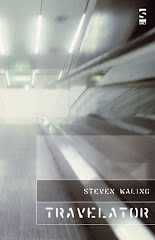
poems drawn from Travelator and Captured Yes as well as other more recent poems.
This was a particularly interesting set because it appeared to offer views from
different stages of a writer attempting to rethink and reposition his practice
closer to where his interests lie than what is conventionally expected of him.
Plainly given my own history over the last few years this has resonance for me,
and it helped that I am more familiar with his work than with that of the other
readers on the night.My personal preference was for the poems from Captured Yes
because they appeared most thoroughly subjected to disruptive processes like
being cut-up and the furthest from personal/confessional poetry. This is not to
say that the poems from Travelator were not disjointed but that the way they
were read tended to smooth over any disjunctions. This is not something unique
to Steven I must stress, it is something I have noticed in some other readers,
and in a slightly different way was present in Rob Holloway's reading. I will
expand my thoughts on performance a little at the end of this review.I like
Steven's collaging of disparate elements from a variety of sources although for
my taste his use of pop culture references feels rather dated. I feel that
experimental musics and poetry on the whole have started to move beyond the
navel-gazing Romantic heroic/visionary fantasy of the artist as the centre of
their art that these references seem to conjure up. This may be a personal
idiosyncracy and didn't seriously impair my enjoyment of the reading. I did feel
that the reading was somewhat tentative and broken-up without that necessarily
being the intention.Steven's poems shift from the present tense to the past
tense or reflection, from specific observations or reported speech/text to more
abstract concerns, from simple language and quotidian detail to complex and
specialist language. There are nods to the conventional formal structures of
poetry - particularly in the form of sonnets that are in the contemporary
tradition of exploding and exploring the form and its meaning rather than the
historical tradition of inherited metrical and rhyme schemes. It will be very
interesting to see where he goes from here.


In mitigation, I have to say at the beginning I could hardly read some of the pages from Captured Yes. I made a mistake there; I'll not use the book again. But he also made some interesting remarks about performance itself which will make me think for the future, so much thanks for that:
My misgivings about Steven and Rob's performances are reflected by a wider
concern with performance that I've become increasingly aware of over the last
couple of years. I appreciate that many poets do not want to perform, that many
would even see it as inimical to their practice. There is the argument that
performance can give a spurious authority to the performer and narrow
understanding of the work. There is also what I would regard as the more serious
problem that performance can draw attention to the poet, that performance can be
used in the development of a persona, and that the persona becomes a block to
critical approaches to the work. Some poetry primarily exists on the page and
any performance would be a form of translation and perhaps remove important
elements of the original work.But while recognising this I believe that if poets
choose to perform, especially if they claim that performance is a part of their
practice or an element in how certain poems were written, then that should be
reflected in the performance. Performance is not just something that happens to
the poem, and the effects on the poem are not trivial or unimportant. For one it
is different from the poem on the page in that it is a unique iteration. Those
precise circumstances of space, people, time, and other environmental factors
will not be repeated. A live performance cannot be reworked and revised in the
same way that poems can prior to their appearance on the page. The page is a
space that looks more or less the same in any place or situation, and that can
be visited at times when it's most convenient for the reader. This means that
the performer is in a unique position to react moment by moment to the specific
circumstances of the reading. For me this ability to be responsive and the
ephemerality of performance are crucial, core differences between poetry on the
page and poetry readings.This is not to say that the performance needs to be
easy to understand, or that the poet should try to project a persona that the
audience will easily warm to. Any glance at the performing arts of the last
century should demonstrate that. But any writer considering performance should
think about what they want to achieve with their performance, how they want to
go about that, and what unique aspects of performance (duration, location,
acoustics) they want to reflect in what way, and how that relates to the poems
they will perform. Surely for someone who wants to perform with any sort of
regularity, or who finds that they are performing frequently, these should be
considered in the same way that words, meaning or non-meaning, arrangement on
the page and other elements of poetry are considered during the writing and
editing of pieces. I may return to this subject at greater length shortly.
The whole review can be found at: http://santiagosdeadwasp.blogspot.com/

Friday, February 05, 2010

Ten Dumb Things To Say About Jackson Pollock


1. I can see a face in it.

2. How can they tell it's not upside down?

3. Do you think he paints landscapes in his spare time?

4. I'd hate to be his shrink.

5. The eyes kind of follow you around the room don't they?

6. The more you look into it, the more it looks into you.

7. I hear they've taught elephants in India to paint.

8. I don't know why, but I'm thinking spag boll for tea.

9. Are you sure there's not a face in it?

10. Well, it's deep; I'll give it that.

Thursday, January 14, 2010


OLD ABBEY WEDS. 3RD FEB. 7PM (in Manchester Science Park)

The Other Room Reading with Holly Pester, myself and Rob Holloway. My chance to be terrifically post-avant without restraint.

Friday, January 08, 2010

The Cold Weather

Oh yes, it's beautiful.

But it's murder to walk through.

Still, I've got a few new poems under my belt, and I've already written the first for 2010. It's called May Eye and has nothing to do with the snow.

I've been working my way through Barbara Guest's Collected, being amazed at every turn by just what a wonderful poet she was. I've finally finished Warrent Error, and that too is recommended, for very different reasons. I got hold of Galatea by Melanie Challenger, and I'm currently reading Cliff Yate's Frank Freeman's Dancing School.

I saw the film Nowhere Boy last Saturday, and me and my friend Elaine both agreed that it was very good. It tells the story of John Lennon's difficult relationship with his absent mother and his very different Aunt Mimi, and it's very powerful at dealing with those emotions. Kristen Scott Thomas is brilliant as Mimi, very reined in, a contrast to his mother, who seemed to me to be rather bi-polar. Worth catching.

(Irony mode) Yesterday I achieved my greatest ambition! I went on one of the new Manchester trams! I was visiting a friend near Heaton Park. Very swish they are too, and quiet.

Anyway, Happy (belated) New Year and I hope it's a productive and innovative year for all. I'm reading at The Other Room in February, so be there or be square.

Friday, December 11, 2009

Anxiety Before Entering The New

How to be new?

When you're a mainstream poet, it's probably not a problem. You just do another variation on what's gone before. Take Carol Ann Duffy's dramatic monologues. It was a form that Browning and Tennyson made their own; and she brings a new slant to it just by her choice of characters. Psychopaths, thieves and bored unemployed young men. Not, as in Browning, safely set in the Medieval world, or in the past, but in the now. That's what makes a poem like Education for Leisure its power for many people; though technically, it's no real advance on My Last Duchess, another poem about a psychopath.

But the "innovative poet" has to go further; has to find some technical means to be "new." And this, I suspect, can get to be a terribly anxious process if you let it. Hearing Nick Thurston reading his "conceptual poetry" at The Other Room the other day, I was wondering how long he can go on producing things that are so self-consciously original. One of his pieces - a recording of the speaking clock leading up to 9pm - reminded me of a track from OMD's Dazzle Ships, probably their most "experimental" album, and one which explored musical collage and "musique concrete" as a kind of pop music.

In the end, I can only speak for my own writing; but I have to step back from being anxious about whether I'm new or not, and just write the way that it feels right. I'm constantly exploring through my reading and through thinking what it means to be a writer in the 21st century, and what it means to be new; but when I write, I have to be free to write what comes. You have to go on your nerve, as Frankie says. If somebody in 1921 wrote a poem that's a little like what you're writing now, that just means you're part of the continuing stream that is innovative writing. And it won't be the same. It'll be new.

Tuesday, November 24, 2009

Paperplanes did a workshop in Burnley recently, and it went very well, despite us getting a bit bogged down in philosophical questions at one time. The Red Triangle Cafe on St James Street is a wonderful place, with good food if the bean & butternut squash casserole with polenta was anything to go by. And they do lovely coffee - good, strong filter coffee.

The people who came along were interesting and engaged fully with the discussions and the exercises. We even persuaded two people who had never read their work in public before to do so, which I suspect was a real breakthrough for them. Actually acknowledging that the stuff you write is actually worth revealing to other people is the first step on becoming a writer who is willing to publish their work. It takes a leap of faith.

So what was the "philosophical issue"? It had to do with making sense. Should a story or a film or a poem actually make sense? Well, of course, there's no real answer. There's such a thing as "artistic sense:" no-one expects a picture these days to "look like" what it's a painting of. Even in the past, the picture space was manipulated to make a harmonious painting, rather than to reflect reality. Nowadays, an artwork is seen as different from the thing or idea it is supposed to represent, and nobody complains about that. Much.

The same is true of stories and poems. They make a kind of poetic sense, in that they connect with a feeling, with a kind of linguistic pulse, with an idea; but they don't neccessarily follow in a logical order from beginning to end, with a neat conclusion at the end. Sometimes, they're all middle. Sometimes they exist merely as a game with words. Sometimes they give off a strong feeling, but are unpindownable (is that a word? It is now...)

TS Eliot's contention that a poem is appreciated before it's understood is still true. Poems communicate through rhythm, through image, through rhyme (not just end rhyme) and in all kinds of ways that can't be put into any other words than the ones on the page. And that's OK.

Thursday, November 05, 2009


***PLEASE NOTE***
IF YOU WANT TO ATTEND OUR WORKSHOP
WRITE, REFINE AND GET PUBLISHED
YOU NEED TO BOOK YOUR PLACE BEFORE 2 PM
ON WEDNESDAY NOVEMBER 11
You can book your place by phoning Steve on 07954 369 774,
or call in person at the Red Triangle Cafe, 160 St James Street, Burnley BB11 1NR,
or you can phone Andy at the cafe on 01282 832 319.
You can book by e mailing paperplanes@hotmail.co.uk, though the above methods are more immediate.

Thank you for your interest, and we look forward to seeing you.

Tuesday, October 27, 2009

PAPER PLANES: ALL-DAY CREATIVE WRITING SEMINAR
WRITE, REFINE AND GET PUBLISHED
Red Triangle Café
160 St James Street, Burnley, Lancs BB11 1NR
Tel 01282 832319
Vegetarian restaurant / cafe – Licensed. Informal daytime cafe; Fri Sat eve booking only
Sunday 15 November 2009
10.30am til 5pm, £27/£24 conc

From getting started to getting in to print – and all the steps between
WRITE Discover new, enjoyable and challenging ways to generate new writing in a friendly, creative and supportive atmosphere. You’ll take home 3 or 4 new pieces of writing and learn how to trigger new ideas for yourself
REFINE Switch on new ways to look at your work, as you are guided through a wide variety of enjoyable and often surprising methods to re-write, edit, refine and re-imagine your writing
GET PUBLISHED: PROSE
GET PUBLISHED: POETRY You’ll be taken step by step through how to get published, and where possible given individual suggestions for specific magazines and internet zines to suit your style of poem or story
YOUR QUESTIONS ANSWERED
NETWORK You’ll be given free membership of the Paper Planes mailing list and kept informed of a host of competitions and submission invitations. You can network with Paper Planes and each other to increase your success rate from now on

You’ll be guided and given individual advice by experienced, published writers
Steve Waling (poet, Commonword trustee and author of Travelator),
and Comma fiction writer Anthony Sides.
Whether you write poetry or prose, and whether you’re a beginner or more experienced,
this work shop is for you

paperplanes@hotmail.co.uk myspace.com/mypaperplanes
TESTIMONIALS: -
VIEWS ON PAPER PLANES: William West: "amazing classes. .. . the teaching is pure gold!" Lynn Myint-Maung: "thank you for the work shop ... I found you graceful and organized as facilitators, but also cheerful, kindly and playful and allowing so that the atmosphere was both safe and encouraging." Adam Grant: "You guys are bloody superb, I love what you're doing with Paper Planes." Pat Selden : "I never expected it to be this good."
Elaine Speakman: "It's my favourite way to spend a Saturday, I think it's lovely."

Tuesday, October 20, 2009

Various Marvelous Things

I've been putting together a new collection recently - writing furiously, in fact. At least six new poems in a couple of months. I've also been reading in some unusual places - a launderette in West Didsbury, for instance, as well as in the usual pub venues. I also performed as part of a jazz/poetry trio in the Didsbury Arts Festival - that was great, as for the first time in my fifty years on this planet, I felt like I was in a band! Anyone who grew up in the last half of the 20th century probably has that ambition stitched into their skin-tight genes (sic)!

The collection, by the way, is coming from Alec Newman's Knives Forks & Spoons Press, which is also publishing the first collection by Simon Rennie, fellow Arranite and runner of poetry events. It's going to be called Captured Yes, and contains quite a few poems inspired by reading the late Barbara Guest. I have several of her collections, but I've also been sneaking into the bookshop reading the monumental Collected Poems, which came out from Wesleyan earlier this year. It's £30 so I can't afford (though if anyone wants a review, they could send it to me...) She is the missing side of the New York Poets pentagram for many people, and if you've missed out on her, go and check her out! She has a luminous depth, and possesses that serious sense of humour that all the NY poets have that punctures pomposity but isn't frivolous.

I'm also reading Elizabeth Baines' new novel Too Many Magpies, but I'm taking my time over it, because although like all good novels, it makes you want to read it, it's more reflective than most, and I want to take my time over it. It's available from Salt, by the way, as of course, is my book, which is still available if you haven't already got it (there, Chris, I'm doing my selling bit for you...;) )

I went to the Other Room and saw Craig Dworkin's film of himself reading, and Micheal Haslam. Haslam was great, wonderfully animated and powerful reading. I can't see myself rushing out to buy Craig Dworkin, though I enjoyed his New York slang version of Beowulf. He only read 100 lines of it, which is probably enough. The rest of his reading was not really to my taste; but it was good to experience it.

During the literature festival, I went to see Ruth Padel read from her Darwin book, which was very good. I also went to see four Buddhist poets at the Buddhist Centre on Thomas Street. That was OK - a bit too mainstream for me - except for one multiple-voiced poem about an abandoned asylum.

So I've been busy.

Tuesday, September 29, 2009

Pig Fervour & Voice Recognition

There is a real groundswell of good poetry out there in the world of poetry.


Richard Barrett is just one of these poets, and a very promising local poet (Pig Fervour, publ. the Arthur Shilling Press). Here is a poet who is constantly trying out ideas, experimental and open without being dauntingly obscure. In poems such as "the good fortune of being happy in yr work" he's working out what it is to live in the modern urban environment with its constantly shifting media saturation.


Sometimes, it's like listening in to several radio channels at once, with a blizzard of word coming at you to be sorted out later. I'm reminded of Tom Raworth and Sean Bonney, but this is very much his own world he's talking about. He walks by the canal to Salford Quays, then suddenly breaks off to wonder where he's going with this poem ("Don't use Facebook in The Station?Don't Use Facebook At Home).


This pamphlet feels like a poet slowly finding his way forward to his own - I would say voice, but that's not right, poets often have several voices - style? Method? His long shortlined poems that seem to spill down the page and go off in several different directions at once, are perhaps still a little too reminiscent of his influences, but there's a confidence here that will move him forward.


If Richard Barrett is one of the more promising new "post-avant" poets around, Bloodaxe's new anthology "Voice Recognition" is rather more mainstream in its focus. There are some dizzyingly young poets in this collection, however, so anything is possible. Anna Katchinska's is a bright, sassy voice, as capable of tenderness as it is of hutzpah. And she's only 19.

There are some poets here who feel rather too like the previous generation of mainstreamers - Adam O'Riordan seems rather too much "school of Micheal Donaghy" for my liking (I was never too convinced by him myself, though I understand he's influenced a lot of people.) Others, however, seem already to be branching out on their own, and the ones who I'll be looking out for include Sandeep Parmer, Ahren Warner, Siddhartha Bose, Jonathen Morley and Sophie Robinson. All of them seem to have learned from non-mainstream poetries without being tied down to reproducing them.

Along with Tom Chivers' City State, this has gone a long way to convincing me that poetry is at last begin to burgeon with new blood again. All these poets are under 35 and haven't had a full-length collection published - 21 poets for the 21st century (cheese promotional guff though that is). But they're not the only ones. There are probably another 21 poets waiting in the wings, and there are lots of poets, published by Shearsman or Barque or Happenstance or any one of the new presses out there, who deserve our support. Look out for books from local Manchester presses too: the Arthur Shilling Press, Knives Forks & Spoons Press, ifpthenq etc etc.

I could, of course, go off and be jealous of all this youthful talent. But what the heck - it's not often that we live in an age when so much good poetry is being produced and anyone as obsessed as I am with poetry, it's all good.

Thursday, August 13, 2009

You’re invited to a
CREATIVE WRITING WORK SHOP
Monday 24 August 2009
2 pm til 5pm, only £10
(10% goes to Barnabus causes)
Downstairs in the café at
BARNABUS EMPORIUM
473 Wilmslow Road, Withington, Manchester
0161-445 7744


PAPER PLANES: HAPPY ACCIDENTS
paperplanes@hotmail.co.uk myspace.com/mypaperplanes
You can come to this newly-announced work shop and enjoy trying some easy, unusual and fun writing exercises that use randomization and play to trigger fresh ideas for your writing.
You’ll look at your writing in a fresh way and take home 3 or 4 new pieces. Whether you write poems, fiction, scripts, raps or blogs, and if you’re a beginner or you’re more experienced, this work shop is for you.
Join poet and Commonword trustee Steve and Comma fiction writer Anthony downstairs in the café with no name at 2pm

Wednesday, August 05, 2009

The State of British Poetry 3

Being a review of City State: New London Poetry, penned in the margins, 2009 (£9.99)

The picture on the cover is of fingerprint through which can be seen a map of the London Underground. So far so London: but it says something about the status of British poetry: it goes on under most peoples' feet most of the time. It's hardly noticed by the media, and yet it goes on, beautifully producing.

And here is a good, deep shaft drilled into the poetry of the capital. I don't know what it says about what's going on elsewhere, in Sheffield, say, or Cardiff, or even remoter parts like Cockermouth; but it shows that poetry is in a very healthy state at least in the capital.

What I like about this anthology is its range. There are poets here as Heather Philipson who, I guess, could fit into the latest Bloodaxe catalogue with relative ease. There are others, like Nick Potamitis or the founders of the Oppened readers, Steve Wiley and Alex Davies, who are much more experimental and are carrying on the work of poets such as Allen Fisher and Iain Sinclair. And there's poets coming out of a more performance-oriented stream such as Jacob Sam La Rose, whose wonderfully ironic How to be Black is one of the many highlights of this collection. Holly Pester, too, is a performer, but one of a very different type: her mashups of syntax, semantics and sound probably deserve to be heard as well as read.

Mostly, these are new names to me: except for the very wonderful Chris McCabe, whose first collection The Hutton Enquiry is an essential must-buy from Salt. It's good to see so many young poets in one place, all of them writing in different ways. It's good to see a book that is so diverse: most anthologies have one poem followed by another fairly similar. Here we get the rhymes of Ben Borek followed by the more open-form Siddartha Bose, and a real sense of surprise and adventure.

If it shows one thing, it's that adventure and ringing the changes are still part of the world of contemporary poetry. When the media, if they touch poetry at all, just give us the usual suspects, it's great to know that beyond all that, there's a real wealth of poetic talent about. This is a true anthology of what's going on in poetry now; and even though it confines itself to the capital of this fair land, it's a real barometer of what's going on over the whole country.

Tuesday, August 04, 2009

Organised Chaos

Last week saw the wonderful Manchester Jazz Festival, and what a lot of lovely noise and clatter there was about town that week. Although I didn't go to any paying gigs this year, I did see a few bands that were up-and-coming, including the very wonderful If Destroyed Still True, who combine that very English folk-jazz tradition with making a very good and at times pretty free improvising. They were at the Bridgewater Hall foyer, along with a piano trio and the Ryan Quigley Sextet (or Sextent as he kept joking throughout.) They were both good, but also a little ordinary. I also found out about the jam session and the jazz that's going on around Manchester, with a fair number of young people involved. Some great jazz during the week, and at times the rain provided extra percussion effects on the tent outside the Town Hall!

Poetry wise, I read at a charity gig for the Barnabus people who work with sex-workers and the homeless in the centre of Manchester. A Christian group putting their lives where their faith is, as it were; and the evening was gently political, with my old friends Dave Pullar and Claire Mooney providing some excellant ranting.

I'm also impressed by the Unsung Arran issue; a bunch of very enthusiastic young people who put together a magazine for free, organise a wonderful evening's reading in The Thirsty Scholar and generally don't seem to mind being among older folk like me at times. Even if I do have to say no to going on to late night parties, it's good to know there's some real enthusiasm going on with poetry around Manchester. And some of the poetry that came out of the Arran trip - I won't mention names - was great too.

Saturday, July 25, 2009

The State of British Poetry 2

Just as one thinks that poetry is on the rise, one reads the list of Forward Prize nominations (http://www.guardian.co.uk/books/2009/jul/23/forward-poetry-prize-shortlist) and starts to despair again. I mean, what an unimaginative bunch. Nothing wrong with any of them; perfectly OK, and at least there is one name who might actually be interesting; but they could have looked a bit further, to say, Shearsman Press, to find a bunch of stuff that would actually be worth reading.

Instead, we get the same old names. Nothing wrong with any of them, though they don't appeal to me much. But it's the same old Faber/Picador hegemony with a couple of Americans thrown in. And in the case of Sharon Olds, an overwrought confessionalist duffer, frankly.

The real business of poetry, meanwhile, goes on under the radar. Get hold of Troubles Swapped For Something Fresh, new out from Salt, to see lots of interesting prose, prose poetic and poetic manifestos from a really exciting bunch of people, mainstream to post-avant. It will give a much more true analysis of what's actually going on in poetry than the Forward Prizes ever could. There we have a truely international grouping of ideas, of thought and emotion from the likes of Robert Shepherd, Nick Piombino, Nathan Thompson, Sheila E Murphy and a host of others, including my own modest contribution.

Perhaps poetry's under the radar status is no bad thing; it can go on and do things that official verse culture can't do. It can speak its visions uncluttered by the demands of the media. But it also needs to be heard. So go out and search out the real stuff, and don't bother with the prizewinners.

Thursday, July 16, 2009

Marina Abramovich Presents

Fascinating evening of performance art at the Whitworth last night. It was weird, first, to see the whole gallery empty of pictures, bare walls except for one room which had been scrawled on by one of the performance artists.

It started with The Drill, where Marina Abramovich give a speech about art then took us through a series of "excercises" that include looking someone straight in the eye, screaming loudly and walking out the room while paying attention to each movement. A good way of getting us to start paying attention of our own body processes and the world around, but being short sighted, looking in someone's eyes was difficult because all I saw was a blur!

The art itself was somewhat variable in quality. Things that didn't work for me included Melati Suryodarmo carrying a piece of glass around while saying "I love you." OK, maybe it's about the barriers we put up even when we say sweet words to each other. But it was a rather dull point, made dully. Similarly, jumping from the staircase onto a mountainous mound below while semi-naked (Amanda Coogan) didn't seem too deep to me.

But I do emphasise that this is something that may appeal to others, rather than me. Things that did work for me, however, included Ivan Civic's Back to Sarajevo, which involved projecting a film onto the wall while the artist climbed all over it, basically inserting himself into a film about a return to Sarajevo. I found it unaccountably beautiful. Similarly, Alastair MacLennan's piece, which involved carefully arranged shoes, all single shoes, no pairs; and also dry earth, pigs' heads, shredded paper, fish and chairs; with the artist himself sitting holding a bit of tree and a shoe on his head, was decidedly odd, but also strangely poetic. It seemed to me memorialising something, some past terrible deed; but it wasn't specific.

There was a little bit of nudity about, with Yingmie Duan exploring "dark desires" by walking very slowly and touching herself in a kind of mock-erotic way, and Kira O'Reilly falling very slowly down stairs, and making me think that if she slipped she could do herself an injury. These performance artists need a lot of discipline and control to do what they do; but I wasn't sure either piece had that much to say.

Nikhil Chopra was the only artist to use the gallery as his canvas, by acting the part of a fictional artist, drawing in charcoal on the walls, in a sometimes frenetic, sometimes meditative way. I liked that piece, not just because there was something happening, but because it had a sense of the primitive about it. In terms of control, Italian artist Marie Cool Fabio Balducci's piece was much cooler; but it seemed almost as if there was a barely concealed passion beneath the choreographed movements, making and unmaking of sculpure using mirrors, string, salt piles and other objects. The way she carefully lit a piece of cotton thread, that kept the flame at the same height as her hand moved down to meet it was mesmerising.

There was something mildly disturbing about seeing an artist's feet sticking out of a pile of rugs; but otherwise I think I missed the point of Jamie Isenstein's piece. Terence Koh lying about the gallery floor while music was playing similarly did nothing for me. But I liked Eunhye Hwang's The Road, which used radio static and her own body to make a curious kind of music. The noisiest piece, though, was Nico Vascallari's piece, in one of the stairwells, which involved him hitting metal on metal and causing the most amazing resonance and natural feedback effect I've ever heard. Although he was at the bottom of the stairs, some of the sound seemed to come from above.

The most disturbing and effective piece, however, was Fedor Pavlov-Andreevich's piece on the life and death of Vitaly Titov, in which he was completely encased in a wooden box, apart from a hole for his mout where members of the audience were asked to feed him, clean his teeth, even scrape his tongue. I took part in this, cleaning his tongue and it was the weirdest experience of the evening.

All in all, a good event and one I think I'll remember.

Tuesday, July 07, 2009

The State of British Poetry 1

Seems to me that anyone who's afraid that poetry in Britain has lost its way hasn't been travelling in the circles I've been travelling recently. Though I have been known to complain about especially performance poetry, my second trip to Arran confirmed that even that is in a reasonably happy state, with a new collection from Gerry Potter about to hit the stands (in fact, his first as Gerry rather than Chloe.) Performance poetry is often about story telling, and his stories from life in Liverpool are often highly colourful and moving, though in a rather traditional mode.

I met the poets from Unsung magazine in Arran, who had camped under the stars in Lamlash and got eaten alive by the English-hating midges, who managed to set up a reading in the Lamlash Bay Hotel on the Wednesday evening. A very lively reading ensued, and some great writing from all concerned.

But it's the post-avant side of Manchester poetry that interests me most. I really must get hold of Richard Barrett's latest publication (review copy, anyone?) and James Davies and Tom Jencks are both doing things that both puzzle me and intrigue me. Matt Dalby's sound poetry performance at The Other Room was also wonderful, if at times rather hard on the ears.

In fact, throughout the country, there's a host of weird and wonderful experimental things going on. Tom Chiver's selection of London poets for penned in the margin, City State, has loads of new young poets, many of whom are playing with the edges of what poetry is, mixing up the mainstream with the nonmainstream, the performance with the post-avant, etc...

But all this goes on under any kind of radar. The BBC Poetry Season had Tom Chivers on Late Review, but that was it. If you read the Guardian Review, you'd think all poets were published by Faber and Bloodaxe and there weren't very many of them. In fact, there's loads, and a lot of it adventurous and exploratory in ways that I don't understand sometimes, but I'd rather poetry went to new places than stayed in the same places all the time. Long live British poetry!

Tuesday, June 02, 2009

Buy Salt!

If you haven't already, go and buy some Salt books.

There's my own, of course, Travelator, for those who haven't already got it.

Then there's the work of Chris MacCabe, with The Hutton Enquiry and the new Zeppellins.

Ghost & Other is a great book from Geraldine Monk.

Jane Holland's two books are well-worth reading.

Tony Lopez is great.

Help to save one of the best publishers in the country.

Go to http://www.saltpublishing.com/ now!

Oh, and, News Just IN! A Third off all Salt Books throughout June!

Friday, May 15, 2009

Text Festival & Philip Davenport's About Everything

The second Bury Text Festival is well underway, with an interesting exhibition that at the Art Gallery. I went to the reading for the Bury Poems, where Philip Davenport read from his spell-binding new long poem About Everything, which mixes news reportage with photograph in a dazzling display of collage poetry. In many ways, it's a marvelously polyvalent poem, which can be read in several different ways, so that meanings shift and slide like continental plates underfoot.

But if I have a cavil, it is that it seems a little cold and distant at times; and perhaps reflects a bias towards minimalism in the festival itself. The works are all good, technically polished pieces; and I enjoyed the exhibition. But it rather lacked a little "wildness." Actually, my favourite piece that I say that day was Stuart Pickard's neon tube version of Darwin's Evolution tree sketch from his notebooks. I'm a sucker for anything Darwinian anyway.

I liked the way Philip's poems keep inserting a square box which, when he read from it, he read as nothing. As if all communication is miscommunication and everything amounts to nothing in the end. If there's a like of wildness in the poem, there's also an acceptance of that nothing.

The Bury poems reading was actually stunning. Geoff Huth and Matt Dalby have already blogged about it; but my personal favourite was the poems of Carol Watts. There, I think, is a poet who actually doesn't seem scared of emotions; the poem she read about her "Roy Orbison phobia", with its repeated references to American iconography, was spellbinding, as well as being properly challenging and "post-avant."

They all took themselves very seriously, though. It was lightened somewhat by Tony Lopez photographing the audience, but apart from that, they hardly cracked a smile. Do post-avants have to be so serious all the time? That's why I always prefered New York to Black Mountain or Objectivist: they didn't take themselves too seriously. Jokes are Ok in poems as well as philosophy, you know.

Saturday, May 09, 2009

The Luareate

Some of the reaction to Carol Anne Duffy's appointment I find rather puzzling. Aside from the sexist and homophobic Daily Mail comments, I read on Tony Trehy's blog that some avant garde poets were angry about it. Why I have no idea. Avant garde poets were hardly likely to be in line for it, and most of them think it's irrelevant, so why do they care?

Personally, I'm pleased for her, and if anyone can do the job, she can. If it means that poetry gets a little more attention in the next ten years, and she manages to promote it a little out of some of its self-imposed ghettos, then good. She's not the best woman poet in the country, not when Geraldine Monk, Wendy Mulford, Carol Watts and a host of us are around; but the post has never been about "the best"; and it's never been about the adventureous edge of poetry either. It's pure establishement; and that's Ok.

Mostly, I'm going to ignore it, as I did with Andrew Motion's tenure. I'll get on with life; it's not worse getting hot under the collar about.

Monday, March 23, 2009

Padel & Monk

A while since I've been here. I've been getting my head down, working at the prison and thinking of what I want to do next. More about that soon.

I've been going through a slow patch, writing wise, but finally things are coming again. I've just read two books of poetry from opposite sides of the poetic track. One is Ruth Padel's Darwin, which is basically a biography in verse. It uses her characteristic long, loping lines to good effect, and is actually very enjoyable, and sometimes moving, especially in the poems about his family. She inserts a lot of Darwin's writings into the poems; but this is no avant-garde cut'n'paste job; it all takes place in chronological order, it all makes sense, and doesn't do anything more than most mainstream poetry does. But it does it well. I enjoyed it a lot, actually. Though I wished it were more adventurous, that it played with our expectations more, that it surprised us with its form. But I guess you can't expect much more from a mainstream poet.

Geraldine Monk's Ghost & Other Sonnets is a much less mainstream affair that plays with the 14 line structure of the sonnet to create dense, rich sequences and connections that are much more the kind of thing I usually like to read these days. This is probably at first glance more approachable than some of her work, but it is in fact as intriguingly structured as any of her work. The sounds of some of these poems are often extraordinary; and picking one's way through the fractured narratives, glimpses of imagery and song and the juxtoposing registers of speech here can keep you rereading for hours.

It's good to see both of these collections. If I prefer one over the other, it would have to be the Monk. She seems to me to have a handle on how we experience reality in these days where even popular films like Pulp Fiction can interweave several narratives at once, can justapose time zones and themes with a kind of cut-up craziness that make your head spin. Ruth Padel seems stuck in the old chronological, hyptactic way of thinking; whereas everyone these days is getting used to thinking paratactically. It's how the internet reads the world, cyberrealism not realism.

The poetry of the future will be less tied to the old realism, methinks. But who knows? We might see a return to narrative...