Tuesday, November 18, 2008

Sonnets

Been reading the Reality Street Book of Sonnets, edited by Jeff Hilson recently. I'm inclined to actually agree with Ron Silliman that it's one of the best and most significant anthologies produced in the last 25 years. It's full of so many different versions of the sonnet (and some things that aren't even sonnets) that it makes me gasp at times at the possibilities of the form. Everything from the concrete poetry of Mary Ellen Solt to variations on Berrigan's sonnets to the recent uses of the sonnet "box" by Abigail Obourne and Sophie Robinson.

There's a great deal of humour in this collection, and the sonnet is variously stretched, squashed and bent out of shape, though most people stick to at least one of the rules, even if it's only the 14 line rule, or the volta, or that peculiar out-of-balance octet/sestet division that makes it still so fascinating. There are poems and poets I don't get on with yet, but that's true of any anthology. A lovely Christmas present for the post avant poet and linguistically innovative chaps and chapesses out there.

Speaking of presents, I have recently reached the grand old age of 50. Time to lift my old willow wand to the crowd to acknowledge the applause of the crowd at reaching my first fifty. And I bet you never expected a cricket reference from me, did you?

Monday, November 10, 2008

Remembrance and Hypocrisy

Anybody else out there feel that all this Remembrance stuff that's all over the place is a teeny weeny bit hypocritical? Here we are again, remembering the "heroic sacrifice" of the First World War, while another set of young men go out to the Gulf and Afghanistan to be "heroic sacrifices" in another pointless war.

All those young men who died on the Somme (including among them, ancestors of my own family) didn't die for a great cause. Let us be clear about this: they died in vain, to support the flawed values of a bunch of tired empires trying to prop themselves up by killing young people. They were not heroes, great warriors going in to battle evil dragons; they were ordinary working people who died in their millions to uphold the great dragon of British imperialism. The Germans who they fought were also ordinary working men upholding their own dragon of imperialism. They were no doubt terribly loyal and patriotic and, like the well-brought up young people they were, they did as they were told.

But they were sold a lie. Just as the young men (often, in the case of American troops at least, poor and ill-educated) who march off to Iraq and Afghanistan are now. Watching the black-uniformed officers marching up to the Cenotaph to lay their wreaths makes me kind of sick. These people - or at least the politicians who declare wars - are still sending young men to die for British imperialism, pretending that it's a great sacrifice, invoking God and Christ as being on "our side", and it's just as much a lie now as it was then.

But there are still some brave souls who refuse. The conscientious objectors who refused to "go for a soldier", who refused to obey orders, who refused to prop up the dragon of hatred, prejudice and greed that is still what imperialism means, deserve to be saluted. They deserve their own monument. Refusing to kill is every bit as brave as going out to kill your "enemy." In fact, it's braver. Who is my enemy anyway? An ordinary Iraqi who gets in the way of a bullet? A young German man who's just come from the fields to die in another field?

Tuesday, October 21, 2008

Geeks and Elites

I went twice last week to the Fab Cafe in Manchester, a place dedicated to cult TV and what it calls "independent" music. It made me think some rather naughty thoughts.

There I was, basically in a crowd of geeks, people who could tell you cast lists and continuity errors in Doctor Who or Star Wars, who could talk the hindleg off a donkey about Star Wars, and I wondered, are poets like this too? Except, of course, we're interested in "high culture", not the "low culture" of long-running TV series that are perhaps not the most intellectually stimulating of programmes.

Except - they do often deal in quite poetic themes about the nature of reality, of time, even of memory. There are often quite complex themes about the nature of what we call life - is a pan-dimensional cloud of glass "alive" in any way, for instance?

I used to read science fiction all the time, and now I rarely do. Nowadays, I read an enormous amount of poetry. Most poets like to put themselves as rather superior to science-fiction fans, especially the kind of fan that dresses up as a Klingon. Yet being passionate about our art is exactly what makes us poets. Fandom is, perhaps, rather secondhand; someone else has usually done the writing, unless you become one of the many who write their own stories as an adjunct to the franchise; even then you're just slotting into an already established format. Rather like neo-formalist poets, he suggests with a tongue wedged firmly in his cheek...

One thing that fans have in their favour is that nobody ever suggests that their interest in and love of a science-fiction series is ever called "elitist", unlike those of us who are interested in "high art." Whether that "high art" is contemporary visual art, classical music, opera, or poetry (especially of the difficult late-modernist variety), it's assumed that if you like something that only a minority like, it must be "elitist."

But it's really no more elitist than watching every episode of Blake's Seven 10 times. Or prefering Tom Baker to David Tennant. We may like to think of ourselves as being concerned with more important ideas to do with language, culture etc etc etc, but I often wonder if a good science fiction story isn't as much concerned with those as poetry is.

Of course, all this could just be a temporal shift anomaly and really we're still back in Kansas.

Tuesday, October 14, 2008

Conscientious Objectors, Richmond Jail

Today I saw something truely humbling. I was looking at the archives of the Northern Friends Peace Board, getting them ready to deposit in a library, and came across a series of photos taken in the '70's, I think, of the graffiti by conscientious objectors in Richmond Jail.

I came across these two verses, by one HE Hancocks, of Sheffield, from June 21st 1915:

Ez for war I calls it murder
There you has it plain & flat
And I ain't to go no furder
Than me testimint fur that

If yer takes a sword and drors it
And go sticks a feller thro'
Gov'ment ain't to answer fur it
God'll send the bill to you.

Not great poetry, I suppose, but heartfelt nontheless. It made me realise even more that poetry's in everyone's soul, not just in the mind of the clever, and when people are in extremis, they don't turn to prose. No doubt they'll not put this in any anthology of first world war poetry, most of which seem to ignore the conscientious objectors, but this is just as meaningful to me as anything by Owen, and shows that not everyone buys into war propaganda, in any age.

I don't know what happened to Mr Hancock, or how far he suffered for his beliefs; but I salute him: fellow poet, fellow human, fellow child of God.

Tuesday, October 07, 2008

Two Readings Reviewed

Two readings proved instructive this week. Another installment of The Other Room, with Joy As Senseless Vandalism, David Annwyn and Caroline Bergvall, and The Poetry Party. I'm afraid, in the end, I prefered the first, the more avant garde of the two. But they both had their interests.

JASV were a bit scrappily presented, with photographs and accompanying poems (or is that the other way around) but apart from that, they produced some interesting material - a combination of found material, list poetry and visual pun. David Annwyn was wonderfully lively and physical in his reading style, reading poems about figures of the avant garde like Mina Loy and others. It was lovely stuff, wonderfully presented. Caroline Bergvall was a quieter figure, reading from her Salt book, Figs, and poems such as Fuses; but the effect if anything was more charged; these were wonderful conceptual pieces which were full not just of subject matter, but the substance of language, the way it drives meaning into other areas.

It was a wonderful evening again at the Old Oak,

The Poetry Party has visions of balloons, or perhaps a meeting of lefties in an upstairs room in a pub. It was more like the latter, though, like the Old Oak, it was a packed room. It also had music, unlike the Old Oak, though I left before the last band, dischuffed that I hadn't been able to last long enough for the open mike. I was just too tired and had to go to work.

But the poetry: best of a mixed bunch was Micheal Wilson, who actually pitched his reading just right. His poems were deep enough to intrigue, and his memnonic devices didn't just include rhyme; I noticed that he looped in several refrains and iterative devices into his poems. Plus, there was something of the Dylan Thomas about his writing that was lovely. John G. Hall himself was his usual self; wonderfully vituperative, spitting out his poems with real energy.

Sophie McKeown was one of the two guest, and she was very lively and again political; but her over-reliance on rhyme and a rather obvious plain style was a bit wearing for me. I couldn't agree more with her sentiment, but wish that the language wasn't so ordinary, that there was something of the same energy in her words as there is in her performance.

Abie D'Olivera read a long poem from someone else to start with; it was a strong piece about the Troubles that apparently was written in the '80's. And therefore, I'm afraid, rather dated; though it had a very Ginsberg energy to the words. In fact, there was something of Ginsberg and other Beat poets in her poems; though on the whole they seemed to drag (something true of Ginsberg at times) and repeat themselves rather too much. A good poet who needs an editor, methinks. Sometimes the poems were very powerful, full of emotion and anger.

But her performance was something else. If there were Oscars for over-acting she would be nominated. Her poems are quite dramatic enough, especially the one about being beaten up, without the theatrics. If ever there was a case for reigning back the performance in order to pay attention to the words, it's that poem. Some element of intonation and performance is a good thing, but I often feel that the more dramatic the writing is, the less you need to perform it. It's rather like a Whitney Houston song: too much vibrato ruining a perfectly good tune.

I prefered the Other Room because it's mostly my cup of tea. But it's good to know that not all performance poetry evenings are full of dull attempts to shock or tubthumping.

Monday, September 29, 2008

Collage World

I watched a weekend of Arts TV on BBC 4 this weekend: old issues of Arena, Omnibus and Monitor; interviews with Henry Moore, Orson Welles, and a wonderfully oddball programme about Pop Art directed by Ken Russell. A programme about Picasso, an edition of Civilisation, and the wonderful Ways of Seeing with John Berger.

In it, the sadly neglected figure of Pauline Boty was featured, showing some of her collages, and she helped me to complete a painting I've been doing for ages, by incorporating some collage. I don't paint much, and it takes me ages to see where the painting is going; so that was an evening well spent. Thank you BBC.

Collage, I suspect, is pretty much the twentieth century art form. That, and its sculptural equivalent, assemblage, seems to be what the art world does best these days: disparate elements drawn in to make something new. (The turner prize is full of assemblage and collage, and very little straight painting.) From Ernst's collages made from old etchings down even to Tracey Emin's Bed, art these days has more to do with picking up the bits and pieces from life and putting them together, not into an order, so much as a jigsaw of pieces missing, and pieces from other jigsaws. It doesn't make much sense, because it can't make much sense, because our lives are often cobbled together from disparate elements. A bit of religion or anti-religion, a bit of politics, a bit of New Age, a curiously reactionary bit there; it's not exactly a fully-worked through philosophy, more a kind of smorgasbord of found ideas.

Poetry's version of the collage is the cut-up, or it could be these days, flarf. It makes a new set of relations from the materials we make. Sometimes, we collage our own writing when we make one poem out of more than one; or we collage our experience when we don't write about one thing but about many at the same time. Simultaneity, as Appollinaire might have put it, is everywhere. We flip channels; in fact, perhaps the most potent symbol of the late twentieth/early twenty-first century could well be the TV remote and the set-top box.

Tuesday, September 23, 2008

Keeping Up

Does anybody else feel like they're not reading the "right"poets? I sometimes get the feeling that because I don't go out and get the latest Faber or Picador poet, that I must be out of the loop. I know it's impossible to keep up; but then there's still the pressure to read "what everybody else is reading."

And then there's all the young poets. I should be keeping up with them, surely... Not really. Some.

And I'm probably missing some good poetry. I know that the few poems by Nick Laird that I've read in magazines have been enjoyable; but I wonder if I could read a whole book of them. Instead, I get hold of a review copy of Robert Shepherd's Complete Twentieth Century Blues because that's the one I want to read. It's like I'm deliberately being awkward. If Sean O'Brien or Don Paterson are bringing out a new collection, I may get around to it one day; but I'm too busy ordering the latest by Geraldine Monk.

I might even enjoy their books. But not as much as the new Geraldine Monk; or the little pamphlet of Rupert Loydell poems he's just sent me. There's a massive amount of poetry out there, and the majority of it doesn't float my boat particularly. But I don't feel like dissing it either; most of it will appeal to someone, and most poets have their coterie of readers who can't wait for their next publication.

Nevertheless, there is still the vague feeling of not reading enough, especially when I read that Roddy Lumsden reads 100 books-plus a year and I look at the long list of Books Recieved on Ron Silliman's blog. Some of them even look really interesting. And that's not to mention all the poets from earlier ages I've not read yet. People have been recommending Wyatt; and if I can find an edition that's not too expensive, I might well have a go...

But, first, I'm not made of money. Second, I have other jobs to do. Third, there has to be time to relax, take in the world outside of poetry, sleep, eat, listen to music, stare at the ceiling/stars and even, dare I say it, write. So I don't feel that bad.

Saturday, September 06, 2008

Sheer Numbers

One of the things Ron Silliman is frequently commenting on is the question of numbers. There are now more poets writing than there are ever were before. Is this a good thing, or are we going to see a decline in quality because of so much quantity?

Certainly, it's impossible to read all this poetry, unless you spend 24 hours a day reading it all and have a private income big enough to buy all the books (or you're important enough to get them all sent free to you...) And where would you put them? I have to have regular a clearout just to provide some space to put the books...

And there are so many different kinds of poetry - or writings that come under the banner of poetry in some way - from highly experimental to highly traditional, and every combination in between. If I feel personally that England at least produces rather too much bland quietist verse, there's still plenty out there to keep me interested. Poets I think I ought to be reading, and haven't got round to, poets I wouldn't touch with a ten-foot bargepole, poets I might find interesting if I had the time.

Then there are the poets I ought to discover that have been forgotten about. There's a new anthology of Mervyn Peake's poetry that looks fascinating - a good addition, I think, to my collection of forgotten '40's poets. There's soem poems in an article about Nicholas Moore in PN Review that look really good.

How do we evaluate it all? Most of it will probably not last - but then some will be forgotten forever, some will get rediscovered, some will get reforgotten. Some big names now will disappear, I suspect.

I ought to be reading more Peter Riley, for instance. He sounds fascinating from the recent article in PN Review - just up my street. But when will I get the time?

Thursday, August 07, 2008

The Other Room

Barely a week since my last post, and here I am again. What's going on?

Well, despite a summer cold (aren't they the worst?) I ventured out to the Other Room, a reading series in a pub behind Manchester University, last night. And very glad I am I went, though it's a shame that one of the readers, Philip Davenport, wasn't able to make it. The two other readers, Maggie O'Sullivan and Stuart Calton, were there however.

From what I've seen in anthologies, I haven't quite got Maggie O'Sullivan's work yet, but her performance last night went a long way towards me beginning to appreciate her work. It seems to straddle various strands of avant garde poetry. There's a large element of "radical pastoral" that one can see also in poets like Harriet Tarlo, Frances Presley and Geraldine Monk; but also a large element of pure sound in the work. It's interesting that the book of early work she brought with her was called "Body of Work", but it does have a very physical element to it; this is a poetry concerned as much with the physical articulation of sound as with "meaning." It seems to be to be very "instinctual"; as opposed to a more "calculated" approach. Which doesn't mean that there wasn't a very feirce intellect behind the words, because there certainly was. Although I don't want to make too obvious a connection, it's something I also find in poets such as Geraldine Monk and Micheal Haslam; although all of them have a strong intellectual basis for their work, there's something untamed about them, a kind of wandering spirit that seeks to go beneath the surface of the world and bring something elemental back.

Stuart Calton, on the other hand, seemed to be a much more calculated poet. The two long pieces he read were sometimes funny, very involved, fragmented narratives and arguments with a strong political bent. The second poem was about the Co-Op, in fact, which he is ambivalent about. Although this was very definitely non-mainstream, this was on the surface much more controlled and probably represents the more politically-charged end of the non-mainstream as represented most publically by Keston Sutherland, Andrea Brady and Barque Press. It was difficult to understand, but also fascinating, and I enjoyed his performance, especially the halting way he sometimes spoke half-phrases and sentences. I bought one of his pamphlets, so I can pore over it and seek a way through it.

All in all, a fascinating evening. The Other Room is a good series to have in Manchester; we've had so much mainstream poetry for years, it's good to have something rather stranger at last.

Wednesday, July 30, 2008

Improvisation

Since last time I was here, I've been on holiday, a writing holiday to the beautiful Isle of Arran, and I wrote 4 poems there. But I was thinking recently about improvisation (I've just written a review of the Manchester Jazz Festival for Jazzwise magazine.) How does it relate to poetry?

If you're writing a poem that fits a particular shape, say a sonnet, then improvisation is less important: like a piece of music, you have a particular shape that it fits into (sonata form, symphony, or the generic pop song.) But you still manipulate that shape, twist it into slightly different shapes, otherwise what you have is the same as everyone else. But if you break too far away from the basic shape, then it stops being recognisable as a sonnet, and becomes something else. That's where poetic improvisation comes in: the poem starts to develop a shape that the author isn't aware of before starting the writing.

It happens too with subject matter: if one sets out writing about one thing, one may end up writing about something wholly other. Ashbery's poems always seem to me to set off in one place and end up somewhere else, because he doesn't have a subject to start off with. He has an atmosphere, perhaps, a form of words. These lead somewhere but he's not strictly in control of it, he's let go of that control. Perhaps that's what improvisation in poetry: letting go of the controls and letting the poem lead the writer.

In Arran, I found myself writing a poem out of one of the workshops that didn't fit any shape at all. It was free-form, even open-form - even the left-hand margin wasn't sacrosanct. Then I cut a heart-shaped hole in the front page of the Observer's business page, and wrote down what was found there. I also used quotes from songs. The shape was arrived at, not because it was decided on beforehand, but because it felt right. There was no idea of what was going to be said even.

Later, the poem was revised to jazz music. Some things were changed, others stayed the same. Revision wasn't done with the idea of trying to make it tidier, but with the idea of making it truer to the moment of writing. It felt organic (Denise Levertov's essay on Organic Form comes to mind!) and I didn't feel entirely in control. Quite an exhilarating experience.

Saturday, July 26, 2008

Thursday, June 19, 2008

The English Line

Rachel Fox has asked me for my definition of "English poetry," one that include Nick Laird (an Irish poet) and Andrew Motion.

It's a difficult question to answer, and I think now that it might be better to talk of the "quietist" poem. Not as in Ron Silliman's rather pejorative "School of Quietude", which is largely a rhetorical device to dismiss a lot of poets who don't fit into his notion of the "post-avant" (I see he now wants to try to encompass flarf & conceptual poetry in the same set as Ojectivism and the New York School.)

But I think it's a good description of what the English Line (to use Neil Corcoran's useful phrase) is about to call it "quietist." Here are a few characteristics I've picked out:

The quietist poem tends to be discrete, both in its aversion to extreme statement, and in the tendency for the poem to be a discrete unit in itself, unlike, say, the often messy, open-ended non-mainstream poem. There's a tendency to irony, to not expressing strong emotion.
The quetist poem tends to be written in a largely rational form, with a beginning, a middle and an end. Its syntax tends to be normative.

The quietist poem tends to be "about something" reasonably discernible - that is, it has one or two subjects and tends to stick with them. The non-mainstream tendency to drift from subject to subject, to slip between meaning and nonsense, is not much in evidence.

Use of chance techniques, improvisation, collage, is not something your average quietist poem will countenance much. Direct use of material taken from popular culture (as in flarf) or technical literature is generally frowned on, though pop cultural references can be used, as long as they're filtered through the quietist frame. Visually, left-justified is favourite, and the visual poem isn't generally seen. It's more like classical music than jazz, for instance. Not that there can't be surprise, as there is in classical music, but the resources for surprise are limited by the form.

These are just a few things I think distinguish the "quietist" poem. There are some very fine poets who fit right in here, so I'm trying not to be dismissive. Not every poem that can be identified as "quietist" will be entirely so. Not everything is as quietist as it appears.

I hope that answers the question, as well as bringing up a whole host of more questions than it answers.


Tuesday, June 10, 2008

Maintaining the Crumbling House

I came across this rather intriguing comment the other day by Jon Stone, on Todd Smith's Eyewear blog:

In seeming very dismissive of the mere fact of the English postulating on
an English tradition that needs to be maintained,

I wondered about what it might be saying for quite some time, and still don't know what it means. "An English tradition that needs to be maintained" sounds as if something is under threat, or fragile, or vulnerable to dry rot. It makes poetry (for that is "the tradition" of which we speak) sound like one of those old manorial fastnesses that need to be maintained by the National Trust. All very nice and historic, but not exactly relevant to the modern world.

I'm sure it's not the intention of Jon Stone to make English poetry sound like this; it's the kind of thing you say in a blog comments stream, not a considered argument. But it nevertheless does continue the postulation that English poetry (as opposed to American, say, or Australian) is somehow under attack. From whom? And what is this English tradition that is under attack?

Well, it's very rarely the English tradition of radical dissent: the Diggers, the Quakers, the Chartists, the peasant balladeers, the trades unionists, the Blakeans etc. It's usually some notion of what I can only call an Anglican compromise: middle-brow, middle-of-the-road, middling and conservative with a small c. It's certainly not the "extremism" so-called of the experimentalists: open-form, open-ended, frequently messy and unclean. It's certainly one English tradition - and it shouldn't be gainsaid that there are some great examples. Edward Thomas is a great example, and more recently, Nick Laird.

But I don't see how it is under fire. Sure, it's probably having to compete with a more open poetics, it's having to absorb a few more influences. But - rather like the English language itself - surely it can do that without having to "maintain" itself. The great thing about poetry is its ability to both continually renew itself - often in the past through translation and cultural exchange - while staying in contact with its past. And its past ought also to contain a few more of those dissenting voices (like the '40's Apocalyptics, for instance) than it does now.

Tuesday, May 27, 2008

Like Buses

There was an interesting article in the Guardian about the "health" of poetry recently, by Anne-Marie Fyfe. It was interesting partly for the names mentioned - some of whom I've heard of and some of whom I've not, but also for the fact that a lot of names were missed out. There's an awful lot of poetry about at the moment. It didn't, for instance, include the names of Annie Clarkson and Eleanor Rees, two recent first collections I've particularly liked. And that's just for starters. The number of poets around is ever increasing: how does anyone keep up?

The fact that there's so much new writing out there can only be a good thing. It would be dreadful if there were only a few names in the "promising" pile; where would the next generation come from otherwise? But the fact that there's a lot of them also brings up its own problems: how do you judge who will be lasting? Some people worry a lot about this; but I can't say it bothers me that much. The poet who worries too much about his or her posthumous reputation is the poet who ends up writing nothing at all. All you can do is listen to the voice(s) of the world around you and attempt to write down, as clearly as possible, what it is saying. Poets who thought they would be remembered forever are long-forgotten (Nahum Tate, Colley Cibber anyone?)

In fact, I'd venture to say that the more you look to your posthumous reputation, the less likely you are to have one. Frank O'Hara had a very casual attitude to publication and wrote about the things that were happening "now", though the "now" he wrote about is over forty years old. And people still read him. Shakespeare wrote for the audience in the stalls and in the pit, not for posterity; he had a keen eye on the box office and never let an idea of "greatness" stop him from being popular. Nevertheless, with his language and his stretching of the iambic line almost to breaking point, he was one of the most innovative writers of his day.

Still, as Ron Silliman is often pointing out, there are now many more poets out there than there ever used to be, and there's no way that any reader can get round them all. Just keeping up with the local scene here in Manchester is quite exhausting, and I don't think I've begun to manage that. So if somebody mentions a name I should have read, or heard, and I look blank, don't worry. There'll be another 3 poets coming up behind that one.

Thursday, May 01, 2008

Columbo - "Oh, and one more thing..."

I've been reading quite a lot recently - in particularly, and slowly, Rupert Loydell's latest from Shearsman, An Experiment in Navigation. There's something about his poems, and the way that they meditate around issues of art, spierituality, representation and lyric that I find fascinating. His style is laconic, undemonstrative, edging towards prosiness and away from a strongly musical rhythm; but under the style is an enquiring mind and a sense of the strangeness of language. In one poem, he can be as plain as a pikestaff, deeply personal, and move into the mysterious use of technical language, culled from his own enormous reading. His use of collage to create many of his texts never seems forced or clever in any way; it somehow seems to flow together into a poem that investigates, subtly and without you noticing mostly, what the possibilities of language are in describing, or rather connoting, the world of phenomena.

Perhaps this is what led me to think of the nature of innovative writing. This book, and the thought of an interview for an MA course in Creative Writing: Innovation & Experiment. There was a question about this on the letter inviting me to the interview, and yesterday, I sat down in a coffee-bar and thought about this. I suddenly had this vision of Columbo, having just interviewed the suspect, turning back to him as he reaches the door, and saying: "Oh, and just one more thing..." The suspect is caught off guard and made to answer on the hoof, and so reveals himself for the duplicitous cad he really is...

So the innovative poet can operate - while language or the reader thinks it's got away with its description or understanding of the world, the poet comes in with one further question, one further twist: Did you really mean to say that? That's innovation for me, and that what Rupert Loydell's poems do for me.

Thursday, April 10, 2008

The Other Room

I went to a reading at The Old Abbey pub (now owned by the Kro chain, it appears.) There was Geraldine Monk, Alan Halsey and Tom Jencks. Geraldine read from Escafeld Hangings and some know "ghost sonnets"; Alan read some of his logoclastic, intertextual poems, including a wonderful variation on some of John Ashbery's poetry from A Tennis Court Oath. Tom Jencks read from his first book, A Priori, just published by ifpthenq - which also run a magazine of loose-leaf sheets in an envelope.

Maybe it's the presence of at least three creative writing courses in the area (Manchester, Manchester Met and Salford) - but there's an awful lot of poetic activity in Manchester at the moment, and quite a lot of it falls into that strange category, the non-mainstream. Tom Jencks himself writes a poetry that uses the language of science and the media, that plays with the conceptual nature of language in ways that make it almost unrecognisable as poetry to those for whom narrativity and shapely well-made shaggy dog stories are the essence of poetry.

There's obviously something in the water. Years ago, we had the conventional mainstream of Manchester Poets, and that was it. Harold Massingham led a course at the Extra Mural Dept of Man U, which I went to and it was good in its way. You couldn't find non-mainstream books anywhere, really. It's really making a difference to what's going on in Manchester. I hope it keeps up and doesn't go away as quickly as it came, as the magazine Mad Cow did about a decade ago.

I have a poem in the latest issue of parameter - which has had a radical makeover. The last issue was conventional A4 staple-stiched, but issue 5 came wrapped in silver foil, with four seperately stapled booklets, one for the editorial, one for poetry, one for fiction and one for reviews and articles. Gorgeous is the word, and with people like Rupert Loydell and Ron Padgett in it, well worth £2 of anyone's money.

It was a great evening, organised partly by a London group called Oppened and by people like James Davies and Scot Thurston. The next one is in June, I think, and I'm already looking forward to it.

Saturday, March 22, 2008

Companion to Lee Harwood

I've just started reading Robert Sheppherd's Companion to Lee Harwood, a book of essays about one of the best English poets around. The essays - by various hands - look at his work as influenced by the New York School, the transatlantic influences of living in Brighton, Boston and New York, and various other issues. Two essays look at his poems about relationships and the influence of women in his life, from his maternal grandmother to lovers, to other poets such as Wendy Mulford, Elaine Randell and others. There's an essay on his translation of Tristan Tzara, and one on his later poems. And a good bibliography at the back. All ably coordinated by Robert Sheppard's unfussy editing.

What everybody agrees about his work is about its openness. This is not just seen in his use of open form; but in the honesty with which he deals with feelings. He doesn't ever get sentimental, but he doesn't shy away from the personal. In fact, he has said himself that it wasn't until The Long Black Veil sequence that he realised how personal a poet he was. In many ways, he's as personal as many a mainstream poet writing about their personal life; but the results couldn't be more different from the average anecdotal closed form poem. He never comes to conclusions, for instance, and invites the reader in to make sense of the poem alongside him. He will write about a relationship in an open way, exploring its circumstances and feelings, but not giving us his answer to it. He doesn't give us the benefit of his wisdom; he leaves gaps for the reader to fill in. There's nothing "difficult" even in the Borgesian story poems he's also fond of; but the reader is not given the meaning of the poem on a plate; he or she is expected to work for it, to enter the poem like entering a room and wander about inside, figuring out what's in the room for themselves.

It's a poetry I've admired and aspired to for many years, ever since I came across the Pig Press books of his in a bookshop in Grassmere. I think he's wonderful, unjustly neglected like every good poet on the wrong side of the mainstream/non-mainstream divide and recommended to anyone who cares about English poetry.

Sunday, March 02, 2008

I wish I could get here more often, but I've been pretty busy.

The second issue of the prison magazine the men started at Whatton is about to hit the cells. I've got a reading at Salford Uni on Tuesday, and a workshop with the students. Then there's the launches of Parameter, The Ugly Tree and Lamport Court, 3 of Manchester's finest magazines, on Monday Night.

I've also been doing some reading. I can thoroughly recommend a translation of Boris Pasternak's My Sister -Life, which I found in an Oxfam bookshop in West Bridgeford. I'm about to start a book of essays about Lee Harwood, when it comes from Salt. I read their Companion to Geraldine Monk, edited by Scott Thurston, and thoroughly enjoyed that.

I also recently read online a very antagonistic review of the anthology, Other, in Antigonish Review online. It was interesting not for the fact that I probably disagree with it; but in the ways that I agree with it. There are aspects of non-mainstream approaches that are no more realistic than the more mainstream ways. Non-mainstream values such things as a plurality of voices, fragmentation and so on, and will tend at times to over-emphasise that in a writer who isn't really all that fragmented; it emphasises "difficulty" but sometimes exagerates that difficulty.

I think the reviewer was almost entirely wrong in his reading of non-mainstream poets. He would mention something in an Alan Fisher poem that sounded, to him, as if it was just some politically correct mention of a London Tube station. But that's where Alan Fisher lives, and he's always written about that place. He quotes a line of one poem as being "bad", which when placed out of context on a page sounds bad. But it's not unlike those preachers cutting and pasting bits out of the Bible to prove that gay people will go to hell. It's out-of-context, and only serves to show the reviewer's prejudices up.

Do non-mainstream critics do the same? You bet they do. I read an article by Ken Edwards where he compared a short magazine poem from early Mathew Sweeney with a dense, allusive poem by Allen Fisher to illustrate the "superiority" of non-mainstream over mainstream strategies. Well, excuse me, but isn't that unfair? Shouldn't we at least compare similar to similar? What would happen if we take a more straightforward Lee Harwood poem and put it alongside Sweeney? Or a more densely allusive mainstream poem (Geoffery Hill?) next to Allen Fisher? What difference does that make to your point?

In the end, the whole thing comes to see like two cats fighting in a paper bag. Non-mainstream writers have a tendency to over-valorise their outsider status. Clare, Blake and others are invoked as "outsiders" - which in a sense they were; but in another sense, they aren't now.

So maybe I'm fence sitting here. Well, more on this later.

Monday, February 04, 2008

Winter Hands by Annie Clarkson

If there's any movement in poetry more stealthy than any, it's the almost invisible rise in England of the prose poem. Poets have discovered the prose poem in increasing numbers, but I can't think of anyone yet commenting on this. I went to see Simon Armitage reading from his Gawain poem, and even he ended the evening with some prose poems.

Annie Clarkson is a new, young, addition to this growing band of "prose-poets," with her first chapbook collection, Winter Hands (Shadowtrain Books, www.shadowtrain.com). Unlike her fellow prose poet, Luke Kennard, there isn't any stand-up comedy surrealism here. Instead, what we have is a dark, wintry landscape of fractured relationships, fairgrounds and factory yards and people living on the edge.

These lyrical portraits of people and places, and people in places, are not totally grim, but there is a dourness about these poems that is lifted into poetry by the exactness, and aptness, of the language. When she describes the dirty sexuality of The Fairground Man: "dark hair curling round your ears, smell of generators and dirty denim, you open the door to my skin the ride of my life the holding on..." the reader is taken spinning into the romance of the fairground ride, and the dangerous glamour of it.

In places, there is a sense of the form only just holding onto the words, which at any moment could go spinning into the atmosphere. At other times, there's a grim realism pinning it down to earth. The prose poem here is not a vehicle for reverie and over-poetic language (which compensates for the lack of "poetic devices" in some prose poems.) Nevertheless, there is nothing else to call these pieces except poems. They vibrate like poems do, they leave resonances like poems do, they leave mysteries, they make you want to go back and reread them.

Annie Clarkson is a brave poet; and these are brave poems.

Tuesday, January 22, 2008

Poetry mags & well-made poems

I've been trying to read both the Poetry Review and Poetry, and wondering why on earth I bought them. Not that there aren't good poems in them, but they just don't seem terribly interesting overall. Or relevant. Some poetry magazines continue while having long since lost any raison d'etre. They're not publishing the new, upcoming poets, they're just publishing the few remaining members of whatever school of poetry they were set up to support. Poetry especially seems tired; well, it is nearly 100! It's full of perfectly decent well-made poems that refuse to lift off the page. Poetry Review is a bit better, but not by much.

Which brings me to this thing about "well-made poems." Surely poems ought to be well-made, not just cobbled together? Well, yes and no is the best answer. So many poems are perfectly well-constructed but ultimately empty. They're vessels for lots of clever phrases or ideas, or little packages of not very original insights or observations. There has to be more than just a good construction to make a poem interesting, something apart from it being well-made. Though there is some value in "well-madeness," and a good traditional sonnet is still worth reading.

But then there is always the non-well-made poem: the cut-n-paste, the aleatory, the fragmentary, where the point is precisely not to look well-made. A serial poem like Maximus questions the very idea of something being finished, or looking complete, well-rounded or beautiful. The well-made poem starts, works its way through an argument and ends with a satisfying sigh or clunk at the end. The modernist fragment poem starts arbitrarily (seemingly), ends arbitrarily, doesn't finish its thoughts, sometimes doesn't even finish its sentences or stick to a horizontal line. It scatters itself about the page, mixes register, interupts itself. In short, it doesn't follow a logical or sequential order.

All these techniques have been around the block for awhile now, and I suspect that for many younger writers, the opposition between well-madeness and fragmentariness is a lot less problematic. I suspect we will see in future, poets who can do both; who can write sonnets and fragmentary cut-up poems.

I don't think many of the big name magazines have caught onto this yet. But there are a few newer magazines - Parameter, Succour and a few others - that may be cottoning onto this.

Monday, January 07, 2008

Two books I ought to add to my list of favourite books of 2007.

David Morley's Invisible Kings, which is one of most inventive and enlightening books of 2007, and from the usually rather dry Carcanet press (I agree with Jane about Carcanet, often: though Ashbery & O'Hara are on their list.) Due to failing memory, I missed this out of my list. Apologies, David, it was great, especially the title poem Kings. Its use of Romanni language and its shape poetry, and its trawling of folklore, was wonderful.

And, just inside the year, Sandra Tappenden's Speed, which is Salt, of course. Very fast poetry, to be read fast, but several times over so you can get what you missed the first time. It's the kind of poetry that I can imagine some critics skimming over because it doesn't seem serious, and yet under the speed and the wit, there's a lot of serious meditation on mortality, on the way we live in the 21st century, on sexual politics.

Wednesday, December 19, 2007

Books I Like 2007

Poetry books I've really enjoyed this year include:

Eleanor Rees: Andraste's Hair
John Ash: The Parthian Stations
John Ashbery: A Worldly Country
Luke Kennard: The Harbour Beyond The Movie
Zoe Brigley: The Secret
Charles North: Cadenza
Tony Lopez: Covers
David Kennedy: The Devil's Bookshop
The Selected Poems of Alice Notley
Geraldine Monk: Racoon
Jane Holland: Boudicca & Co

There are others, but those are the ones I've remembered off the top of my head

I've also discovered the prose poetry of Annie Clarkson, and I'm looking forward to Sandra Tappenden's new book.

I've noticed that this year poetry by young women has become to seem more adventurous, and, dare I say it, more so than young men. But on the whole, younger poets seem less tied to particular ways of writing, mixing up genres often with an abandon I haven't seen for years. I once said that it was better for a young poet to read Ginsberg than Larkin; but maybe reading the two simultaneously (one in each hand?) is what people are doing right now. No bad thing.

Salt is my star publisher; not just because they published me (though that helps), but also because of the range of books they publish, from avant garde to mainstream. And they do look utterly gorgeous on a coffee-table. But Shearsman are also up there as among the best. Faber if anything look worse than ever.

Maybe I'm being over-optimistic in looking forward to next year's cropsof poetry and new poets. But I think we're in for some interesting new discoveries: the names I've never heard of on Dusie's British issue are quite amazing.

Wednesday, December 05, 2007

Salt Winter Poetry Party etc

I had a terrific time at the Salt winter Party at Foyles last Thursday. Firstly, it was great to meet poets who I've admired for ages like David Grubb and John Hartley Williams. Secondly, it was great to meet and have a drink with that fine poet and controversialist, Jane Holland. It was even more amazing to actually meet Chris, after talking to him on the phone & e-mail corresponding so much. I got to meet my publisher!

The venue was slightly awkward - long rows of seats - but there were 200 people there to hear me read (next to last - the curse of having a name that at the back of the alphabet!) and I read two sonnets from the collection. I think there were some terrific writers there - Peter Jaegar and Sandra Tappenden among the poets, for instance. Gavin Salerie - who I met once at Geraldine Monk's party - said he liked my poems, which was a boost. It means so much more to me than if Andrew Motion had said he liked my poems. Though really I'd like everyone to like my stuff. I'm that shallow.

But I had a good time in London - and found a nice cheap place to eat in Old Compton Street in Soho - the Stockpot. Reasonable to good food, not showy, very quick turnaround and pleasant atmosphere. I went to Tate Modern, and was pleasantly surprised that a room full of Surrealist art had pictures by Tristram Hillier, Eileen Agar, Roland Penrose and Ithell Colloqhun as well as the usual names. English surrealism was often thought of in the past as not as good as the greats of the continent but I think it stands up very well.

I spent some time in the Poetry Library on the South Bank, discovering a terrific Nicholas Moore poem called Meaningless Gesture, that I must type up here soon.

On the Sunday, after having stopped off Saturday at Whatton, I was back in Manchester, and went to another poetry event, at Fuel in Withington. Well, there was some good stuff: John G Hall and Micheal Wilson in particular seemed to have real energy and above, a real love of language and what it can do. But Change Kunde was dispensing Good Advice when she wasn't trying to be terribly rude (God, how I hate that British seaside postcard innuendo about sex!), Matt Panesh was all shouty and un-PC in a terribly tired way, and there was so much obvious rhyme I wanted to scream. Oh, and Gordon Zola, who would have been a scream in music-hall in 1907, but just seems so old hat now.

The Salt event was great, because even when you weren't terribly turned on by what you heard (as I wasn't by a couple) at least you were aware that the writers were crafting their work, and weren't just in love with the sound of their own voices (you couldn't always hear them, in fact: bad sound system.)

Tuesday, November 13, 2007

First Review

From Rob Mackenzie's Surroundings blog

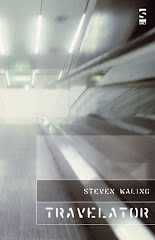
Review: Travelator by Steven Waling
Impossible to classify, the poems in Steven Waling’s Travelator (Salt, 2007) flit between the experimentalism, play, shifting tones and unexpected leaps a reader might expect from the New York School, and an earthy, northern English, lyrical vernacular that wouldn’t sound out of place in an early Simon Armitage collection. One aspect they share is a reluctance to tie-up all the loose ends, or close with the force of aphorism, and there’s little straight, linear narrative. Instead, images juxtapose and gradually form a picture, often punctuated by gaps and missing links. The best poems almost seem to push beyond their own limits, very much like the sailors of The Prospects navigating towards a place of blessed happiness they’ve heard about, who finally touch land and find that:

whatever it was we were looking for
on this bare headland out in the ocean
has jumped ship to the next blessed isle
or the next or the next after that.

The collection is split into two sections. The first comprises a selection of ‘sonnets’ (some people might debate use of the term as the 14-line poems are unrhymed and without regular metre), which took their inspiration from a sequence by American poet, Ted Berrigan. The poems often use a ‘cut-up’ technique in which the lines in a poem are reordered. They don’t always make conventional sense, but most are compelling reading nonetheless. The cut-up phrases convey fleeting impressions. The poems leap from one impression to another, line by line and often across lines, using the vocabulary of the lyric poem, slang conversation, advice columns, and responses to news of tragedy by telephone (some of these may even be partly 'found poems', made up up of overhead conversation snippets or chopped-up phrases from newspaper articles). Phrases recur from one poem to another too, lending a tenuous unity to the sequence. An example from Advice Column:

Don’t let it get you down .... Madness is doing
the same old things .... Since he stopped drinking
nothing about it seems funny except the way
you’re looking at things .... Poetry should contain
coffee and croissants .... Fold it up .... put it away

The artful arrangement of phrases is humorous and absurd in equal measure. The unexpected juxtapositions lend themselves to irony, but can also be utilised to explore feelings of unease, such as in The All-Purpose Stars where a relationship appears to be threatened both by what’s currently unspoken and by what should have been left that way.

Steven Waling’s poems stand at an angle to much contemporary poetry in the UK. Linear narrative isn’t a feature of many poems in this collection, although I should emphasise that they are not absurdly ‘difficult’, abstract or obscure. Waling has an ear for the music of words, a willingness to steer the poems by force of an untamed imagination, a sense of humour, and a connection with real human concerns at an emotional level. Cod, probably a cut-up poem, uses the technique not as an end in itself, but to get to the emotional heart of the matter:

on their way from Iceland emptying cargo
on the deck at Fleetwood less and less
shoals departed smaller the hunger as deep
eaten with fingers washed down with loss

The second section of the book doesn’t evidence cut-up technique with great regularity, and employs fairly conventional syntax for the most part. However, the juxtaposition of surprising images that don’t quite connect (at least, not at first) is still a strong feature in some of these poems. Other poems are nostalgic and lyrical, often beginning from a situation of sadness or alienation. I particularly liked the ‘bus-stop epiphany’ of Catching the 22, in memory of Kenneth Koch.

The characters in many poems are complex and not quite comfortable in their environment: the man commuting to a job interview who feels ill-at-ease in a world where “the lighting of lamps/ on fogbound stations breaks my heart” and “professors speak like newsreaders/chatting theology” (Through the White Hole); the vulnerable Romano outsider wandering Prague with his dreams and love of the arts – “Don’t wait for time/ to give you her hand. Go out, find/ a name for yourself: I call myself home./ My name means Gorge crossed by a bridge” (Ghosts on the Wall); the boy and his sisters looking on as a leather-clad biker, a “roaring streak of Black Lightning,” rides off with his delicate girl, the same man previously described as “reading aloud from the paper,/ that old-fashioned chivalry arm/ gentled round her waist – unnatural/ and stilted” (Before). I won’t give away the ending.

A couple of poems, Trade is Increasing and That Summer, were perhaps just too Ashbery-esque, but quite enjoyable all the same. Gorgeous, the final poem in the sequence Three Poems about Love, contained such a ham-fisted metaphor that I wondered if it had been meant as an ironic joke (but I don’t think so!). However, this collection is generally very strong, and I wouldn’t want to dwell on the few poems that didn’t hit the mark. Travelator is quite different from most collections you’ll read this year. I thought it would be the kind of book I would enjoy, but even I was surprised by how much I enjoyed it.

from: http://www.robmack.blogspot.com/

Friday, November 02, 2007

Perception & Reality

I was in the Cornerhouse bar here in Manchester the other day, and, as you do when you're a writer, overheard something interesting. They were talking about the Lowry, and one of them said, "it's not for the people of Salford though, is it?"

Which got me thinking. What is art for, anyway? Opera, for instance, is generally thought to be terribly elitist, especially in this class-ridden island. It's said to be far too expensive for the ordinary pocket. But is it any more expensive than a ticket to see U2 or Madonna? In fact, when I went to the opera last year it cost me about £20 a ticket. Less, I suspect, than U2 or Madonna. Yet opera is said to be beyond the pockets of the ordinary punter...

What's stopping people engaging with the arts, especially the "difficult" arts like opera, or non-mainstream poetry, is perception rather than reality. They think that they're not going to like something, before they've even tried it; or that it's "not for them." It's like a five year old taking an instant dislike to a carrot, even though they've never had a carrot before. The reality is that opera can be a very enjoyable and exciting experience, even overwhelming; every bit as enjoyable as U2 or Madonna, who both use tricks that operas have used for centuries. Non-mainstream poetry often looks odd, and can sometimes be difficult, but is never quite as difficult as you think it's going to be.

Anyway, to anyone who's reading locally, I'm in the Chorlton Book Festival on the 11th of November, in Chorlton Library, at 7pm. Come along, and I promise not to sing an aria.

Wednesday, October 10, 2007

The Gate Universe - First Days in Prison

It’s like entering an alternative universe, that we could if we were Star Trek fans (which we are, even if we’re not great fans of Klingon Opera) call the Gate Universe, entered through a wormhole just the other side of the Great Spiral Nebula. Far away from everywhere else, in a land where all windows have bars. Not, funnily enough, straight up and down bars, but patterned, white-painted bars. Everywhere, there are doors and gates, each one has either to be locked shut or locked open (they can’t just swing free – nothing is free in a prison.)

I’m being introduced to lots of people with names I instantly forget. The Governor is full of enthusiasm for the Writers in Prison project, and even decides to search me out on Amazon and order my books. Which is a bit daunting: what if he doesn’t like them?

I’m incredibly supported – I even got my keys on the first day. Which is another thing about this place. The music of keys. Music in the key of keys. Chains don’t rattle, at least not the key chains we’re given; it’s a kind of jingle-jangle sound, not like something out of Dickens or Edgar Allan Poe. Oh, and you don’t take your keys out of the prison. On pain of being kicked out of the Gate Universe and back into the real world by one of the many Acronyms that seem to rule the roost in this universe.

Acronyms, by the way, are strange small creatures with spiky ears that breed like rabbits in prisons. Everything has to have its acronym. Or EHTHIA for short. Which sounds like the name of one of the strange planets that exist in this universe.


Prison haiku


he who walks corridors
looks neither left nor right
& ignores the sky

*

this is not the key
clanking in the door this is
the air cracking

*

breathe out breathe in
the same air recycles itself
finally expelled

*


I never thought I
could laugh in here I do things
slowly at my age

*

walk the corridors
I’ll be going out soon what
will the air taste of

*
in the gate universe
have you locked it are you sure
the stars wait outside

Saturday, September 08, 2007

Prison Writer

So much has happened -

I've just been away for a week in Wales with the Writers In Prison Network. I'm going to be a writer in residence, for the next year at least, in a prison near Nottingham. I'm both scared and looking forward to it, which is apparently the right attitude to have. During the training, I got to make, along with a whole bunch of other writers, a video, write a radio script, put together a pamphlet of poems, learnt about storytelling and other things useful to the job. It was a very exhausting week and I'm still reeling from it. Clive and Pauline, the co-ordinators, did a terrific job with the whole project, and I met Pat Winslow again, one of the bubbliest, loveliest people I know and a terrific poet. She herself is at Long Lartin.

I know it's going to be a steep learning curve for me, especially considering the nature of the prison. It's a training prison for adult male sex-offenders who are all "addressing their offending behaviour", that is, all attending treatment courses to help address their crimes and prevent them re-offending. That's the theory at least. It's going to be a challenge form the get-go.

Before that, I did an interesting thing. I went, as a Quaker, on the Manchester Pride March on the August Bank Holiday. It was odd being straight among gay people, but also remarkably celebratory, especially when we passed the usual sad contingent of fundies with their banners quoting obscure verse of the Bible to justify their prejudice. As if the Bible were some kind of collection of magic formulae, not a book of stories, which, like all stories, are seeking to discover truths about the world.

It's good that some Christians (and their were about 30 Anglicans and Catholics alongside us, as well as some Unitarians) are not entirely negative about alternative ways of living. Sometimes I think that the Church is pointless, but not that day I didn't.

Anyway, there's some big changes happening in my life, and I'm looking forward to them.

Monday, August 20, 2007

Language + Science

I've recently been to two really interesting art exhibitions, both curated by Tony Trehy. The first is Iceland at Bury Art Gallery, and the second is Language + Science at the Mid Pennine Art Gallery in Burnley. That two small towns can have such interesting exhibitions is a real sign of hope, I think.

The Iceland exhibition is based around a contact between Bury and the Safn gallery in Reykyavik (http://www.safn.is/) which is a private gallery with a collection of contemporary art including work by British artists as well as Icelandic artists. In the exhibition, there's a stone circle by Richard Long, Birgir Andrésson, Roni Horn and a wonderful set of etchings by Tacita Dean called The Russian Endings, apparently taken from actual postcards in Russia, which are pictures of things like ships sinking! It's worth the price of the bus ticket for that, but there's some great photography and a real sense of white space in the gallery that makes it very atomospheric.

The Language + Science exhibition is, if anything, even better. Here we have six mainly text-based artists, dealing with the interplay between language and science. One piece struck me: Evolution, by Carolyn Thomson, where the artist, using only the words found in individual chapters of the Origin of Species, has created two new stories (one from each chapter.) It's particularly interesting for me because my latest poem incorporates text from a Penguin 60 extract from Darwin, as well as an older poem of my own.

There's also some great poems by Philip Davenport, incorporating mathematical symbols and scientific words into what are basically a series of break-up poems. Tony Trehy has a wall-based piece, and a piece using blank canvases on the four sides of which he has written a poem, again incorporating scientific language. Shaun Pickard has one of his pieces incorporating descriptions of birds, there's a really interesting light piece, and a film of Hester Reeve reading the whole of Frankenstein while sitting on Mary Shelley's grave.

Both exhibitions seem to be exactly the right size. The second is more interesting to me as an increasingly more innovative poet, because of the use of language. They are all artists who are not afraid of using words for more than their representational uses. I was quietly inspired by this exhibition. It won't turn me into a visual artist, but it will help me to remember that words can be as plastic and abstract a medium as paint or marble.

I hope that at least some of my readers will make an effort to see these exhibitions, as I think they deserve to be seen. Small art galleries in small towns often put on splendid exhibitions that are not well-seen, and I think it's important to support them if you can.

Monday, August 06, 2007

Random thoughts

Well, it's August now. My book is certainly selling to friends, though now I've got to persuade some people to write their Amazon reviews as promised...

I've been reading some interesting poetry. Robert Shepherd in particular, whose big Twentieth Century Blues poem-serial I've never read a big bulk of. There's a lot of sexual politics in his poetry, which is not something I'd noticed much before, and the sex in his poetry always seems to concentrate on the seedy side. He's trying in his verse for what he calls a "poetry of saying", something akin to a poem which unfolds its meanings in front of you as you read, as you put your own voice into it. He opposes this to a poetry of the said, where the meaning is already on the page ready to be obtained: that's how he characterises the Movement poets, and most of the mainstream.

There is a lot of truth in this, though it's never the whole story. No poetry is entirely "said", even Philip Larkin and co., and I think there are lots of poets who are characterised as "mainstream" who are much more open to "saying."

I try in my own poetry to find out what is/can be said during the writing. I very rarely decide what I'm going to say before writing these days. In fact, it's difficult to do that anyway when you're making poetry from found material, as I have been doing; the found material determine the content, and whether it works or not. The recent sonnets have used material from adverts, streets signs, newspaper dating columns... but I recently stopped doing one half way through because I thought I was merely repeating myself.

I think I'm probably not going to write much this month, which is no bad thing. I have several things to prepare, in particular a new job at HMP Whatton, where I am going to be the writer-in-residence. This is quite a challenge - to do creative writing with prisoners - and I'm sure it's goiong to affect my writing in exciting new ways. But it's scary too; I've got the job for 18 months.

I met the sister of Terry Eagleton, Annie, recently at Earth cafe, where she bought a copy of the book. Maybe I should make more of these links with famous people...

Friday, July 20, 2007

This is what Ian MacMillan said about Travelator in last Saturday's Times:

Five to cherish
TRAVELATOR by Stephen Waling, Salt Press Waling was once
poet-in-residence in a chip shop and his poetry has a salty quality that makes
you want more. Salt churns out quality books like there’s no tomorrow.


Not bad at all. I was top of the list of five to cherish. He also wrote a very good article about the continuing importance of small presses in English writing, drawing attention to such presses as Shearsman as well as Salt. It's an indication of their increasing importance that Luke Kennard, Melanie Challenger and Eleanor Rees all got nominated for the Forward Prize this year. Nothing too avant garde, but both Luke Kennard & Eleanor Rees are very interesting young poets with an experimental edge, and in Kennard's case, an absurdist sense of humour.

I did a storming reading at the Central Library last Thursday - there were people hanging from the rafters and I sold some hardback books. I read with Chloe Poems - who is a performance poet quite prepared to stretch him/herself into new territory with a set of poems about Manchester that captured some of its vibrance as well as some of the annoying aspects of all this "new Manchester" we're supposed to so admire (all shiny new flats and not a poor person in sight.) I read some of my oddest poems, and they went down well.

Eleanor Rees was very good in Liverpool the day after. Another Salt hardback - very beautiful - and intriguingly complex poems set in a kind of magic-realist version of Liverpool.

Thursday, June 28, 2007

Updates

The book is finally out, and can be purchased from your local book shop, or for a 20% discount at www.saltpublishing.com, so go out and get it meanies! It's beautiful, hardcover and full of my usual demotic wit, verbal play and cut'n'paste po-mo shenanigans!

This Saturday there's another paperplanes workshop at Fuel, 11.30 - 3pm.

I have a reading with Chloe Poems at Manchester Central Library on 12th July at 1pm. It's going to be interesting. Chloe Poems is one of the few reasons why performance poetry isn't yet entirely dead, despite what the recent issue of Poetry Review thinks. There's a magazine that since its recent flirtation with avant-gardism has gone scuttling back to its nice little suburban garden of verse. Though it does have a token poem from Ian Davidson in the latest issue.

I've recieved Poetry London, Rialto and Smiths Knoll recently. All fairly decent, mainstream mags which all have fairly decent mainstream poems in them. Smiths Knoll often has good little poems in them. Poetry London is better this issue than the last; Ciaran Carson's two are very good.

I also recieved a lovely little pamphlet from Geraldine Monk, called Racoon. A sequence about a trip to America, I guess; and I love the way her poems move and sound.

I've started writing prose poems based on Chinese Fortune Cookie sayings. I shall have to see where this one takes me. As Frank O'Hara might put it - prose poems, I'm a real poet!

Wednesday, June 13, 2007

A Plague on Light Verse

One thing that gets my goat: light verse, what's it all about? I can get humour in poetry - anyone who doesn't sometimes laugh out loud at Ashbery or Tom Raworth has had a humour bypass. But those little verses about cricket ("Play up! Play up! and Play the Game!") or trains or some other such petit-bourgeois enthusiasm, usually written in a rollicking metre with lots of "funny" rhymes and ending with a neat and over obvious punchline - I just don't get why everybody else seems to like them.

I must be missing a circuit in the brain: maybe the cucumber sandwich circuit that sees writing verse as a nice little pastime equivalent to macrame or darning socks. Ron Padgett's "Nothing In That Drawer" creases me up, though (it's the same phrase, 14 times - a sonnet I guess!) Kenneth Koch can have me in stitches, and so on.

"Light verse" just has the flavour of weak tea served in a vicarage, with doilies and little cakes. A really good funny poem has more of the Lenny Bruce about it; though how many people do write genuinely funny poems? Poems, that is, that are not just gags wrapped up in verse? Not many, I suspect. Much so-called performance poetry is essentially light verse. Oh, it sounds a bit punk because the poet is shouting it through a microphone, but it trots along on its little metrical feet in just the same way as a Pam Ayres poem.

And I like "rude" poetry even less than "light" verse. Stuff that thinks that it's funny to leave a gap where a swearword should be, or the word "cock" or something. If you're going to talk about sex, don't be so fucking coy. At least Chloe Poems, for instance, isn't coy about sex. She comes right out and says the words, doesn't hide under innuendo.

I'd like to see/read/hear some genuinely funny poetry sometime: but I don't think it's going to come from a mainstream still addicted to safety, or a performance scence addicted to giving the audience only what it wants. A performance scene that still appears to worship at the feet at that arch light-versist and sentimentalist, Roger McGough. (Well, he is Liverpudlian: what else would you expect but sentimental guff from the city that still hasn't gone past the Beatles?)

Thursday, June 07, 2007

Elitism vs The Common Touch: A Few Thoughts

I was watching a programme recently about modernism and non-modernism in fiction. The whole Virginia Woolf vs. Arnold Bennet thing. Virginia Woolf couldn't stand Bennet's common touch. Arnold Bennet wrote a lot of books, had plots and stories and beginnings, middles and endings. Woolf said she was more interested in the movement of her characters' minds than the story.

But it all comes down to whether Woolf was elitist in her high art disdain for Bennet's "common touch."

Or does it really?

Personally, I'd rather read Woolf than Bennet, just as I would rather read Ashbery than Armitage. Armitage is the contemporary Bennet of poetry: producing well-written popular (if not strictly populist) poetry that most people can identify with at some level. You know what an Armitage poem is about. Ashbery's poems, I guess, are more to do with the movement and the clutter of his own mind. They're not "about" anything, in the sense that they have a single definable subject. So who's being the more elitist?

You could say that someone who writes "populist" literature is simply writing for the usual lower-middle class expectations of the "general reader", but who is Ashbery writing for? People interested in "high art", whatever that is? But who are those people? Some of them, like me, are, frankly, working-class to the bone. But we just happen to like something rather different from the usual diet of realism and fairly naturalistic language. We like the sound of words for their own sake, the juxtaposition of words and phrases that aren't "supposed" to go together. We might have some critique in mind about the way language is used to uphold the status quo. But even Andrew Motion is aware of that function of language.

What made Woolf a modernist and Arnold Bennet an anti-modernist? I still haven't really puzzled it out, but I don't think at route it's to do with elitism. I suspect that Bennet had as many small-minded prejudices as did Woolf, probably to do with the working-classes and coals in the bath. Woolf was definitely eltitist; she was upper-middle class. We all have a tendency to look down on others.

But at heart, modernist writers are just interested in different things. I find it difficult to read novels that have too much story in them; the last great novel I read was by WG Sebald and seemed to involve a lot of walking around and not much actually happening. What goes on in the mind of his character seemed much more interesting to me than some kind of event happening.

The same is true of the poets I like: they're not giving me little stories, or little insights into the world; they're giving me both the moving of their minds, and a sense of language as something fluid, ever-changing and musical.

A lot of the first generation of modernists were elitist; but less so than their populist cousins? HG Wells, for all his popular novels and his socialism, was no less elitist than Woolf; both were advocates of getting rid of inferior specimens in the human race.

In the end, what interests you as a writer, whether you want to follow in Woolf's steps or Arnold Bennet's, is down to far more interesting factors than looking down your nose at all those "populist writers" and thinking you're special because nobody reads you.

Saturday, June 02, 2007

Thursday, May 03, 2007

50 Heads: Tony Trehy (Apple Pie Editions)

This is a handsome, but formidable-looking book: stiff card covers, no title on the cover and only a picture of what looks like Manchester's Cooperative Insurance tower, with its windows and its solar panels.

The poetry too is intense and formidable, full of scientific, mathematical, philosophical and other specialised vocabulary, off-putting, I suspect, to the casual reader he obviously doesn't want, but rewarding to those who are prepared to wait for the insights this writing can give. Written in prose, each poem begins with 0 and ends with 1, as in probality measurements where 0 is no probability and 1 is certainty. Nothing, of course, is certain, even reaching the end of either this book or a single poem. There are 49 poems, so the 50th head has to be the reader. Here is Houses:

0. Vitruvian in determinedly outside. Of somewhere else, empty rooms, once
empty, somewhere someone else, something somewhere someone else. Madeiraised. Nuclear unit composition in a hidden place of imbalance and ill-considered.
Cartesian headphony coffin lining family rituals, colourless not like sleep.
Euripides women carrying the news of loss. Vicariance perversely rotating,
inheriting weak model fragments I couldn't care less, room vocabulary of windows
of geometry generated in machines designed for the purpose more fullerne than
their products. Renormalisation within building regulation would in ths case
would be a fine object, a still life. Changing light: 1


On first reading this, I didn't understand a word, but I was fascinated by the sound of the words and the oddness of phrases and sentence fragments, how they clashed, flowed into one another and slipped from one register to another seemingly at random: one minute we're as uptodate as "nuclear unit composition", then we're talking Euripides. One minute, "I couldn't care less" (demotic), the next "renormalistion with building regulation" comes in. Then, as I typed it out, it occured to me that here is a poem about those faceless middle-class estates that so many people live on, and about the "coffin lining family rituals" we all put up with in the capitalist hegemony of British society.

Trehy sees himself in opposition to what he calls in his publicity "the moribund state" of British poetry, limited as he claims to special occasion anthologies, radio entertainment, advertising copy or curriculum add-on. While I suspect he rather overstates his case, his anger at it has produced probably one of the most innovative books of poetry I've read this year. He sees himself in the tradition of language artists and poets such as Hester Reeve, Caroline Bergvall and Philip Davenport who see the page as an arena of action, and poetry as about expressing the uncertainties of the present as much as it is about the past.

Whether this rhetoric is somewhat overstated or not, (there's a lot more interesting goings-on in contemporary poetry than the binary oppostion of mainstream verses post-avant) this is a fascinating collection of prose poems that I will be returning to again. But it's not an easy read; it won't give up its meanings on first reading like a Simon Armitage poem. It'll make you think, if you let it.

Saturday, April 21, 2007

Travelator & news.

I've now just put in a direct link to my page on the enormous Salt website, which has a very handsome photo of me, as I'm sure you'll agree.

Paperplanes now has its own myspace page at http://www.myspace.com/mypaperplanes - not much on as yet, but we'll start putting a few things on eventually. We're doing another workshop on 28th of April in Fuel Cafe, Wilmslow Road, Withington, Manchester, 11.30-3.00 - if you want details send me a message, and you're e-mail, and I'll get back to you (I won't keep the e-mail or put it up on the blog, by the way.)

The book is looking good - the cover is terrific:

http://www.saltpublishing.com/assets/covers/648/9781844713141.jpg

Monday, April 02, 2007

The Problem With Poetry London

Sometimes, one looks forward to the thump on the map of a new issue of a magazine. Sometimes, one groans when you realise which magazine it is.

Oh no, it's the London magazine.

I'm sure there are lots of great poets in London, but none of them ever gets into the London magazine. Instead we get something like this, from Ruth O'Callaghan:

On some days a plash of oars
breaks the sleek of water

and a ripple will rim towards us


where you can almost imagine the poet thinking, doesn't that sound poetic? "Plash of oars", "sleek of water": so Heaneyesque, except who except poets use language like that in anything other than poems?

But that's Ok, it's not a serious problem; but this poem then starts getting "serious" and talking about "history", and you know that we're in the realm of symbolic hidden oarsmen and we're going to learn about something.

Or there's Sean O'Brien, who has translated Dante and doesn't let us forget it, so a poem about drains becomes - you guessed it - a metaphor for the underworld. He also wants us to know that he knows some big words - so here's the first line: "Sites of municipal vaticination." Drains have become sites of "prophesy", or an "act of prophesy". Later on we get more references: Barbaricchio's crew and "peristalsis". Now, I've nothing against long words; but why are they there? To add something to the poem or to show off? That first line sounds ugly; it has all the melopoeia of drumkit being kicked over.

Most of the poems are not that bad, thankfully; they're just, well, dull. Lots of clever images (windows like boiled sweets for instance), but lots of poems that proceed from A to B and tell nice little stories and are very personal. Marilyn Hacker - great translator of Francophone poetry that she is - cannot rise above the pedestrian narrative, though it does again get clever in its form (the last line of one verse becomes the first of the next...) Okey, it's a reaction to the Isreali incursion into Gaza, so it's Important - but again, the form is there to say "look at me, I'm a poem, aren't I clever?" It doesn't add anything, and the whole thing is too wordy by far (just thinking about what Lorinne Neidecker would have done with such a subject makes me wish to read her again.)

Cleverness, showing off, long words that don't add anything, I keep wondering what's wrong with me that none of the poems in this magazine impress me with their need to exist. They seem so full of words, but empty of any music. I've haven't even mentioned the horrendous Jeffery Harrison, who sounds like a pale imitation of Billy Collins. As if one Billy Collins weren't bad enough.

Ah well, back to John Ashbery.


Thursday, March 22, 2007

Scott Thurston & Allen Fisher - Matchbox Ist Birthday

Matchbox is a rather remarkable little magazine. You get one poet per issue, published in a matchbox on little bits of paper, for a single pound. The latest issue (the sixth) is from the doyen of the British avant garde, Allen Fisher. Last night, he and Scott Thurston read at the Thirsty Scholar here in Manchester, and I was there to see it.

The room was above the main pub, which is under one of the arches of railway between Piccadilly and Oxford Road station; so the reading was punctuated by the percussive sound of trains going past above our heads. The place is usually used as a club, and had a very late '80's - early 90's vibe to it. It reminded me of places like The Venue. There was a good crowd - mainly students and some folks familiar from the Manchester writing scene such as Adrian Slatcher, and one man who tried to participate very vocally. I'm not sure how much of the rather abstract and not exactly easily accessible verse he got; but he was dealt with magnificently by both writers, and seems to have enjoyed himself.

Scott was on first; the first time I've seen him perform. I read his book Hold (Shearsman) with some interest, and it was good to see him perform. His poems I first found difficult, as I often do with avant poets; but as I read them, they began to coalesce into something, if not exactly solid, then very full of barely-held in emotion. This was the case with his reading; and the way he loped around the reading area added to the sense of something untamed about his writing. I think of the three long pieces he read, I most liked the third, which seemed to have an urgency about it that was really exciting, even when he read a section out in Polish! (Which he then translated.) The long poem about dance that came before I was less sure of, and would have to see it on the page to decide; but it was still enjoyable nevertheless. I liked it at the time he read it, though, and there were passages where the phrases in the poem were almost dancing around each other with a wonderful abandon.

Allen Fisher is a poet who I have only occassionally dipped into, though he has a considerable reputation among the avant garde in this country and abroad. His poems are not always easy to get a handle on immediately, though that of course ought not to be a reason to avoid reading him. Now I've seen him read, I shall probably continue to read more; his reading again was very good and his choice of poems - mainly from his long-running series Gravity as a consequence of shape (Banda, African Boog and newer poems) was not so off-putting as to have me running from the hills. In fact, his reading probably enabled me to "get" his poems more; not in the sense of being able to tell you "what they were about," but in the sense that one looks at an abstract painting and gets a feel for its shapes, its textures and its own internal music.

Which is probably how one should see poetry anyway; not as something with some kind of Point It's Making, some Holy Insight into the fact that I visited Blackpool last week (I didn't, by the way), but as a network of textures and feelings and ideas that come off the page and lead you to your own thoughts. There was a time when I didn't get this point, when I was trying to Be Significant; but somehow by dropping the pose I seem to been able to do something more significant.

Monday, March 12, 2007

Don't Start Me Talking

Don't Start Me Talking ed. Tim Allen & Andrew Duncan (Salt)

In many ways, this is a historic book and tremendously exhilarating to read. I can't get enough ot it - I keep rereading bits of it. It's a series of interviews with contemporary poets - who are all innovative and able to talk about it. There are so many ideas running through it that it's hard to keep up at times, and it has been of tremendous encouragement to a poet like myself who often feels himself to be rather on the fringe of the innovative community.

Or I should say, communities, because there do seem to be a least two: the London group centred around Bob Cobbing, and the Cambridge group centred around JH Prynne, who isn't interviewed but some of his students/colleagues are (in particular, John Hall and Andrew Crozier.) I understand that in the past there were rivalries between these two, and the London group do seem to be distinguished by a perhaps punkier, more anarchistic approach, whereas the Cambridge group seem somewhat more straightlaced.

One can see from these interviews just what an enormous effect The New American Poetry, in particular Black Mountain poets such as Olson, Creeley and John Weiners, had on these British poets; but also there seems to be mention of a lot of improvised, free jazz (Derek Bailey & Evan Parker for instance), European surrealists such as Peret and alternative British traditons from ranter Abiezer Coppe to Quaker Basil Bunting. A lot of the writers interviewed are part of that ongoing project of innovation that began in the 60's and are very important to an understanding of English poetry during that period, and, with the younger writers here, continuing into today.

They don't always come off well: Eric Mottram's prejudice against "pop music" just seems like a blind-spot, and sometimes the anti-mainstream bias comes across as slightly petty (the mainstream is far more diverse than post-movement anecdotalism would have you believe.) Nevertheless, it is an exciting book; and one I'll be reading more than once.

One big gripe, however. In a book of 21 interviews, you'd expect a fair number of women writers among the men. But there is one woman in this book: the no doubt considerable Elizabeth Bletsoe. No Denise Riley, Wendy Mulford, Elaine Randell, Harriet Tarlo, Geraldine Monk, Maggie O'Sullivan, Caroline Bergvall, Frances Presley, Caryle Reedy; and I'm sure I've probably missed someone important out; but even just a few of these names even would have balanced out the ovewhelming smell of male testosterone here. It seems dreadfully unbalanced without their voices added into the mix.

So, although, I highly recommend this book for what it does give, I can't wholeheartedly endorse it. There's a rich fund of stories, ideas, techniques in this book; and lots of interesting avenues for exploration; but there could have been so much more. Perhaps we should have a second volume: twenty female interviewees, with a token male interviewee?

Monday, February 26, 2007

The Genuine and the Artifice

Firstly, another workshop at Fuel this Saturday (3 Mar): 11.30 -3.00 for all those interested.

Secondly: Some interesting experiences this week. I went to two readings this week, one as part of Viral Signs at Salford University, and one at Manchester Central library, launching the latest issue of The Ugly Tree.

They were contrasting in two ways. Phil Davenport at Salford read and discussed his very avant-garde poetry, much of it with a visual basis or at least approaching the condition of contemporary art. His Imaginary Missing Persons, for instance, are made from cut-ups from missing persons adverts in The Big Issue and his own journal, and he wrote a whole series of poems by cutting heart shapes out of a book of porn "readers' letters". There were others, such as a poem taken from what he'd heard a man say in an airport, but these are what struck me at the time. What struck me most was how moving these poems were, though their techniques seemed on the surface to be terribly artificial. He said that he thought it right if he was going to be using material that was about vulnarability to expose his own vulnarability in the process.

The second reading - or performance is a better word - was the Ugly Tree performance the day after. Very lively, sometimes loud, and very entertaining. But also very expected. There was a poet who tried to shock us with horror poems, a bit of feminist rewriting of myth with a lot of vocal over-emphasis, a poem about live fast die young leave a beautiful corpse, and a poem about rock and roll where the poet thumped the podium and got us all to join in.

The one poem that stood out for me, however, was a poem by Tony Walsh called (I think) Girl, Like, y'know which was in the voice of a 17 year old girl who had made a mess of her life. Again, it was a poem about - and expressing - vulnarability. Linguistically, it took an expression of inarticulacy - the expression "like, y'know" - and turned it into an expression of great depth of feeling. You felt that, for a few moments, this tall, very male performance poet had become this poor 17 year old pregnant girl whose boyfriend beats her up. Again, the situation is artificial: but the artifice has revealed more than all the supposed "authenticity" of the rest put together.

A lot of poetry is about posturing of one kind or another. Whether it's the performer saying look at me I'm going to shock you/I'm a rock and roll rebel, or the page poet asking you to admire the amazingness of his images/his perfect sonnet sequence, it's so often not about truth as it is about positioning, posturing, ego.

I'm as guilty as the next man, I guess; I have an ego as big as anyone. Bigger in fact. I have the biggest ego of anyone I know, he says, egotistically. But when I get it right, I hope at least to be able to find something genuine among the artifice.

Friday, February 16, 2007

Being bold

I had a conversation with a poet called John Hall recently. One of the things he said that I agreed with was that an awful lot of English poets are scared of getting things wrong.

By which I think he meant that they pursue tried and tested techniques of writing, that they never try anything they've not really tried before; and they stay within certain boundaries with their work. They never try anything ambitious. Not always true, of course; but if you read a lot of poetry, as I do, you do seem to find a lot of the same kind of shapes (regular stanzas, lines all the same length, everything correctly punctuated) and subjects (personal stuff mostly, with occassional forays into history, or even very subtle, so subtle you almost miss them, political references). Emotionally, let's not whatever we do, go over the top.

It's good to read poets who do take chances, though. These can be anything from formal challenges, forays into abstraction or the use of open-form techniques, or language poetry, or even concrete or viso-poetry. I like the use of sound in the work of Geraldine Monk, I like the way some poets' poetry goes over my head in terms of subject matter but still keeps my attention because it sounds interesting. Or a poet like John Siddique, who takes risks with feeling: whose work veers away from sentimentality at the last minute in often very personal poems.

I reached a crisis in my own work where I had to do something drastic or give up, about a year and a half ago. I knew how to write poetry; but I could do it in my sleep and the poems I wrote sounded like they were written by somebody half-asleep. So I took a pair of scissors to my poems and cut them up, or a wrote them "backwards" or I mixed two poems in one. I made one poem out of lines culled from rejected poems. Suddenly, like when I began, I didn't know what I was doing anymore and my writing began to excite me again.

Being bold is good for the soul, methinks.

Wednesday, January 24, 2007

Paperplanes present:

Writing Workshop

a smorgasboard of ideas to improve your writing from Steven Waling & Tony Sides

For poets, storytellers, scriptwriters, beginners or more experienced

Upstairs at Fuel Cafe, Wilmslow Road, Withington, Manchester (41, 42, 43 buses out of Piccadilly Gardens, get off by Withington Library, and the cafe's across from the Methodist Church), Price: £10/£7.50.

Sat Feb 3 11.30am - 3pm.

Wednesday, January 10, 2007

Jazz & Poetry

I've been continuing my exploration into the outer reaches of British jazz of the 60's and 70's, having recieved as a Christmas party, Return to Captain Adventure, a brilliant two-disc record of Stan Tracey's 100 Club gig in 1975. The familiar attack of clanking chords, and unique sound of one of the greatest pianists this country ever produced, from something dragged up from obscurity by his son's http://tentotenrecords.com label. Here's what one critic said, better than I could:

"You may have read about the 1970s, the decade in which, according to many
histories of jazz, not much of interest was happening. Maybe that received
wisdom temporarily triumphed over both memory and expectation but, as I should
have known, there was a lot of energy being expended in this group (and
elsewhere on the British scene). On the verge of a comeback to wider acceptance
after beneficial dabbling in free-jazz waters, Tracey plays like a man possessed
and his colleagues have to do likewise in order to keep up. This must have been
Stan's first self-financed album, following a successful launch of his Steam
imprint with the initial reissue of Under Milk Wood and, originally released as
Captain Adventure (a single 48-minute LP), it's now augmented with no less than
68 minutes of previously unreleased stuff from the same night at the 100 Club.
The four long tracks of the issued version contained a fast modal-minor piece, a
loose major blues, some fast rhythm-changes (the title-track) and a beautiful
Ellingtonian ballad, 'Doin' It For Art'. The wide-open nature of the performance
and the spontaneity of interchange between all the players is exemplified, if
anything, even more so on the new pieces, which include an improvised answer to
'Friday The 13th' (called 'Friday The 31st'), more modal material and more
blues. The one songbook item, 'Lover Man', is completely dissected by Tracey
alongside Themen's slightly more rhapsodic approach quoting from 'Parker's
Mood', and there's even a Tracey standard ('Afro-Charlie'), written to feature
Bobby Wellins and not otherwise recorded with Art, I think. The contributions of
Green and Spring are a revelation if you've forgotten them in this context but,
choosing one thing worthy of being singled out, it's the joy of hearing the
hugely underrated Themen at greater length." Brian Priestley. Jazzwise


Well worth my sister's searching for it on the Internet.

I've also just been doing some reading, including the '70's collection of Eric Mottram, A Book of Herne, and it occurs to me that there was a consensus from the mainstream (well, Andrew Motion & Blake Morrison to be precise) that nothing much was happening in the '70's poetrt wise too. Yet this dense, Black Mountain influenced delving into British mythology that takes in references as diverse as Harrison Ainsworth and Jim Morrison proves them wrong. There was a lot going on. Unlike Stan Tracey, however, not much if anything of Mottram's work is available. I found a website, but as yet no poetry on it: http://www.albany.edu/mottram/

How many other undiscoevered treasures of British poetry are there out there? Lots and lots, I imagine; and it's great that some publishers have managed to bring some of it back into circulation. But like British jazz, which some have thought to be almost an impossibility, British modernist writing of the '70's is still hard to find. Maybe not all of it is worth finding; but some, like A Book of Herne are worth discovering again and placing into the canon of British poetry.